Technical Specifications
| Brand | Jeep |
| Model | Grand Cherokee |
| Generation | Grand Cherokee V (WL) |
| Type (Engine) | 3.6 V6 Pentastar (293 Hp) Torqueflite |
| Start of production | September, 2021 |
| Powertrain Architecture | Internal Combustion engine |
| Body type | SUV |
| Seats | 5 |
| Doors | 5 |
| Fuel consumption (urban) | 12.4 l/100 km (19 US mpg, 22.8 UK mpg, 8.1 km/l) |
| Fuel consumption (extra urban) | 9 l/100 km (26.1 US mpg, 31.4 UK mpg, 11.1 km/l) |
| Fuel consumption (combined) | 11.2 l/100 km (21 US mpg, 25.2 UK mpg, 8.9 km/l) |
| Fuel Type | Petrol (Gasoline) |
| Weight-to-power ratio | 6.6 kg/Hp, 152.4 Hp/tonne |
| Weight-to-torque ratio | 5.4 kg/Nm, 183.7 Nm/tonne |
| Power | 293 Hp @ 6400 rpm |
| Power per litre | 81.3 Hp/l |
| Torque | 353 Nm @ 4000 rpm (260.36 lb.-ft. @ 4000 rpm) |
| Maximum engine speed | 6700 rpm |
| Engine layout | Front, Longitudinal |
| Engine displacement | 3604 cm3 (219.93 cu. in.) |
| Number of cylinders | 6 |
| Engine configuration | V-engine |
| Cylinder Bore | 96 mm (3.78 in.) |
| Piston Stroke | 83 mm (3.27 in.) |
| Compression ratio | 11.3:1 |
| Number of valves per cylinder | 4 |
| Fuel injection system | Multi-port manifold injection |
| Valvetrain | DOHC |
| Engine oil capacity | 4.7 l (4.97 US qt | 4.14 UK qt) |
| Coolant capacity | 10.2 l (10.78 US qt | 8.97 UK qt) |
| Kerb Weight | 1922-2030 kg (4237.28 – 4475.38 lbs.) |
| Max. weight | 2573 kg (5672.49 lbs.) |
| Max load | 543-651 kg (1197.11 – 1435.21 lbs.) |
| Trunk (boot) space – minimum | 1068 l (37.72 cu. ft.) |
| Trunk (boot) space – maximum | 2005 l (70.81 cu. ft.) |
| Fuel tank capacity | 87 l (22.98 US gal | 19.14 UK gal) |
| Permitted trailer load with brakes (12%) | 2812 kg (6199.4 lbs.) |
| Length | 4915 mm (193.5 in.) |
| Width | 1969 mm (77.52 in.) |
| Width with mirrors folded | 1969 mm (77.52 in.) |
| Width including mirrors | 2149 mm (84.61 in.) |
| Height | 1798-1801 mm (70.79 – 70.91 in.) |
| Wheelbase | 2964 mm (116.69 in.) |
| Front track | 1661 mm (65.39 in.) |
| Rear (Back) track | 1661 mm (65.39 in.) |
| Ride height (ground clearance) | 213-277 mm (8.39 – 10.91 in.) |
| Drag coefficient (Cd) | 0.357 |
| Minimum turning circle (turning diameter) | 11.6 m (38.06 ft.) |
| Approach angle | 20.5-30.1° |
| Departure angle | 26.6° |
| Ramp-over (brakeover) angle | 19.1-24° |
| Drivetrain Architecture | Rear wheel drive. Internal Combustion engine. |
| Drive wheel | Rear wheel drive |
| Number of gears and type of gearbox | 8 gears, automatic transmission Torqueflite |
| Front suspension | Independent multi-link suspension |
| Rear suspension | Independent multi-link suspension |
| Front brakes | Ventilated discs, 354×28 mm |
| Rear brakes | Ventilated discs, 350×22 mm |
| Assisting systems | ABS (Anti-lock braking system) |
| Steering type | Steering rack and pinion |
| Power steering | Electric Steering |
| Tires size | 240/70 R17; 265/60 R18; 265/50 R20; 275/45 R21 |
| Wheel rims size | 8J x 17; 8J x 18; 8.5J x 20; 9J x 21 |
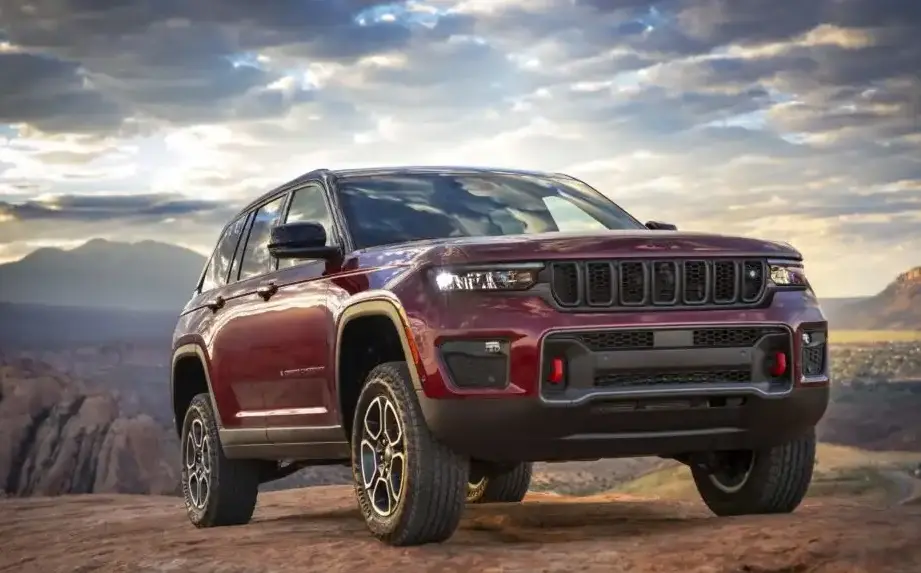
The 3.6-liter V6 Pentastar engine, coupled with the Torqueflite eight-speed automatic transmission, formed a significant part of the initial Grand Cherokee WL lineup. Introduced in 2021, this powertrain aimed to deliver a balance of respectable power and acceptable fuel economy for everyday driving. The WL generation marked a substantial redesign for the Grand Cherokee, moving to a new platform and incorporating updated technology. This particular variant was positioned as the entry-level option, making the Grand Cherokee accessible to a wider customer base. It was designed to appeal to families and individuals prioritizing comfort, space, and a degree of off-road capability without the higher price tag of the more powerful engine options.
Powertrain & Engine Architecture
The heart of this Grand Cherokee variant is the 3.6-liter Pentastar V6 engine. This engine, designated as part of the Chrysler Pentastar family, utilizes a 60-degree V-angle configuration. It features a dual overhead camshaft (DOHC) valvetrain with four valves per cylinder, enhancing breathing and contributing to its power output. The engine employs multi-port fuel injection, delivering fuel directly to the intake ports. The 3.6L Pentastar is known for its relatively simple design and robust construction. The Torqueflite 850RE eight-speed automatic transmission is a key component, providing smooth and efficient gear changes. This transmission is designed to optimize fuel economy and provide adequate acceleration. It features a wide gear ratio spread, allowing the engine to operate in its most efficient range more often. The transmission also includes a manual shift mode for drivers who prefer more control.
Driving Characteristics
The 3.6L V6 and Torqueflite combination delivers a comfortable and predictable driving experience. While not offering the exhilarating acceleration of the V8 models, it provides sufficient power for everyday driving situations, including highway merging and passing. The eight-speed transmission helps to keep the engine in its optimal power band, minimizing the sensation of being underpowered. The gear ratios are tuned for a balance of fuel efficiency and responsiveness. Compared to manual transmission equipped Grand Cherokees (which were not widely available with this engine), the automatic offers greater convenience, particularly in urban environments. However, it does sacrifice some driver engagement and control. The rear-wheel-drive configuration contributes to a more balanced feel, although four-wheel drive was a popular option.
Equipment & Trim Levels
The 3.6L V6 automatic Grand Cherokee typically came standard with a respectable array of features. These included air conditioning, power windows and locks, a touchscreen infotainment system with Apple CarPlay and Android Auto compatibility, and a suite of safety features such as blind-spot monitoring and rear cross-traffic alert. Interior upholstery was typically cloth, with leather options available as upgrades. Higher trim levels, such as the Limited, added features like heated seats, a larger touchscreen display, and premium audio systems. Optional extras included a panoramic sunroof, navigation system, and advanced driver-assistance features like adaptive cruise control.
Chassis & Braking
The Grand Cherokee WL utilizes an independent multi-link suspension system both front and rear, providing a comfortable ride and good handling characteristics. The suspension is tuned to balance on-road comfort with off-road capability. The base models typically featured ventilated disc brakes on all four wheels, providing adequate stopping power. Higher trim levels often included larger brake rotors for improved performance. Anti-lock braking system (ABS) was standard, enhancing safety during emergency braking situations. Stabilizer bars were fitted front and rear to reduce body roll during cornering.
Market Reception & Comparison
Critics generally viewed the 3.6L V6 Grand Cherokee as a solid and practical choice. It was praised for its comfortable ride, spacious interior, and user-friendly technology. However, some reviewers noted that the engine could feel strained when fully loaded or when tackling steep inclines. Compared to the V8 models, the V6 offered significantly lower fuel consumption, making it a more economical option for daily driving. The V6 also undercut the V8 in price, making the Grand Cherokee accessible to a wider range of buyers. Against competitors like the Ford Explorer and Honda Pilot, the Grand Cherokee V6 offered a more premium feel and a greater emphasis on off-road capability.
Legacy
The 3.6L Pentastar V6 paired with the Torqueflite transmission has proven to be a relatively reliable powertrain. While some owners have reported minor issues with oil consumption or sensor failures, these are generally not widespread or catastrophic. The engine’s robust design and relatively simple architecture contribute to its longevity. In the used car market, these Grand Cherokees represent a good value proposition, offering a comfortable and capable SUV at a reasonable price. Regular maintenance, including oil changes and transmission fluid flushes, is crucial to ensuring the long-term reliability of this powertrain.