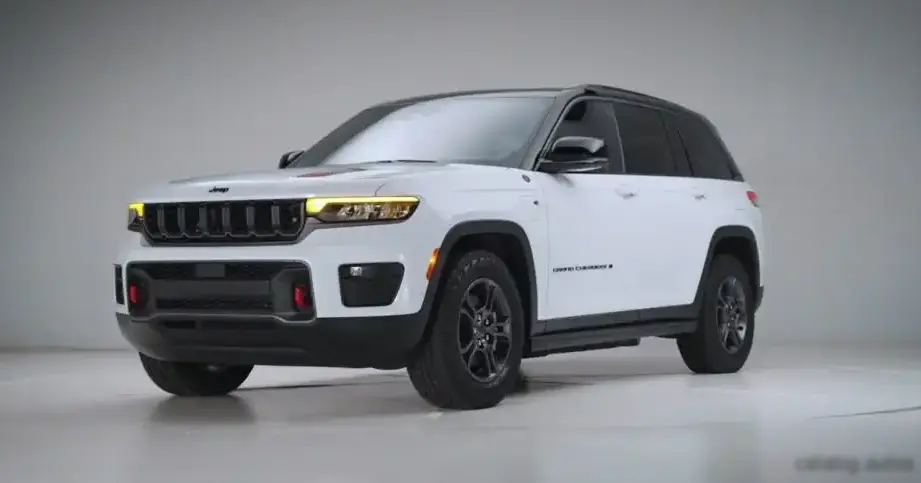
The Jeep Grand Cherokee V (WL), specifically the 2.0 Turbo (375 Hp) 4xe eTorque variant introduced with the 2025 facelift, represents a significant step in Jeep’s electrification strategy. Launched in October 2025, this plug-in hybrid (PHEV) model aims to balance the Grand Cherokee’s renowned off-road capability with improved fuel efficiency and reduced emissions. Positioned as a mid-range offering within the WL lineup, it slots between the base rear-wheel-drive models and the more powerful, higher-trim 3.0L straight-six options. This variant is primarily targeted towards environmentally conscious buyers who still desire the space, comfort, and prestige associated with the Grand Cherokee nameplate.
Technical Specifications
| Brand | Jeep |
| Model | Grand Cherokee |
| Generation | Grand Cherokee V (WL, facelift 2025) |
| Type (Engine) | 2.0 Turbo (375 Hp) 4xe eTorque TorqueFlite |
| Start of production | October, 2025 |
| Powertrain Architecture | PHEV (Plug-in Hybrid Electric Vehicle) |
| Body type | SUV |
| Seats | 5 |
| Doors | 5 |
| Fuel Type | Petrol / electricity |
| Weight-to-power ratio | 6.5 kg/Hp, 154 Hp/tonne |
| Weight-to-torque ratio | 3.8 kg/Nm, 261.6 Nm/tonne |
| Gross battery capacity | 17.3 kWh |
| Battery voltage | 400 V |
| Battery technology | Lithium nickel manganese cobalt oxides (Li-NMC) |
| Battery location | Below the floor |
| Electric motor power (1) | 44 Hp |
| Electric motor torque (1) | 53 Nm (39.09 lb.-ft.) |
| Electric motor location (1) | Front, Longitudinal |
| Electric motor power (2) | 134 Hp |
| Electric motor torque (2) | 265 Nm (195.45 lb.-ft.) |
| Electric motor location (2) | Between the combustion engine and the transmission |
| Electric motor type | Synchronous |
| System power | 375 Hp @ 5250 rpm |
| System torque | 637 Nm @ 3000 rpm (469.83 lb.-ft. @ 3000 rpm) |
| Power | 270 Hp @ 5250 rpm |
| Power per litre | 135.3 Hp/l |
| Torque | 400 Nm @ 3000 rpm (295.02 lb.-ft. @ 3000 rpm) |
| Maximum engine speed | 5800 rpm |
| Engine layout | Front, Longitudinal |
| Engine Model/Code | Hurricane |
| Engine displacement | 1995 cm3 (121.74 cu. in.) |
| Number of cylinders | 4 |
| Engine configuration | Inline |
| Cylinder Bore | 84 mm (3.31 in.) |
| Piston Stroke | 90 mm (3.54 in.) |
| Compression ratio | 10:1 |
| Number of valves per cylinder | 4 |
| Fuel injection system | Direct injection |
| Engine aspiration | Twin-scroll turbo, Intercooler |
| Valvetrain | DOHC |
| Engine oil capacity | 4.7 l (4.97 US qt | 4.14 UK qt) |
| Coolant | 9.4 l (9.93 US qt | 8.27 UK qt) |
| Kerb Weight | 2435-2504 kg (5368.26 – 5520.38 lbs.) |
| Max. weight | 3130 kg (6900.47 lbs.) |
| Max load | 626-695 kg (1380.09 – 1532.21 lbs.) |
| Trunk (boot) space – minimum | 1068 l (37.72 cu. ft.) |
| Trunk (boot) space – maximum | 2005 l (70.81 cu. ft.) |
| Fuel tank capacity | 72 l (19.02 US gal | 15.84 UK gal) |
| Permitted trailer load with brakes (12%) | 2722 kg (6000.98 lbs.) |
| Length | 4914 mm (193.46 in.) |
| Width | 1968 mm (77.48 in.) |
| Width with mirrors folded | 1968 mm (77.48 in.) |
| Width including mirrors | 2149 mm (84.61 in.) |
| Height | 1799-1801 mm (70.83 – 70.91 in.) |
| Wheelbase | 2964 mm (116.69 in.) |
| Front track | 1660 mm (65.35 in.) |
| Rear (Back) track | 1660 mm (65.35 in.) |
| Ride height (ground clearance) | 214-278 mm (8.43 – 10.94 in.) |
| Drag coefficient (Cd) | 0.357 |
| Minimum turning circle (turning diameter) | 11.58 m (37.99 ft.) |
| Approach angle | 20.5-35.7° |
| Departure angle | 26.3-30° |
| Ramp-over (brakeover) angle | 16.3-22.3° |
| Drivetrain Architecture | The Internal combustion engine (ICE) and Two electric motors drive permanently the rear wheels of the vehicle, with a capabllity of running in full electric or mixed mode, and if necessary through the electrically or mechanically controlled clutch, the front wheels are driven. |
| Drive wheel | All wheel drive (4×4) |
| Number of gears and type of gearbox | 8 gears, automatic transmission TorqueFlite |
| Front suspension | Coil spring, Independent multi-link suspension, Transverse stabilizer, Air Suspension – Optional |
| Rear suspension | Independent multi-link spring suspension with stabilizer, Air Suspension – Optional |
| Front brakes | Ventilated discs, 354×28 mm |
| Rear brakes | Ventilated discs, 350×22 mm |
Powertrain & Engine Architecture
At the heart of the 2.0 Turbo 4xe is the Hurricane 4 engine, a 1.995-liter turbocharged inline-four producing 270 horsepower and 295 lb-ft of torque. This engine utilizes direct fuel injection and a twin-scroll turbocharger to maximize efficiency and responsiveness. The “4xe” designation signifies Jeep’s plug-in hybrid system. This system incorporates two electric motors: a 44 hp motor integrated with the front axle and a more substantial 134 hp motor positioned between the engine and the eight-speed TorqueFlite automatic transmission. The combined system output reaches 375 horsepower and a robust 469.83 lb-ft of torque. The 17.3 kWh battery pack, utilizing Lithium Nickel Manganese Cobalt Oxide (Li-NMC) technology, is located under the vehicle floor, minimizing impact on passenger or cargo space. The transmission, the TorqueFlite 8-speed automatic, is specifically calibrated to work seamlessly with the electric motors, providing smooth transitions between electric, hybrid, and gasoline power modes.
Driving Characteristics
The 2.0 Turbo 4xe offers a noticeably different driving experience compared to the standard gasoline-powered Grand Cherokee variants. In electric mode, it provides near-silent operation and instant torque, suitable for short commutes and urban driving. The combined power output delivers brisk acceleration, with the electric motors filling in any gaps in the turbocharger’s response. While not as overtly powerful as the V6 or straight-six models, the 4xe provides ample power for everyday driving and even confident highway passing. The eight-speed automatic transmission is well-tuned, offering smooth and timely shifts. The weight of the battery pack does add some mass, slightly impacting handling agility compared to lighter trims, but the low center of gravity contributes to stability. The 4xe system allows for all-wheel drive capability, enhancing traction in various conditions.
Equipment & Trim Levels
The 2.0 Turbo 4xe trim typically includes a generous array of standard features. These commonly include leather upholstery, a large touchscreen infotainment system with Apple CarPlay and Android Auto compatibility, a premium sound system, and a suite of advanced driver-assistance systems (ADAS) such as adaptive cruise control, lane-keeping assist, and automatic emergency braking. Optional extras often include a panoramic sunroof, upgraded interior trim materials, and a more sophisticated air suspension system. The 4xe trim generally sits in the mid-range of the Grand Cherokee lineup, offering a balance of luxury, technology, and efficiency.
Chassis & Braking
The Grand Cherokee V utilizes an independent suspension system on both the front and rear axles. The front suspension employs a multi-link design with coil springs and a transverse stabilizer bar. The rear suspension also features a multi-link setup with coil springs and a stabilizer bar. Air suspension is available as an optional upgrade, providing adjustable ride height and improved off-road capability. Braking duties are handled by ventilated discs on all four wheels, with the front discs measuring 354×28 mm and the rear discs measuring 350×22 mm. The braking system is augmented by ABS (Anti-lock Braking System) and other electronic stability control features.
Market Reception & Comparison
The 2.0 Turbo 4xe has been generally well-received by automotive critics, praised for its fuel efficiency, smooth ride, and capable performance. Compared to the standard gasoline-powered Grand Cherokee models, the 4xe offers significantly improved fuel economy, particularly in hybrid mode. However, the higher purchase price and the added weight of the battery pack are drawbacks. Compared to other PHEV SUVs in its class, the Grand Cherokee 4xe stands out with its robust power output and genuine off-road capability. Reliability reports are still emerging, but early indications suggest that the powertrain is proving to be durable.
Legacy
The Jeep Grand Cherokee V 2.0 Turbo 4xe represents a pivotal moment in Jeep’s transition towards electrification. Its long-term reliability will be crucial in establishing the viability of PHEV technology within the brand’s lineup. On the used car market, these models are expected to hold their value well, particularly as demand for fuel-efficient vehicles continues to grow. The combination of Jeep’s legendary off-road heritage with the benefits of plug-in hybrid technology positions the 4xe as a compelling option for buyers seeking a versatile and environmentally conscious SUV.