Technical Specifications
| Brand | Jeep |
| Model | Wagoneer |
| Generation | Grand Wagoneer (WS) |
| Type (Engine) | 6.4 V8 (477 Hp) 4WD TorqueFlite |
| Start of production | March, 2021 |
| End of production | November, 2023 |
| Powertrain Architecture | Internal Combustion engine |
| Body type | SUV |
| Seats | 7-8 |
| Doors | 5 |
| Fuel consumption (economy) – urban | 18.1 l/100 km (13 US mpg, 15.6 UK mpg, 5.5 km/l) |
| Fuel consumption (economy) – extra urban | 13.1 l/100 km (18 US mpg, 21.6 UK mpg, 7.6 km/l) |
| Fuel consumption (economy) – combined | 15.7 l/100 km (15 US mpg, 18 UK mpg, 6.4 km/l) |
| Fuel Type | Petrol (Gasoline) |
| Emission standard | LEV II |
| Weight-to-power ratio | 6 kg/Hp, 165.9 Hp/tonne |
| Weight-to-torque ratio | 4.7 kg/Nm, 214.5 Nm/tonne |
| Power | 477 Hp @ 6000 rpm |
| Power per litre | 74.3 Hp/l |
| Torque | 617 Nm @ 4400 rpm (455.08 lb.-ft. @ 4400 rpm) |
| Maximum engine speed | 6400 rpm |
| Engine layout | Front, Longitudinal |
| Engine displacement | 6417 cm3 (391.59 cu. in.) |
| Number of cylinders | 8 |
| Engine configuration | V-engine |
| Cylinder Bore | 103.9 mm (4.09 in.) |
| Piston Stroke | 94.5 mm (3.72 in.) |
| Compression ratio | 10.9:1 |
| Number of valves per cylinder | 2 |
| Fuel injection system | Multi-port manifold injection |
| Valvetrain | VCT |
| Engine oil capacity | 6.6 l (6.97 US qt | 5.81 UK qt) |
| Coolant | 17.8 l (18.81 US qt | 15.66 UK qt) |
| Kerb Weight | 2876-2912 kg (6340.49 – 6419.86 lbs.) |
| Max. weight | 3493 kg (7700.75 lbs.) |
| Max load | 581-617 kg (1280.89 – 1360.25 lbs.) |
| Trunk (boot) space – minimum | 776 l (27.4 cu. ft.) |
| Trunk (boot) space – maximum | 2667 l (94.18 cu. ft.) |
| Fuel tank capacity | 100 l (26.42 US gal | 22 UK gal) |
| Permitted trailer load with brakes (12%) | 4472 kg (9859.07 lbs.) |
| Length | 5453 mm (214.69 in.) |
| Width | 2124 mm (83.62 in.) |
| Width including mirrors | 2388 mm (94.02 in.) |
| Height | 1921 mm (75.63 in.) |
| Wheelbase | 3124 mm (122.99 in.) |
| Front track | 1740 mm (68.5 in.) |
| Rear (Back) track | 1734 mm (68.27 in.) |
| Minimum turning circle (turning diameter) | 11.6 m (38.06 ft.) |
| Approach angle | 21.5-25° |
| Departure angle | 21.1-24° |
| Ramp-over (brakeover) angle | 18.5-22° |
| Drivetrain Architecture | The Internal combustion engine (ICE) drives permanently the four wheels of the vehicle. |
| Drive wheel | All wheel drive (4×4) |
| Number of gears and type of gearbox | 8 gears, automatic transmission TorqueFlite |
| Front suspension | Independent coil spring, Transverse stabilizer |
| Rear suspension | Independent multi-link spring suspension with stabilizer |
| Front brakes | Ventilated discs, 378×30 mm |
| Rear brakes | Disc, 375×22 mm |
| Assisting systems | ABS (Anti-lock braking system) |
| Steering type | Steering rack and pinion |
| Power steering | Electric Steering |
| Tires size | 275/55 R20; 285/45 R22 |
| Wheel rims size | 9J x 20; 9J x 22 |
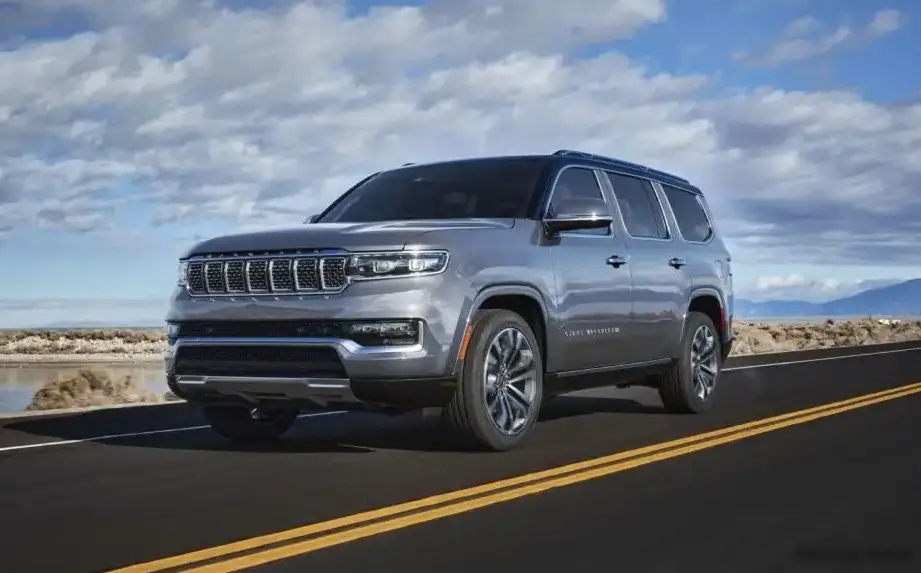
The Jeep Grand Wagoneer (WS) 6.4 V8 4WD represents a bold step for Jeep, aiming to compete with luxury SUV offerings from Cadillac, Lincoln, and European manufacturers. Production spanned from the 2022 to 2023 model years. Built on a body-on-frame construction, it prioritized space, comfort, and towing capacity. This particular variant, equipped with the 6.4-liter HEMI V8 and the TorqueFlite eight-speed automatic transmission, was positioned as the standard engine option for the Grand Wagoneer, offering a balance of power and refinement. It was a key component of Jeep’s strategy to re-establish a presence in the premium SUV market.
Powertrain & Engine Architecture
At the heart of the Grand Wagoneer 6.4 is the 6.4-liter (392 cubic inch) HEMI V8 engine, internally designated as the 6.4L HEMI. This engine is a naturally aspirated, overhead valve (OHV) design featuring multi-port fuel injection and variable valve timing (VCT). The engine produces 477 horsepower at 6000 rpm and 617 lb-ft of torque at 4400 rpm. The TorqueFlite 8HP75 eight-speed automatic transmission, known for its smooth shifts and durability, is paired with the engine. This transmission features a wide gear ratio spread, optimizing both acceleration and fuel efficiency. The engine’s architecture is a traditional V-configuration, providing a good balance of power and smoothness. Cylinder deactivation (MDS) is incorporated to improve fuel economy during cruising conditions.
Driving Characteristics
The 6.4-liter V8 and TorqueFlite transmission deliver a confident and capable driving experience. While not as overtly sporty as some competitors, the Grand Wagoneer offers ample power for effortless acceleration and towing. The eight-speed transmission keeps the engine in its optimal power band, providing responsive performance in most driving situations. Compared to a potential smaller engine option (which was not offered), the 6.4L provides significantly more low-end torque, making it ideal for hauling passengers and cargo. The 4WD system provides excellent traction in various conditions, enhancing stability and control. The large size and weight of the vehicle are noticeable, but the suspension does a good job of mitigating body roll and providing a comfortable ride.
Equipment & Trim Levels
The Grand Wagoneer 6.4 came standard with a high level of equipment, reflecting its luxury positioning. Standard features included premium leather upholstery, heated and ventilated front and second-row seats, a large touchscreen infotainment system with navigation, a premium sound system, and a comprehensive suite of advanced driver-assistance systems (ADAS). Optional extras included a rear-seat entertainment system, a panoramic sunroof, and upgraded interior trim materials. The trim levels offered variations in interior color schemes, exterior styling cues, and available packages, allowing buyers to customize their vehicle to their preferences.
Chassis & Braking
The Grand Wagoneer utilizes a robust body-on-frame chassis, providing a solid foundation for its size and weight. The suspension system consists of an independent coil spring setup at the front and an independent multi-link spring suspension at the rear, both incorporating stabilizer bars to reduce body roll. Braking duties are handled by ventilated discs at all four corners, providing ample stopping power. The Grand Wagoneer is equipped with an anti-lock braking system (ABS) and electronic stability control (ESC) as standard safety features. The large tires (275/55 R20 or 285/45 R22) contribute to both ride comfort and handling.
Market Reception & Comparison
The Grand Wagoneer was generally well-received by critics, who praised its spacious interior, luxurious features, and powerful engine. However, its fuel economy was a common criticism, as expected for a vehicle of its size and weight. Compared to other full-size luxury SUVs, the Grand Wagoneer offered a unique blend of American ruggedness and refinement. The 6.4-liter V8 provided a more traditional engine experience compared to some competitors who were moving towards turbocharged or hybrid powertrains. Reliability reports were still emerging during its short production run, but the HEMI V8 engine has a generally good reputation for durability.
Legacy
The Jeep Grand Wagoneer (WS) 6.4 V8 4WD represents a significant chapter in Jeep’s history, marking its return to the full-size luxury SUV segment. While production was relatively short-lived, the vehicle established a new benchmark for Jeep in terms of refinement and technology. On the used car market, these models are expected to hold their value reasonably well, particularly those in excellent condition with low mileage. The 6.4-liter HEMI V8 and TorqueFlite transmission are proven components, suggesting good long-term reliability, although regular maintenance will be crucial to ensure continued performance. The Grand Wagoneer’s legacy will likely be as a bold and ambitious attempt to redefine the Jeep brand and compete with the established players in the luxury SUV market.