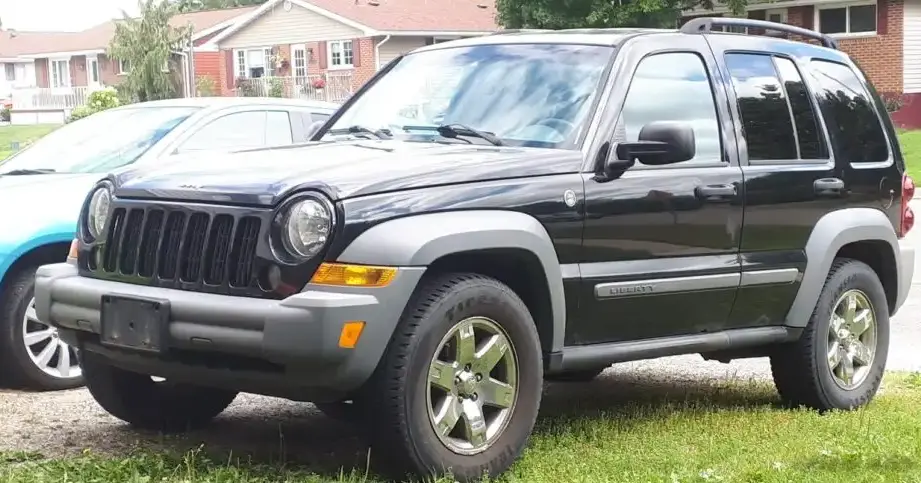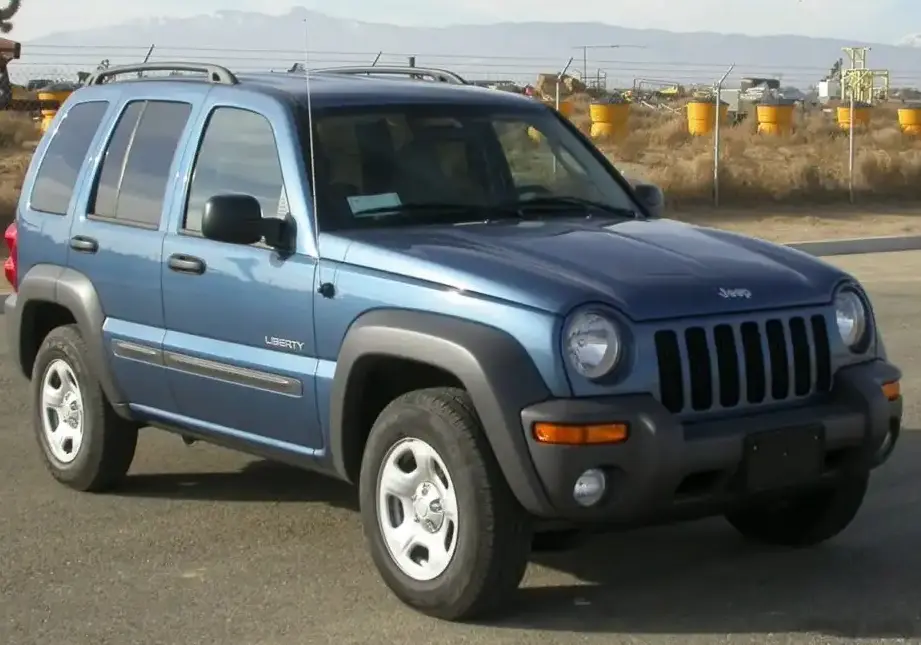
The Jeep Liberty I 2.4 16V, produced between 2001 and 2004, represented the entry-level powertrain option for the first generation (KJ) Liberty, Jeep’s replacement for the Cherokee. Positioned as a more affordable and fuel-conscious alternative to the higher-output 3.7L V6, this variant aimed to broaden the Liberty’s appeal in the increasingly competitive mid-size SUV segment. It was primarily sold in the North American market, offering a blend of Jeep’s off-road capability with a more economical driving experience. This model utilized the 5-speed manual transmission, offering a different driving experience than the available automatic.
Technical Specifications
| Brand | Jeep |
| Model | Liberty |
| Generation | Liberty I |
| Type (Engine) | 2.4 16V (150 Hp) |
| Start of production | 2001 |
| End of production | 2004 |
| Powertrain Architecture | Internal Combustion engine |
| Body type | SUV |
| Seats | 5 |
| Doors | 5 |
| Fuel Type | Petrol (Gasoline) |
| Weight-to-power ratio | 10.6 kg/Hp, 94.3 Hp/tonne |
| Weight-to-torque ratio | 7.1 kg/Nm, 140.8 Nm/tonne |
| Power | 150 Hp @ 5200 rpm |
| Power per litre | 61.8 Hp/l |
| Torque | 224 Nm @ 4000 rpm (165.21 lb.-ft. @ 4000 rpm) |
| Engine layout | Front, Longitudinal |
| Engine Model/Code | ED1 |
| Engine displacement | 2429 cm3 (148.23 cu. in.) |
| Number of cylinders | 4 |
| Engine configuration | Inline |
| Cylinder Bore | 87.5 mm (3.44 in.) |
| Piston Stroke | 101 mm (3.98 in.) |
| Compression ratio | 9.4:1 |
| Number of valves per cylinder | 4 |
| Fuel injection system | Multi-port manifold injection |
| Engine aspiration | Naturally aspirated engine |
| Valvetrain | DOHC |
| Engine oil capacity | 4.7 l (4.97 US qt | 4.14 UK qt) |
| Coolant | 9.5 l (10.04 US qt | 8.36 UK qt) |
| Kerb Weight | 1591 kg (3507.55 lbs) |
| Max. weight | 2245 kg (4949.38 lbs) |
| Max load | 654 kg (1441.82 lbs) |
| Trunk (boot) space – minimum | 821 l (28.99 cu. ft.) |
| Trunk (boot) space – maximum | 1954 l (69 cu. ft.) |
| Fuel tank capacity | 74 l (19.55 US gal | 16.28 UK gal) |
| Permitted trailer load with brakes (12%) | 907 kg (1999.59 lbs) |
| Length | 4437 mm (174.69 in.) |
| Width | 1819 mm (71.61 in.) |
| Height | 1783 mm (70.2 in.) |
| Wheelbase | 2647 mm (104.21 in.) |
| Front track | 1524 mm (60 in.) |
| Rear (Back) track | 1516 mm (59.69 in.) |
| Ride height (ground clearance) | 226 mm (8.9 in.) |
| Minimum turning circle (turning diameter) | 10.9 m (35.76 ft.) |
| Approach angle | 35.3° |
| Departure angle | 31° |
| Ramp-over (brakeover) angle | 21° |
| Drivetrain Architecture | The Internal combustion engine (ICE) drives the rear wheels of the vehicle. |
| Drive wheel | Rear wheel drive |
| Number of gears and type of gearbox | 5 gears, manual transmission |
| Front suspension | Independent coil spring, Transverse stabilizer |
| Rear suspension | Rigid axle suspension, Transverse stabilizer, Coil spring |
| Front brakes | Ventilated discs, 287.02 mm |
| Rear brakes | Disc, 284.48×12.7 mm |
| Steering type | Steering rack and pinion |
| Tires size | 235/70 R16 |
| Wheel rims size | 7J x 16 |
INTRODUCTION
The Jeep Liberty I 2.4 16V, launched in 2001, was a key component of Jeep’s strategy to offer a more accessible and fuel-efficient SUV option. Built on the 1HX0 platform (shared with the Dodge Nitro later on), the Liberty aimed to bridge the gap between the rugged Wrangler and the more luxurious Grand Cherokee. The 2.4L engine, coupled with a 5-speed manual transmission, was positioned as the base model, appealing to buyers prioritizing affordability and reasonable fuel economy over outright performance. Production of this specific configuration continued through 2004, before being superseded by minor revisions and engine updates.
Powertrain & Engine Architecture
The heart of the Liberty 2.4 is the ED1 engine, a 2.4-liter inline-four cylinder powerplant. This engine utilizes a dual overhead camshaft (DOHC) valvetrain with four valves per cylinder, contributing to its relatively efficient operation. Fuel delivery is managed by a multi-port fuel injection system, providing precise fuel metering for optimal combustion. The engine’s 9.4:1 compression ratio strikes a balance between performance and fuel efficiency. The 5-speed manual transmission was a Getrag unit, known for its durability and relatively precise shift feel. This transmission featured gear ratios designed to maximize fuel economy while still providing adequate acceleration. The engine’s longitudinal mounting allowed for a traditional rear-wheel-drive layout, with four-wheel drive available as an option.
Driving Characteristics
The 2.4L engine, producing 150 horsepower and 224 Nm (165 lb-ft) of torque, delivered adequate, but not exhilarating, performance in the Liberty. Acceleration was noticeably slower compared to the 3.7L V6 models. The 5-speed manual transmission allowed drivers to keep the engine in its optimal power band, but required more frequent shifting, especially when climbing hills or carrying a load. The gear ratios were tuned for economy, meaning first gear was relatively tall and fifth gear was geared for highway cruising. The Liberty 2.4 felt more nimble and responsive than its V6 counterparts due to its lighter weight, but lacked the effortless power for quick overtaking maneuvers. The rear-wheel-drive configuration provided a more traditional SUV driving experience, while the optional four-wheel-drive system enhanced traction in adverse conditions.
Equipment & Trim Levels
The 2.4L Liberty typically came with a fairly basic level of standard equipment. Interior features generally included cloth upholstery, a basic audio system, air conditioning, and power windows and locks. Safety features included dual front airbags. Optional extras included features like upgraded audio systems, alloy wheels, a sunroof, and side airbags. The trim level was generally considered the base model, with fewer luxury features compared to the higher-spec Liberty Limited or Renegade trims. The dashboard layout was functional and straightforward, prioritizing usability over aesthetic flair.
Chassis & Braking
The Liberty I utilized a body-on-frame construction, providing robust durability and off-road capability. The front suspension featured an independent coil spring setup with a transverse stabilizer bar, while the rear suspension employed a rigid axle configuration with coil springs and a transverse stabilizer bar. This suspension setup provided a comfortable ride on paved roads, while still allowing for reasonable off-road articulation. Braking duties were handled by ventilated discs at the front and solid discs at the rear. The braking system was adequate for everyday driving, but lacked the stopping power of larger, more performance-oriented SUVs. The Liberty’s relatively high ground clearance (226mm / 8.9 inches) contributed to its off-road prowess.
Market Reception & Comparison
The Jeep Liberty 2.4L was generally well-received as an affordable entry point into the Jeep brand. Critics noted its fuel efficiency and reasonable price, but also pointed out its lack of power compared to the V6 models. Compared to the 3.7L V6, the 2.4L offered significantly better fuel economy, but at the cost of performance. The 2.4L was also generally more reliable than the 3.7L, which was known for some engine issues. In terms of competition, the Liberty 2.4L faced rivals like the Ford Escape, Honda CR-V, and Toyota RAV4, all of which offered similar levels of practicality and fuel efficiency.
Legacy
The Jeep Liberty I 2.4L has developed a reputation as a relatively reliable and affordable used SUV. The 2.4L engine is known for its durability, and the 5-speed manual transmission is generally considered robust. However, like any vehicle of this age, potential buyers should be aware of common issues such as rust, suspension wear, and potential problems with the cooling system. Today, the Liberty 2.4L represents a budget-friendly option for those seeking a capable and practical SUV with Jeep’s iconic styling. Its simplicity and relatively low maintenance costs make it an appealing choice for those looking for a dependable vehicle without the complexities of modern SUVs.