Technical Specifications
| Brand | Jeep |
| Model | Liberty |
| Generation | Liberty I |
| Type (Engine) | 3.7 i V6 12V (210 Hp) 4WD |
| Start of production | 2001 |
| End of production | 2004 |
| Powertrain Architecture | Internal Combustion engine |
| Body type | SUV |
| Seats | 5 |
| Doors | 5 |
| Fuel consumption (urban) | 13.1 l/100 km (18 US mpg, 21.6 UK mpg) |
| Fuel consumption (extra urban) | 10.7 l/100 km (22 US mpg, 26.4 UK mpg) |
| Fuel Type | Petrol (Gasoline) |
| Acceleration 0 – 100 km/h | 9.2 sec |
| Acceleration 0 – 62 mph | 9.2 sec |
| Acceleration 0 – 60 mph | 8.7 sec |
| Maximum speed | 180 km/h (111.85 mph) |
| Weight-to-power ratio | 8.3 kg/Hp, 120 Hp/tonne |
| Weight-to-torque ratio | 5.5 kg/Nm, 181.7 Nm/tonne |
| Power | 210 Hp @ 5200 rpm |
| Power per litre | 56.7 Hp/l |
| Torque | 318 Nm @ 4000 rpm (234.54 lb.-ft. @ 4000 rpm) |
| Engine layout | Front, Longitudinal |
| Engine Model/Code | EKG |
| Engine displacement | 3701 cm3 (225.85 cu. in.) |
| Number of cylinders | 6 |
| Engine configuration | V-engine |
| Cylinder Bore | 93 mm (3.66 in.) |
| Piston Stroke | 90.8 mm (3.57 in.) |
| Compression ratio | 9.1:1 |
| Number of valves per cylinder | 2 |
| Fuel injection system | Multi-port manifold injection |
| Engine aspiration | Naturally aspirated engine |
| Engine oil capacity | 4.7 l (4.97 US qt | 4.14 UK qt) |
| Coolant capacity | 13.2 l (13.95 US qt | 11.61 UK qt) |
| Kerb Weight | 1750 kg (3858.09 lbs.) |
| Max. weight | 2540 kg (5599.74 lbs.) |
| Max load | 790 kg (1741.65 lbs.) |
| Trunk (boot) space – minimum | 821 l (28.99 cu. ft.) |
| Trunk (boot) space – maximum | 1950 l (68.86 cu. ft.) |
| Fuel tank capacity | 74 l (19.55 US gal | 16.28 UK gal) |
| Permitted trailer load with brakes (12%) | 1588 kg (3500.94 lbs.) |
| Length | 4437 mm (174.69 in.) |
| Width | 1819 mm (71.61 in.) |
| Height | 1785 mm (70.28 in.) |
| Wheelbase | 2649 mm (104.29 in.) |
| Front track | 1524 mm (60 in.) |
| Rear (Back) track | 1518 mm (59.76 in.) |
| Minimum turning circle | 10.9 m (35.76 ft.) |
| Approach angle | 35.3° |
| Departure angle | 31° |
| Ramp-over angle | 21° |
| Drivetrain Architecture | The Internal combustion engine (ICE) drives the rear wheels permanently, and the front wheels are driven through an electrically or mechanically operated clutch if necessary. |
| Drive wheel | All wheel drive (4×4) |
| Number of gears | 5 |
| Type of gearbox | manual transmission |
| Front suspension | Independent, type McPherson with coil spring and anti-roll bar |
| Rear suspension | Rigid axle suspension, Transverse stabilizer, Coil spring |
| Front brakes | Ventilated discs, 287.02 mm |
| Rear brakes | Disc, 284.48×12.7 mm |
| Assisting systems | ABS (Anti-lock braking system) |
| Steering type | Steering rack and pinion |
| Tires size | 225/75 R16 |
| Wheel rims size | 7J x 16 |
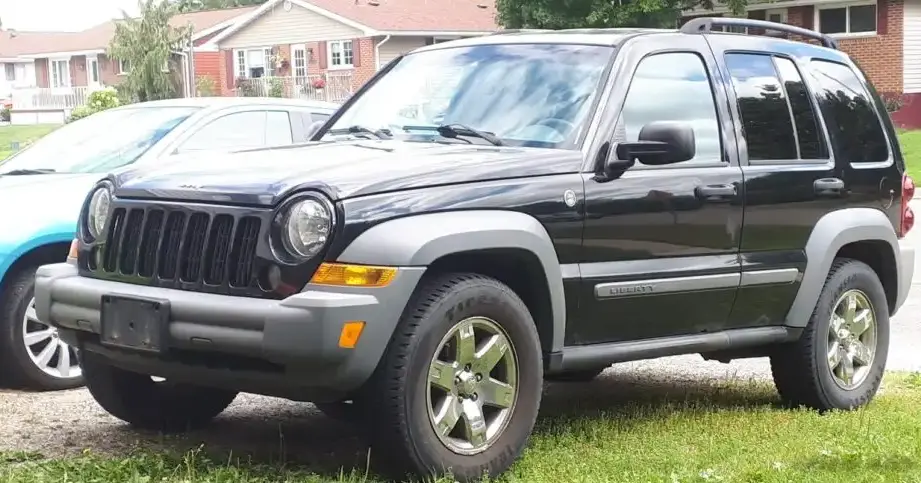
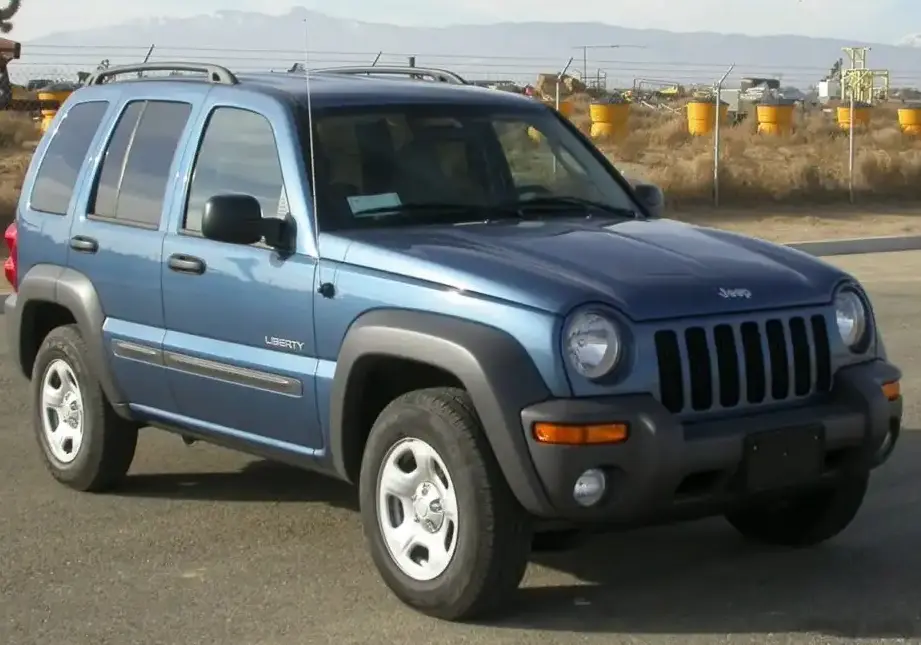
The Jeep Liberty I, produced from 2001 to 2004, marked Jeep’s entry into the mid-size SUV segment, positioned below the larger Cherokee and Grand Cherokee. The 3.7L V6 4WD variant was a significant offering within the Liberty lineup, aiming to provide a balance of capability, comfort, and affordability. This model year represented the initial launch of the Liberty (KJ) platform, intended to replace the aging Cherokee. It was primarily marketed towards families and individuals seeking a versatile vehicle for both on-road driving and light off-road adventures. The 3.7L engine and four-wheel-drive configuration were popular choices, offering a compelling package for buyers in North America.
Powertrain & Engine Architecture
The heart of the Jeep Liberty I 3.7L V6 4WD was the EKG engine, a 3.7-liter (3701 cc) V6. This engine was a significant departure from the inline-six engines previously used in Jeep Cherokees. The EKG featured a 90-degree V-angle, a cast iron block, and aluminum cylinder heads. It utilized a multi-port fuel injection system, delivering fuel directly to each intake port. The engine employed a single overhead camshaft (SOHC) design with two valves per cylinder. The 12-valve configuration, combined with the relatively large displacement, provided a broad torque curve suitable for both on-road and off-road driving. The 4WD system was a part-time four-wheel drive, engaging the front axle when needed via a transfer case. The five-speed manual transmission was the standard offering, providing direct control over the engine’s power.
Driving Characteristics
The 210 horsepower and 318 lb-ft of torque delivered by the 3.7L V6 in the Liberty I provided adequate, though not exhilarating, performance. Acceleration from 0-60 mph took approximately 8.7 seconds. The five-speed manual transmission allowed drivers to maximize the engine’s potential, offering precise gear selection. However, the Liberty I wasn’t known for being a sporty vehicle. The focus was on providing a comfortable and capable ride. The 4WD system enhanced traction in slippery conditions, making it suitable for light off-roading and inclement weather. Compared to higher-trim Liberty models with more powerful engines, the 3.7L version felt less responsive, particularly when fully loaded or climbing steep inclines.
Equipment & Trim Levels
The 3.7L 4WD Liberty typically came with standard features such as air conditioning, power windows and locks, and an AM/FM stereo. Higher trim levels offered options like upgraded audio systems, leather upholstery, sunroofs, and alloy wheels. The interior was designed with practicality in mind, featuring durable materials and ample storage space. The base trim focused on providing essential features at an affordable price point, while optional packages allowed buyers to customize their Liberty to their specific needs and preferences.
Chassis & Braking
The Jeep Liberty I utilized a body-on-frame construction, providing a robust and durable platform. The front suspension featured an independent McPherson strut design, while the rear suspension employed a solid axle with coil springs. This setup offered a good balance of ride comfort and off-road capability. The braking system consisted of ventilated discs at the front and solid discs at the rear. Anti-lock brakes (ABS) were standard, enhancing safety and control during emergency braking situations.
Market Reception & Comparison
The Jeep Liberty I 3.7L 4WD was generally well-received by consumers and critics alike. It was praised for its comfortable ride, spacious interior, and capable 4WD system. However, some reviewers noted that the 3.7L engine could feel underpowered, especially when compared to competitors with larger engines. Fuel economy was also a concern for some buyers, averaging around 18 mpg in the city and 22 mpg on the highway. Compared to the higher-trim Liberty models with the 4.7L V8 engine, the 3.7L version offered a more affordable entry point into the Liberty lineup, appealing to budget-conscious buyers.
Legacy
The Jeep Liberty I, particularly the 3.7L V6 4WD variant, has become a popular choice among used car buyers seeking a reliable and capable SUV. The EKG engine, while not known for being exceptionally powerful, has proven to be relatively durable and long-lasting with proper maintenance. Common issues include oil leaks and occasional sensor failures. However, parts availability is generally good, and repairs are relatively straightforward. Today, the Liberty I represents a value-oriented option for those seeking a classic Jeep SUV with proven off-road capability.