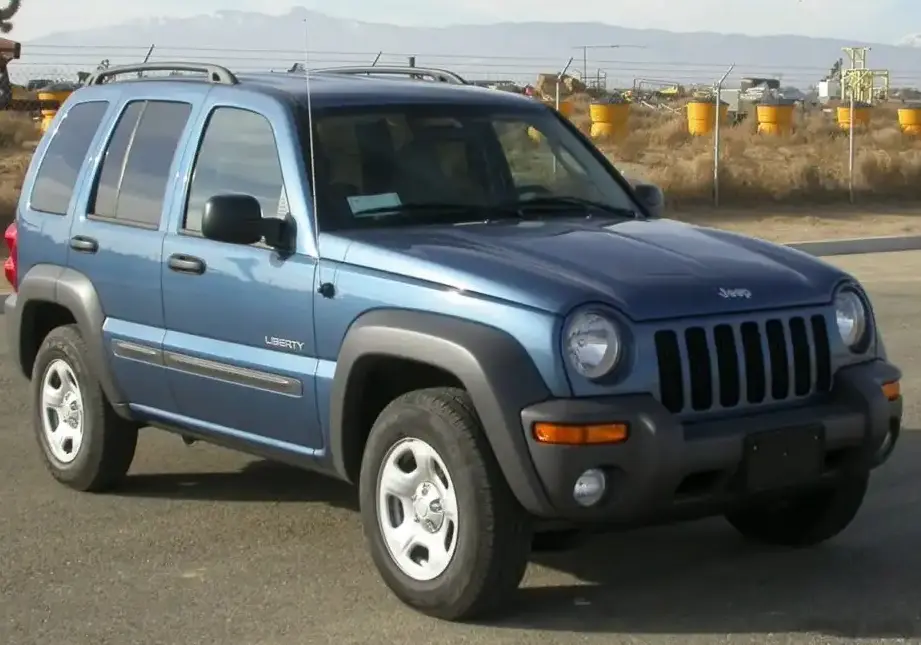
The Jeep Liberty I (facelift, 2004) 2.4 16V, producing 150 horsepower, represents an entry-level offering within the redesigned KJ series Liberty lineup. Introduced for the 2005 model year and continuing through 2006 in this configuration, it aimed to provide a more affordable and fuel-conscious option compared to the higher-trim Liberty models equipped with the 3.7L V6 engine. This variant was primarily marketed towards buyers seeking a capable SUV with Jeep’s traditional off-road heritage, but with a lower purchase price and potentially better gas mileage for daily commuting. It occupied a unique position, bridging the gap between more basic SUVs and the more powerful, premium Liberty trims.
Technical Specifications
| Brand | Jeep |
| Model | Liberty |
| Generation | Liberty I (facelift 2004) |
| Type (Engine) | 2.4 16V (150 Hp) |
| Start of production | 2005 |
| End of production | 2006 |
| Powertrain Architecture | Internal Combustion engine |
| Body type | SUV |
| Seats | 5 |
| Doors | 5 |
| Fuel Type | Petrol (Gasoline) |
| Weight-to-power ratio | 11.1 kg/Hp, 90.3 Hp/tonne |
| Weight-to-torque ratio | 7.4 kg/Nm, 134.8 Nm/tonne |
| Power | 150 Hp @ 5600 rpm |
| Power per litre | 61.8 Hp/l |
| Torque | 224 Nm @ 4000 rpm (165.21 lb.-ft. @ 4000 rpm) |
| Engine layout | Front, Longitudinal |
| Engine Model/Code | ED1 |
| Engine displacement | 2429 cm3 (148.23 cu. in.) |
| Number of cylinders | 4 |
| Engine configuration | Inline |
| Cylinder Bore | 87.5 mm (3.44 in.) |
| Piston Stroke | 101 mm (3.98 in.) |
| Compression ratio | 9.4:1 |
| Number of valves per cylinder | 4 |
| Fuel injection system | Multi-port manifold injection |
| Engine aspiration | Naturally aspirated engine |
| Valvetrain | DOHC |
| Engine oil capacity | 4.7 l (4.97 US qt | 4.14 UK qt) |
| Coolant | 9.5 l (10.04 US qt | 8.36 UK qt) |
| Kerb Weight | 1662 kg (3664.08 lbs.) |
| Max. weight | 2245 kg (4949.38 lbs.) |
| Max load | 583 kg (1285.29 lbs.) |
| Trunk (boot) space – minimum | 878 l (31.01 cu. ft.) |
| Trunk (boot) space – maximum | 1954 l (69 cu. ft.) |
| Fuel tank capacity | 78 l (20.61 US gal | 17.16 UK gal) |
| Permitted trailer load with brakes (12%) | 907 kg (1999.59 lbs.) |
| Length | 4437 mm (174.69 in.) |
| Width | 1824 mm (71.81 in.) |
| Height | 1824 mm (71.81 in.) |
| Wheelbase | 2647 mm (104.21 in.) |
| Front track | 1524 mm (60 in.) |
| Rear (Back) track | 1516 mm (59.69 in.) |
| Front overhang | 734 mm (28.9 in.) |
| Rear overhang | 1052 mm (41.42 in.) |
| Ride height (ground clearance) | 241 mm (9.49 in.) |
| Minimum turning circle (turning diameter) | 10.9 m (35.76 ft.) |
| Approach angle | 37.2° |
| Departure angle | 31.5° |
| Ramp-over (brakeover) angle | 21.8° |
| Drivetrain Architecture | The Internal combustion engine (ICE) drives the rear wheels of the vehicle. |
| Drive wheel | Rear wheel drive |
| Number of gears and type of gearbox | 6 gears, manual transmission |
| Front suspension | Independent, type McPherson with coil spring and anti-roll bar |
| Rear suspension | Rigid axle suspension, Transverse stabilizer, Coil spring |
| Front brakes | Ventilated discs, 287.02 mm |
| Rear brakes | Disc, 284.48×12.7 mm |
| Assisting systems | ABS (Anti-lock braking system) |
| Steering type | Steering rack and pinion |
| Tires size | 225/75 R16 |
| Wheel rims size | 7J x 16 |
INTRODUCTION
The Jeep Liberty I, launched in 2002, represented a significant departure for Jeep, moving away from the traditional body-on-frame construction to a more modern unibody design. The 2004 facelift brought revised styling and minor mechanical updates. The 2.4L 16V engine option, introduced in 2005, was a key component of Jeep’s strategy to broaden the Liberty’s appeal. This engine, designated ED1, was intended to offer a more economical alternative to the standard 3.7L V6, particularly in markets where fuel costs were a concern. The Liberty, positioned as a mid-size SUV, aimed to compete with vehicles like the Toyota RAV4 and Honda CR-V, while retaining Jeep’s off-road capability.
Powertrain & Engine Architecture
The 2.4L ED1 engine is an inline-four cylinder powerplant featuring a double overhead camshaft (DOHC) valvetrain and multi-port fuel injection. It produces 150 horsepower at 5600 rpm and 224 Nm (165.21 lb-ft) of torque at 4000 rpm. The engine’s 9.4:1 compression ratio and relatively modest output were geared towards fuel efficiency rather than outright performance. The engine utilizes a timing chain, contributing to lower maintenance costs compared to timing belts. Paired with this engine was a 6-speed manual transmission, offering a wider range of gear ratios than the available automatic options in other Liberty trims. This manual transmission was crucial in maximizing the engine’s limited power output and improving fuel economy. The engine’s longitudinal mounting allowed for a rear-wheel-drive configuration, a characteristic Jeep maintained to preserve some of its off-road DNA.
Driving Characteristics
The 2.4L Liberty, equipped with the 6-speed manual transmission, offered a noticeably different driving experience compared to the V6 models. Acceleration was slower, requiring more deliberate downshifting for passing maneuvers. The 6-speed gearbox helped keep the engine in its optimal power band, but the overall performance was best described as adequate rather than spirited. The manual transmission provided a more engaging driving experience, allowing drivers to better control the engine’s power delivery. Compared to the automatic transmissions found in other Liberty trims, the manual version offered improved fuel economy and a more direct connection to the powertrain. However, the lower torque output meant that off-road performance, while still respectable for a Jeep, was not as effortless as with the V6 engine.
Equipment & Trim Levels
The 2.4L Liberty typically came with a relatively basic level of standard equipment. Interior features generally included cloth upholstery, air conditioning, and a basic audio system. Power windows and locks were often standard, but features like leather seats, premium audio, and sunroofs were typically optional extras. The trim level for this engine was generally the base model, focusing on affordability. Optional packages could add features like alloy wheels, upgraded interior trim, and enhanced safety equipment. The dashboard configuration was consistent across all Liberty models, featuring a straightforward layout with easy-to-read gauges.
Chassis & Braking
The Liberty utilized an independent McPherson strut front suspension and a rigid axle rear suspension with a transverse stabilizer bar. This suspension setup provided a reasonable balance between ride comfort and handling. The base 2.4L model typically featured ventilated disc brakes at the front and solid discs at the rear. ABS (Anti-lock Braking System) was standard equipment. The relatively lighter weight of the 2.4L engine compared to the V6 contributed to slightly improved handling characteristics. The suspension was tuned for a comfortable ride, but it could feel somewhat soft during aggressive cornering.
Market Reception & Comparison
The 2.4L Liberty received mixed reviews. Critics generally praised its fuel economy and affordability, but many found the engine’s performance to be underwhelming, especially when compared to the V6 models. The manual transmission was appreciated by driving enthusiasts, but it was not as popular with the broader market. Compared to the 3.7L V6 Liberty, the 2.4L version offered significantly better fuel economy, but at the cost of performance. The V6 models were generally preferred by buyers who prioritized power and towing capacity. In terms of reliability, the 2.4L engine proved to be reasonably dependable, with fewer reported issues compared to some of the early 3.7L V6 engines.
Legacy
The 2.4L Liberty, while not a high-volume seller, remains a relatively affordable entry point into Jeep ownership. The engine and transmission combination has proven to be reasonably durable, and parts availability is generally good. Today, these vehicles are often found in the used car market, appealing to buyers seeking a budget-friendly SUV with Jeep’s off-road heritage. While not as desirable as the V6 models, the 2.4L Liberty offers a practical and economical alternative for those who prioritize fuel efficiency and affordability over outright performance. Its simplicity and relatively low maintenance costs make it a viable option for those seeking a reliable and capable SUV.