Technical Specifications
| Brand | Jeep |
| Model | Liberty |
| Generation | Liberty I (facelift 2004) |
| Type (Engine) | 2.4 16V (150 Hp) 4WD |
| Start of production | 2005 |
| End of production | 2006 |
| Powertrain Architecture | Internal Combustion engine |
| Body type | SUV |
| Seats | 5 |
| Doors | 5 |
| Fuel Type | Petrol (Gasoline) |
| Weight-to-power ratio | 11.6 kg/Hp, 85.9 Hp/tonne |
| Weight-to-torque ratio | 7.8 kg/Nm, 128.2 Nm/tonne |
| Power | 150 Hp @ 5600 rpm |
| Power per litre | 61.8 Hp/l |
| Torque | 224 Nm @ 4000 rpm (165.21 lb.-ft. @ 4000 rpm) |
| Engine layout | Front, Longitudinal |
| Engine Model/Code | ED1 |
| Engine displacement | 2429 cm3 (148.23 cu. in.) |
| Number of cylinders | 4 |
| Engine configuration | Inline |
| Cylinder Bore | 87.5 mm (3.44 in.) |
| Piston Stroke | 101 mm (3.98 in.) |
| Compression ratio | 9.4:1 |
| Number of valves per cylinder | 4 |
| Fuel injection system | Multi-port manifold injection |
| Engine aspiration | Naturally aspirated engine |
| Valvetrain | DOHC |
| Engine oil capacity | 4.7 l (4.97 US qt | 4.14 UK qt) |
| Coolant | 9.5 l (10.04 US qt | 8.36 UK qt) |
| Kerb Weight | 1747 kg (3851.48 lbs.) |
| Max. weight | 2359 kg (5200.7 lbs.) |
| Max load | 612 kg (1349.23 lbs.) |
| Trunk (boot) space – minimum | 878 l (31.01 cu. ft.) |
| Trunk (boot) space – maximum | 1954 l (69 cu. ft.) |
| Fuel tank capacity | 78 l (20.61 US gal | 17.16 UK gal) |
| Permitted trailer load with brakes (12%) | 1588 kg (3500.94 lbs.) |
| Length | 4437 mm (174.69 in.) |
| Width | 1824 mm (71.81 in.) |
| Height | 1824 mm (71.81 in.) |
| Wheelbase | 2647 mm (104.21 in.) |
| Front track | 1524 mm (60 in.) |
| Rear (Back) track | 1516 mm (59.69 in.) |
| Front overhang | 734 mm (28.9 in.) |
| Rear overhang | 1052 mm (41.42 in.) |
| Ride height (ground clearance) | 239 mm (9.41 in.) |
| Minimum turning circle (turning diameter) | 10.9 m (35.76 ft.) |
| Approach angle | 37.2° |
| Departure angle | 31.5° |
| Ramp-over (brakeover) angle | 21.8° |
| Drivetrain Architecture | The Internal combustion engine (ICE) drives the rear wheels permanently, and the front wheels are driven through an electrically or mechanically operated clutch if necessary. |
| Drive wheel | All wheel drive (4×4) |
| Number of gears and type of gearbox | 6 gears, manual transmission |
| Front suspension | Independent, type McPherson with coil spring and anti-roll bar |
| Rear suspension | Rigid axle suspension, Transverse stabilizer, Coil spring |
| Front brakes | Ventilated discs, 287.02 mm |
| Rear brakes | Disc, 284.48×12.7 mm |
| Assisting systems | ABS (Anti-lock braking system) |
| Steering type | Steering rack and pinion |
| Tires size | 225/75 R16; 235/65 R17 |
| Wheel rims size | 7J x 16; 7.5J x 17 |
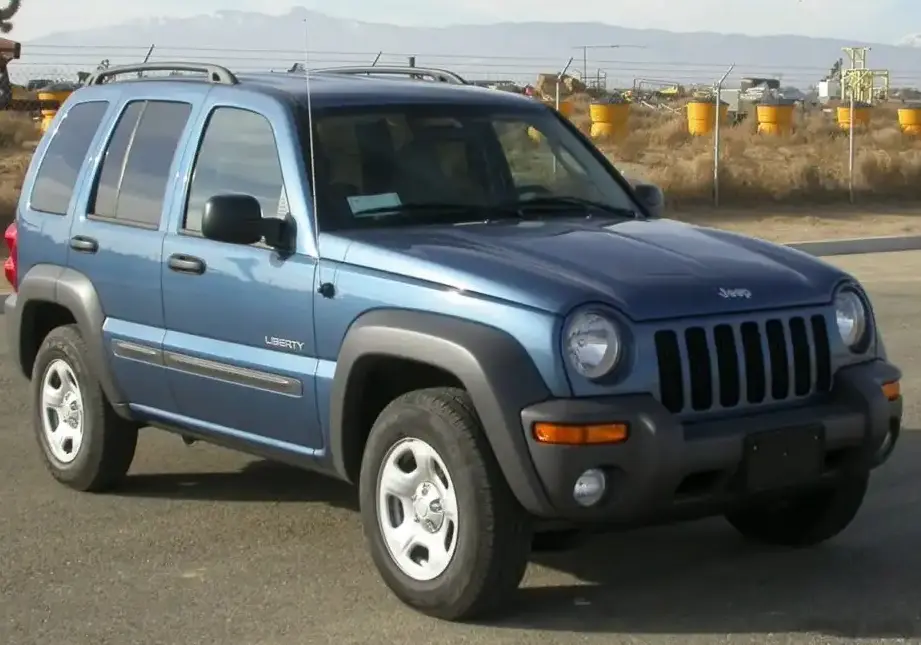
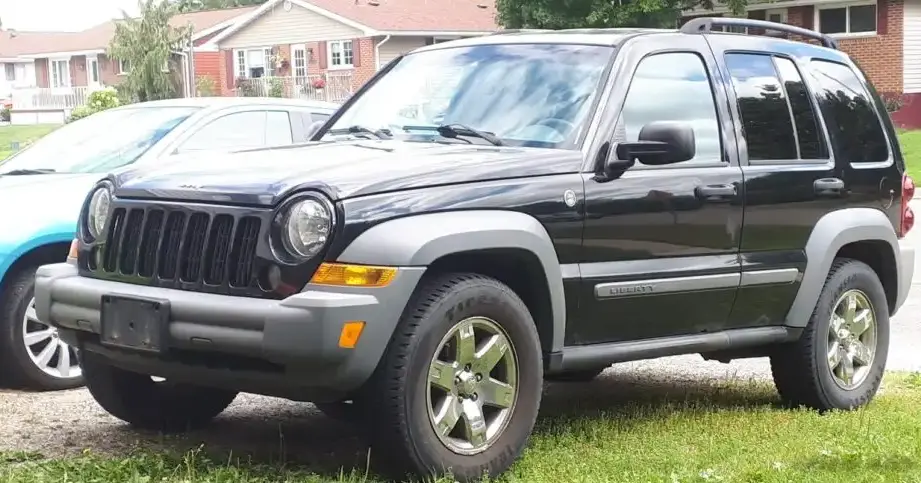
The 2005-2006 Jeep Liberty I 2.4 16V 4WD represented a mid-cycle refresh of the original Liberty (KJ) model, first launched in 2002. The facelift included cosmetic updates to the exterior, notably a revised front fascia, and minor interior refinements. This specific variant was powered by the 2.4-liter four-cylinder engine (identified by engine code ED1) coupled with a six-speed manual transmission and Jeep’s Selec-Trac full-time four-wheel-drive system. It occupied the entry-level position within the Liberty range, targeting buyers who prioritized fuel efficiency and a lower purchase price over the increased performance offered by the V6 engine options. The Liberty was designed to offer a more comfortable and refined driving experience than its predecessor, the Jeep Cherokee, while still maintaining Jeep’s reputation for off-road capability.
Powertrain & Engine Architecture
The core of this Liberty variant is the 2.4-liter inline-four cylinder engine, designated the ED1. This engine utilizes a dual overhead camshaft (DOHC) valvetrain with four valves per cylinder, enhancing its volumetric efficiency and contributing to a respectable power output for its displacement. Fuel delivery is managed by a multi-port fuel injection system, providing precise fuel metering for optimal combustion. The engine generates 150 horsepower at 5600 rpm and 224 Nm (165.21 lb-ft) of torque at 4000 rpm. The six-speed manual transmission offers a wider range of gear ratios compared to the available automatic transmission, potentially improving both fuel economy and acceleration. The Selec-Trac 4WD system provides the driver with the ability to select between 2WD, Auto 4WD, and 4WD Lock modes, offering versatility for a variety of driving conditions, from dry pavement to challenging off-road terrain.
Driving Characteristics
The 2.4-liter engine, while suitable for daily commuting and general driving, delivers noticeably less spirited performance than the V6 engines available in the Liberty lineup. Acceleration is moderate, and overtaking maneuvers require careful planning. The six-speed manual transmission allows the driver to keep the engine operating within its optimal power band, but the overall driving experience is geared towards efficiency rather than outright performance. The Selec-Trac 4WD system provides confident traction in adverse weather conditions and on loose surfaces, making it capable for light off-road excursions. The gear ratios are tuned to strike a balance between fuel economy and usability, with a relatively tall sixth gear designed for comfortable highway cruising. Compared to the V6 models, this variant exhibits a less refined feel and generates more engine noise under hard acceleration.
Equipment & Trim Levels
The 2.4L 4WD Liberty typically came equipped with a standard feature set that included air conditioning, power windows and door locks, and an AM/FM radio with a CD player. Safety features such as anti-lock brakes (ABS) were also standard equipment. Interior upholstery was generally cloth, and the dashboard featured a straightforward and functional layout. Optional extras included upgrades such as a premium sound system, alloy wheels, and a power sunroof. This trim level was generally considered a base model, prioritizing essential features over luxury appointments.
Chassis & Braking
The Liberty utilizes an independent McPherson strut front suspension and a rigid axle rear suspension, incorporating coil springs and a transverse stabilizer bar. This suspension setup provides a reasonable compromise between ride comfort and handling characteristics. The front brakes are ventilated discs, while the rear brakes are solid discs. The braking system is adequate for the vehicle’s weight and performance capabilities, but it lacks the stopping power of the larger brake systems found on the V6-equipped models. The relatively high ride height (239 mm / 9.41 in) enhances its off-road capability, but it also contributes to a higher center of gravity, which can slightly affect handling dynamics on paved roads.
Market Reception & Comparison
The 2.4-liter Liberty was generally perceived as a practical choice for buyers prioritizing fuel economy and affordability. Automotive critics acknowledged its adequate performance for everyday driving but noted that it lacked the power and refinement of the V6 models. Fuel economy was a key selling point, offering a noticeable improvement over the larger engine options. Reliability was generally considered average, with some reports of minor issues related to the engine and transmission components. When compared to competitors such as the Honda CR-V and Toyota RAV4, the Liberty offered a more rugged aesthetic and a more capable four-wheel-drive system, but it did not match the Japanese brands’ established reputation for long-term reliability.
Legacy
The 2.4-liter Liberty, while not the most popular variant, has garnered a following among budget-conscious buyers and those seeking a simple, reliable SUV. The ED1 engine is generally considered a durable unit, provided that regular maintenance is performed. Parts availability remains good, and the relatively straightforward mechanical design makes it accessible for do-it-yourself repairs. In the used car market, these Liberties are typically priced lower than the V6 models, making them an attractive option for those seeking an affordable and capable SUV. However, prospective buyers should be aware of the engine’s modest power output and the potential for age-related wear and tear on various components.