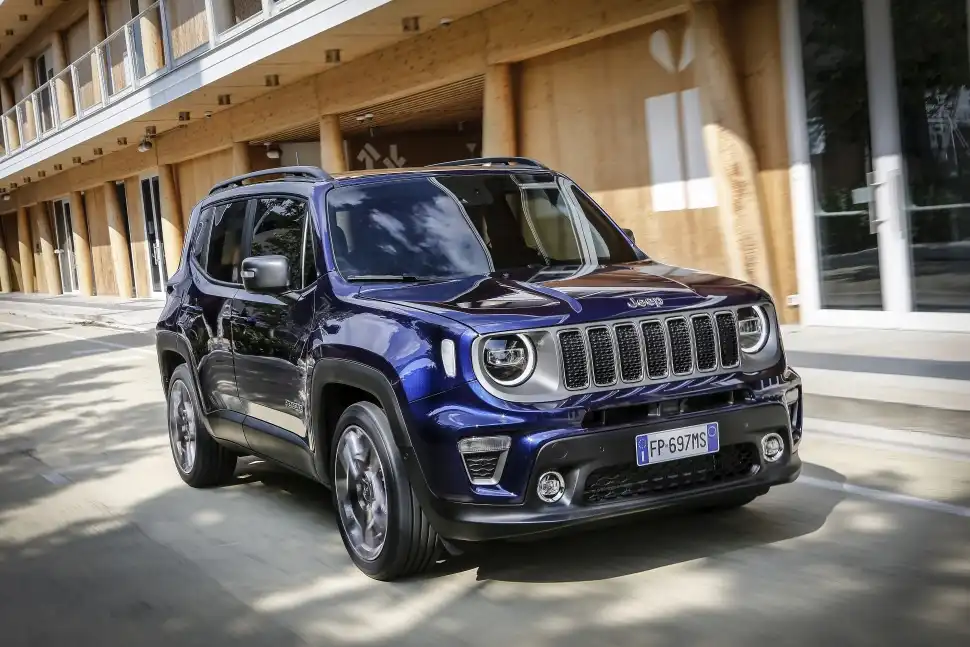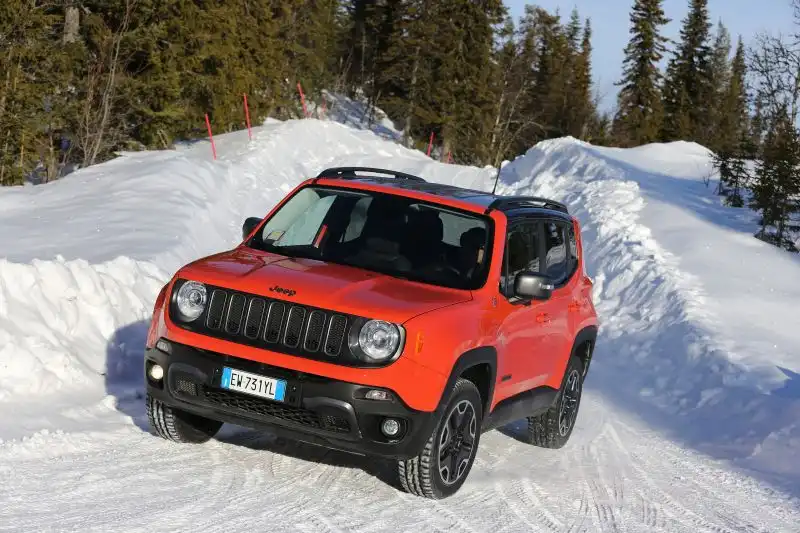
The Jeep Renegade 1.6 e-torq, producing 110 horsepower, was a key variant in the Renegade lineup offered primarily in the European and Latin American markets from 2014 to 2018. Positioned as the entry-level engine option, it aimed to provide an accessible and fuel-efficient gateway into the popular subcompact SUV segment. This model represented Jeep’s attempt to broaden the Renegade’s appeal beyond the more powerful, and often more expensive, engine choices. It was built on the Small Wide architecture, shared with the Fiat 500X, marking a significant step for Jeep into a more globally-focused platform strategy.
Technical Specifications
| Brand | Jeep |
| Model | Renegade |
| Type (Engine) | 1.6 e-torq (110 Hp) start&stop |
| Start of production | 2014 |
| End of production | 2018 |
| Powertrain Architecture | Internal Combustion engine |
| Body type | SUV, Crossover |
| Seats | 5 |
| Doors | 5 |
| Fuel consumption (urban) | 7.8 l/100 km (30.2 US mpg) |
| Fuel consumption (extra urban) | 5 l/100 km (47 US mpg) |
| Fuel consumption (combined) | 6 l/100 km (39.2 US mpg) |
| CO2 emissions | 141 g/km |
| Fuel Type | Petrol (Gasoline) |
| Acceleration 0 – 100 km/h | 11.8 sec |
| Acceleration 0 – 62 mph | 11.8 sec |
| Acceleration 0 – 60 mph | 11.2 sec |
| Maximum speed | 178 km/h (110.6 mph) |
| Emission standard | Euro 6 |
| Power | 110 Hp @ 5500 rpm |
| Torque | 152 Nm @ 4500 rpm (112.11 lb.-ft. @ 4500 rpm) |
| Engine layout | Front, Transverse |
| Engine Model/Code | 55263842 |
| Engine displacement | 1598 cm3 (97.52 cu. in.) |
| Number of cylinders | 4 |
| Engine configuration | Inline |
| Cylinder Bore | 77 mm (3.03 in.) |
| Piston Stroke | 85.8 mm (3.38 in.) |
| Compression ratio | 11:1 |
| Number of valves per cylinder | 4 |
| Fuel injection system | Multi-port manifold injection |
| Engine aspiration | Naturally aspirated engine |
| Valvetrain | SOHC |
| Engine oil capacity | 4.6 l (4.86 US qt | 4.05 UK qt) |
| Trunk (boot) space – minimum | 351 l (12.4 cu. ft.) |
| Trunk (boot) space – maximum | 1297 l (45.8 cu. ft.) |
| Fuel tank capacity | 48 l (12.68 US gal | 10.56 UK gal) |
| Permitted trailer load without brakes | 1000 kg (2204.62 lbs.) |
| Length | 4236 mm (166.77 in.) |
| Width | 1805 mm (71.06 in.) |
| Height | 1667 mm (65.63 in.) |
| Wheelbase | 2570 mm (101.18 in.) |
| Front track | 1541 mm (60.67 in.) |
| Rear (Back) track | 1541 mm (60.67 in.) |
| Ride height (ground clearance) | 175 mm (6.89 in.) |
| Drag coefficient (Cd) | 0.34 |
| Minimum turning circle (turning diameter) | 11.07 m (36.32 ft.) |
| Approach angle | 17.9° |
| Departure angle | 29.7° |
| Drivetrain Architecture | The Internal combustion engine (ICE) drives the front wheels of the vehicle. |
| Drive wheel | Front wheel drive |
| Number of gears and type of gearbox | 5 gears, manual transmission |
| Front suspension | Independent type McPherson |
| Rear suspension | McPherson |
| Front brakes | Ventilated discs |
| Rear brakes | Disc |
| Assisting systems | ABS (Anti-lock braking system) |
| Steering type | Steering rack and pinion |
Powertrain & Engine Architecture
The 1.6-liter e-torq engine, designated with engine code 55263842, is a naturally aspirated inline-four cylinder gasoline engine. It utilizes a multi-point fuel injection system, a relatively simple and cost-effective technology. The engine features a single overhead camshaft (SOHC) valvetrain, operating four valves per cylinder. This configuration balances simplicity with reasonable performance. The ‘e-torq’ designation refers to Fiat’s (and subsequently Jeep’s) efforts to optimize engine efficiency through variable valve timing and improved combustion chamber design. The 110 horsepower output is achieved at 5500 rpm, while peak torque of 152 Nm (112 lb-ft) arrives at 4500 rpm. This engine was paired with a five-speed manual transmission in most configurations, contributing to its fuel efficiency. The transmission’s gear ratios were tuned for everyday drivability rather than outright performance.
Driving Characteristics
The Renegade 1.6 e-torq with a manual transmission offered adequate, but not exhilarating, performance. Acceleration from 0-60 mph took around 11.2 seconds, and top speed was limited to 178 km/h (110.6 mph). The engine felt somewhat strained when pushed hard, particularly when fully loaded or climbing hills. The five-speed gearbox helped to keep the engine within its optimal power band, but frequent downshifts were often necessary. Compared to the more powerful 1.4 Turbo or 2.0-liter diesel options, the 1.6 e-torq prioritized fuel economy and affordability over outright speed. The steering was light and easy, making it well-suited for urban driving, but lacked the precision of some competitors.
Equipment & Trim Levels
The 1.6 e-torq variant typically served as the base trim level for the Renegade. Standard equipment generally included air conditioning, power windows, central locking, and a basic audio system with USB connectivity. Safety features such as ABS and front airbags were also standard. Interior upholstery was typically cloth, and the dashboard featured a simple, functional design. Optional extras included alloy wheels, a touchscreen infotainment system, rear parking sensors, and cruise control. Higher trim levels added features like leather upholstery, automatic climate control, and more advanced safety systems.
Chassis & Braking
The Renegade 1.6 e-torq utilized an independent McPherson strut suspension at the front and a McPherson strut rear suspension. This setup provided a comfortable ride quality, absorbing bumps and imperfections in the road reasonably well. Front brakes were ventilated discs, offering good stopping power, while rear brakes were solid discs. The suspension was tuned for comfort rather than sporty handling, resulting in a slight degree of body roll during cornering. The steering system employed a rack and pinion setup, providing light and responsive steering feel.
Market Reception & Comparison
The Jeep Renegade 1.6 e-torq was generally well-received as an affordable and practical entry point into the subcompact SUV segment. Critics praised its fuel efficiency and comfortable ride, but noted its lack of outright performance. Compared to the 1.4 Turbo version, the 1.6 e-torq offered lower running costs but significantly less power. The diesel variants provided even better fuel economy but came with a higher purchase price. In terms of reliability, the 1.6 e-torq engine proved to be generally dependable, although some owners reported minor issues with the fuel injection system.
Legacy
The Jeep Renegade 1.6 e-torq remains a relatively common sight on the used car market, particularly in Europe and Latin America. Its simple engine design and robust construction contribute to its long-term reliability. While not the most powerful or technologically advanced version of the Renegade, it offers a practical and affordable option for buyers seeking a small, versatile SUV. The 1.6 e-torq powertrain, while superseded by more modern engines, represents a significant step in Jeep’s expansion into the global small SUV market, and its affordability continues to make it an attractive option for budget-conscious buyers.