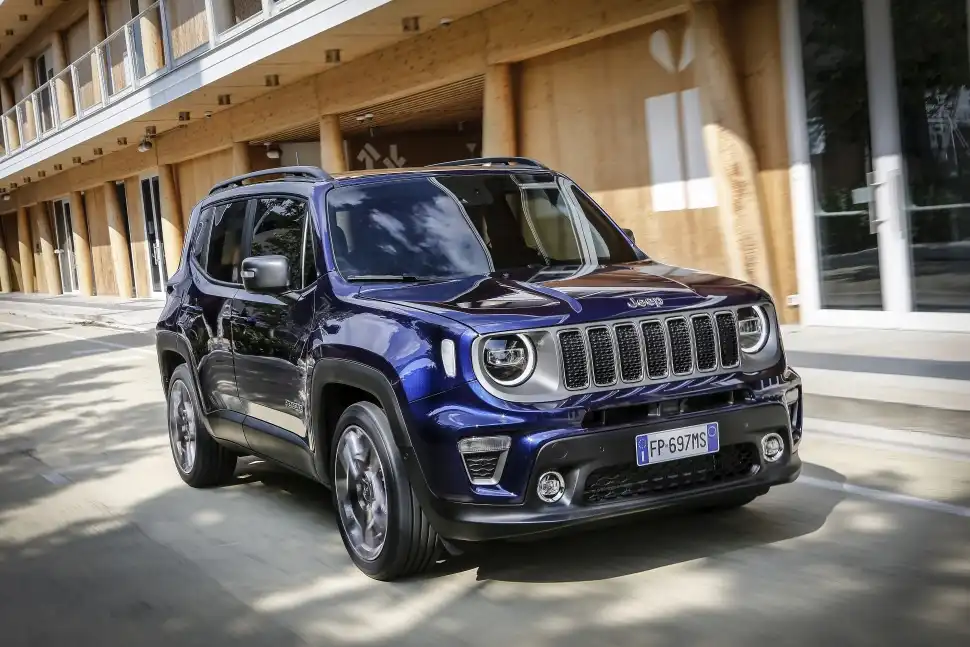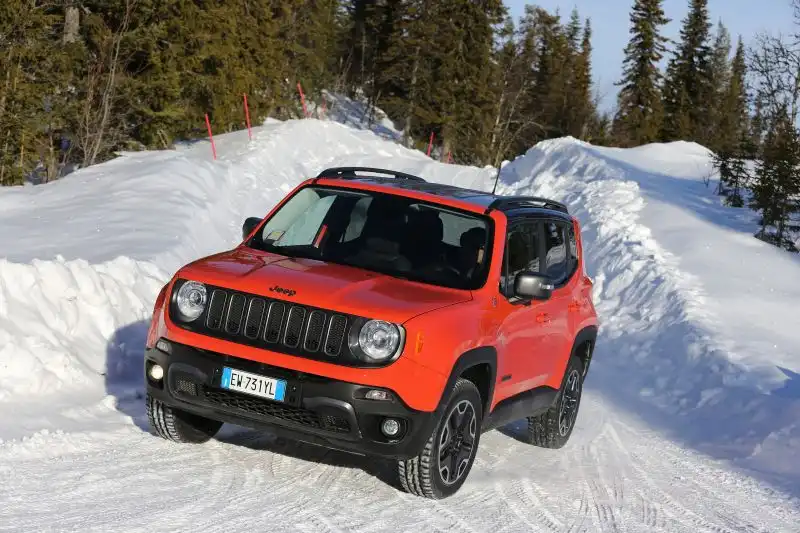
The Jeep Renegade 2.0 MultiJet 4×4 Automatic, produced from 2014 to 2018, represents a significant entry for Jeep into the burgeoning subcompact SUV segment. This variant, powered by a 2.0-liter turbocharged diesel engine producing 140 horsepower, was primarily aimed at the European market, where diesel engines held a substantial share of the automotive landscape. It occupied a mid-range position within the Renegade lineup, offering a balance between fuel efficiency, all-wheel-drive capability, and relative affordability. The Renegade itself was a groundbreaking vehicle for Jeep, being the first model jointly developed with Fiat following Chrysler’s acquisition by Fiat S.p.A. It utilized the Small Wide architecture, shared with other Fiat and Alfa Romeo models, allowing for a more efficient and cost-effective production process.
Technical Specifications
| Brand | Jeep |
| Model | Renegade |
| Type (Engine) | 2.0 MultiJet (140 Hp) 4×4 Automatic start&stop |
| Start of production | 2014 |
| End of production | 2018 |
| Powertrain Architecture | Internal Combustion engine |
| Body type | SUV, Crossover |
| Seats | 5 |
| Doors | 5 |
| Fuel consumption (urban) | 6.7 l/100 km (35.1 US mpg, 42.2 UK mpg, 14.9 km/l) |
| Fuel consumption (extra urban) | 5.1 l/100 km (46.1 US mpg, 55.4 UK mpg, 19.6 km/l) |
| Fuel consumption (combined) | 5.7 l/100 km (41.3 US mpg, 49.6 UK mpg, 17.5 km/l) |
| CO2 emissions | 154 g/km |
| Fuel Type | Diesel |
| Acceleration 0 – 100 km/h | 10.2 sec |
| Acceleration 0 – 62 mph | 10.2 sec |
| Acceleration 0 – 60 mph | 9.7 sec |
| Maximum speed | 182 km/h (113.09 mph) |
| Emission standard | Euro 6 |
| Power | 140 Hp @ 3750 rpm |
| Torque | 350 Nm @ 1750 rpm (258.15 lb.-ft. @ 1750 rpm) |
| Engine layout | Front, Transverse |
| Engine Model/Code | 55284064 |
| Engine displacement | 1956 cm3 (119.36 cu. in.) |
| Number of cylinders | 4 |
| Engine configuration | Inline |
| Cylinder Bore | 83 mm (3.27 in.) |
| Piston Stroke | 90.4 mm (3.56 in.) |
| Compression ratio | 16.5:1 |
| Number of valves per cylinder | 4 |
| Fuel injection system | Diesel Commonrail |
| Engine aspiration | Turbocharger, Intercooler |
| Valvetrain | DOHC |
| Engine oil capacity | 4.3 l (4.54 US qt | 3.78 UK qt) |
| Coolant capacity | 6.5 l (6.87 US qt | 5.72 UK qt) |
| Trunk (boot) space – minimum | 351 l (12.4 cu. ft.) |
| Trunk (boot) space – maximum | 1297 l (45.8 cu. ft.) |
| Fuel tank capacity | 48 l (12.68 US gal | 10.56 UK gal) |
| Permitted trailer load with brakes (12%) | 1500 kg (3306.93 lbs.) |
| Length | 4236 mm (166.77 in.) |
| Width | 1805 mm (71.06 in.) |
| Height | 1697 mm (66.81 in.) |
| Wheelbase | 2570 mm (101.18 in.) |
| Front track | 1541 mm (60.67 in.) |
| Rear track | 1541 mm (60.67 in.) |
| Ride height (ground clearance) | 198 mm (7.8 in.) |
| Drag coefficient (Cd) | 0.36 |
| Minimum turning circle | 11.07 m (36.32 ft.) |
| Approach angle | 21° |
| Departure angle | 32.1° |
| Drive wheel | All wheel drive (4×4) |
| Number of gears and type of gearbox | 9 gears, automatic transmission |
| Front suspension | Independent type McPherson |
| Rear suspension | McPherson |
| Front brakes | Ventilated discs |
| Rear brakes | Disc |
| Assisting systems | ABS (Anti-lock braking system) |
| Steering type | Steering rack and pinion |
Powertrain & Engine Architecture
The heart of the Renegade 2.0 MultiJet 4×4 Automatic is the 55284064 engine code, a 1.956-liter inline-four cylinder diesel engine. This engine utilizes a common-rail direct injection system, delivering fuel at extremely high pressures for optimized combustion. A turbocharger with an intercooler is employed to boost power and torque, mitigating turbo lag and improving overall responsiveness. The engine features a double overhead camshaft (DOHC) valvetrain with four valves per cylinder, enhancing volumetric efficiency. The 9-speed automatic transmission, sourced from ZF, was a relatively new technology at the time, designed to improve fuel economy and provide smoother gear changes compared to traditional automatic transmissions. This transmission offered a wide range of gear ratios, allowing the engine to operate within its optimal power band more frequently.
Driving Characteristics
The 140 horsepower and 350 Nm (258 lb-ft) of torque provided by the 2.0 MultiJet engine, coupled with the nine-speed automatic, resulted in a comfortable and capable driving experience. Acceleration from 0-60 mph took approximately 9.7 seconds, which was adequate for everyday driving but not particularly sporty. The automatic transmission, while offering smooth shifts, could sometimes feel hesitant during quick acceleration. Compared to the higher-output 185 hp version of the 2.0 MultiJet, this variant offered less outright performance. However, it provided better fuel economy and a more relaxed driving experience. The all-wheel-drive system, primarily front-wheel drive with automatic engagement of the rear axle when needed, provided enhanced traction in slippery conditions.
Equipment & Trim Levels
The 2.0 MultiJet 4×4 Automatic typically came equipped with features such as air conditioning, power windows and locks, a touchscreen infotainment system, and alloy wheels. Higher trim levels offered upgrades like leather upholstery, heated seats, a rearview camera, and advanced safety features like lane departure warning and automatic emergency braking. The interior design was functional and modern, with a focus on practicality. Optional extras included a panoramic sunroof, upgraded audio systems, and various styling packages.
Chassis & Braking
The Renegade’s chassis featured an independent McPherson strut suspension at the front and a McPherson strut rear suspension. This setup provided a comfortable ride quality, although it wasn’t particularly sporty. The front brakes were ventilated discs, while the rear brakes were solid discs. Anti-lock braking system (ABS) was standard. The Renegade’s relatively compact size and light weight contributed to its nimble handling characteristics. Stabilizer bars were included to reduce body roll during cornering.
Market Reception & Comparison
The Jeep Renegade 2.0 MultiJet 4×4 Automatic was generally well-received by automotive critics, particularly for its fuel efficiency, all-wheel-drive capability, and distinctive styling. However, some critics noted the relatively slow acceleration and the occasionally hesitant behavior of the automatic transmission. Compared to other subcompact SUVs with diesel engines, such as the Nissan Juke dCi or the Peugeot 2008 BlueHDi, the Renegade offered a more rugged and adventurous image. Its fuel economy was competitive, averaging around 5.7 l/100 km (41.3 US mpg), and its reliability was generally considered to be good.
Legacy
The 2.0 MultiJet engine proved to be a reliable and durable powerplant, with many examples still on the road today. The nine-speed automatic transmission, while initially experiencing some teething issues, became more refined over time. The Renegade, as a whole, helped to broaden Jeep’s appeal to a wider audience, particularly in Europe. On the used car market, the 2.0 MultiJet 4×4 Automatic Renegade represents a good value proposition for buyers seeking a fuel-efficient, capable, and stylish subcompact SUV. Regular maintenance, including timely oil changes and filter replacements, is crucial for ensuring the long-term reliability of this powertrain.