Technical Specifications
| Brand | Jeep |
| Model | Renegade |
| Type (Engine) | 2.4 MultiAir2 TIGERSHARK (185 Hp) Automatic 4×4 |
| Start of production | 2014 |
| End of production | 2018 |
| Powertrain Architecture | Internal Combustion engine |
| Body type | SUV, Crossover |
| Seats | 5 |
| Doors | 5 |
| Fuel consumption (urban) | 11.2 l/100 km (21 US mpg) |
| Fuel consumption (extra urban) | 8.1 l/100 km (29 US mpg) |
| Fuel consumption (combined) | 9.8 l/100 km (24 US mpg) |
| Fuel Type | Petrol (Gasoline) |
| Emission standard | Euro 6 |
| Power | 185 Hp @ 6400 rpm |
| Torque | 232 Nm @ 4800 rpm (171.11 lb.-ft. @ 4800 rpm) |
| Engine layout | Front, Transverse |
| Engine Model/Code | 50052375 |
| Engine displacement | 2360 cm3 (144.02 cu. in.) |
| Number of cylinders | 4 |
| Engine configuration | Inline |
| Cylinder Bore | 88 mm (3.46 in.) |
| Piston Stroke | 97 mm (3.82 in.) |
| Compression ratio | 10:1 |
| Number of valves per cylinder | 4 |
| Fuel injection system | Multi-port manifold injection |
| Engine aspiration | Naturally aspirated engine |
| Valvetrain | SOHC |
| Engine oil capacity | 5.2 l (5.49 US qt | 4.58 UK qt) |
| Coolant | 6.5 l (6.87 US qt | 5.72 UK qt) |
| Trunk (boot) space – minimum | 351 l (12.4 cu. ft.) |
| Trunk (boot) space – maximum | 1297 l (45.8 cu. ft.) |
| Fuel tank capacity | 48 l (12.68 US gal | 10.56 UK gal) |
| Permitted trailer load without brakes | 907 kg (1999.59 lbs.) |
| Length | 4236 mm (166.77 in.) |
| Width | 1805 mm (71.06 in.) |
| Height | 1697 mm (66.81 in.) |
| Wheelbase | 2570 mm (101.18 in.) |
| Front track | 1541 mm (60.67 in.) |
| Rear track | 1541 mm (60.67 in.) |
| Ride height (ground clearance) | 210 mm (8.27 in.) |
| Drag coefficient (Cd) | 0.34 |
| Minimum turning circle | 10.76 m (35.3 ft.) |
| Approach angle | 30° |
| Departure angle | 34° |
| Drive wheel | All wheel drive (4×4) |
| Number of gears and type of gearbox | 9 gears, automatic transmission |
| Front suspension | Independent type McPherson |
| Rear suspension | McPherson |
| Front brakes | Ventilated discs |
| Rear brakes | Disc |
| Assisting systems | ABS (Anti-lock braking system) |
| Steering type | Steering rack and pinion |
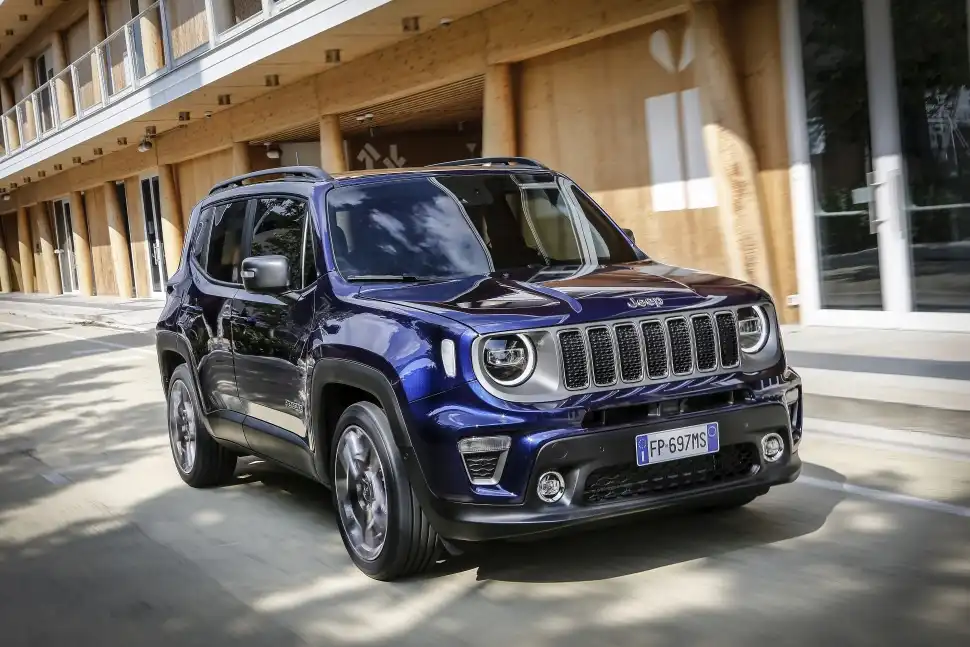
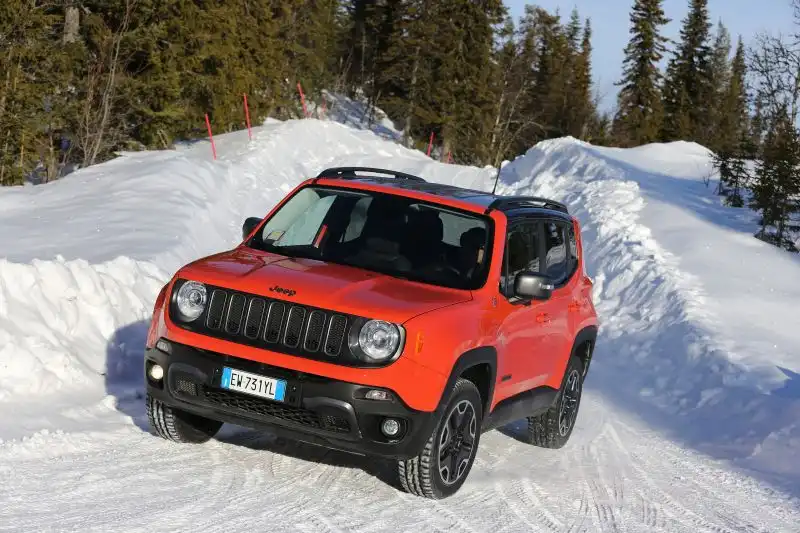
The Jeep Renegade 2.4 MultiAir2 TIGERSHARK, produced from 2014 to 2018, represented a significant expansion of the Jeep lineup into the burgeoning subcompact SUV segment. This particular variant, equipped with a 185 horsepower 2.4-liter engine and a 9-speed automatic transmission coupled with four-wheel drive, was positioned as a mid-range to upper-mid-range offering within the Renegade family. It aimed to strike a balance between capability, fuel efficiency, and modern features, appealing to buyers seeking a versatile and stylish vehicle with a degree of off-road prowess. Notably, the Renegade was the first Jeep vehicle to be manufactured outside of North America, with production taking place in Melfi, Italy, as a result of the collaboration between Jeep and Fiat.
Powertrain & Engine Architecture
At the core of this Renegade trim lies the 2.4-liter “TIGERSHARK” inline-four cylinder engine, internally designated as the 50052375. This engine incorporates Fiat’s innovative MultiAir2 electro-hydraulic valve actuation system. MultiAir2 allows for precise and independent control of both intake valve timing and lift, optimizing the combustion process for improved efficiency and reduced emissions. The engine employs a single overhead camshaft (SOHC) configuration and utilizes multi-port fuel injection for precise fuel delivery. Paired with this engine is a 9-speed automatic transmission sourced from ZF. This transmission’s wide gear ratio spread was engineered to enhance both fuel economy during highway cruising and provide responsive acceleration when needed. The transmission control unit (TCU) was specifically programmed to complement the engine’s characteristics, aiming for smooth and timely gear changes.
Driving Characteristics
The combination of 185 horsepower and 171 lb-ft of torque delivered by the 2.4-liter engine and 9-speed automatic transmission resulted in adequate, though not particularly sporty, performance. Acceleration from a standstill to 60 mph typically required around 8.5 to 9.5 seconds. While the 9-speed transmission offered a broad range of gears, it occasionally exhibited some hesitancy or abruptness during shifts, especially at lower speeds. In comparison to the available 1.4-liter turbocharged engine option, the TIGERSHARK engine provided a more linear and predictable power delivery, making it easier to manage in everyday driving scenarios. It also avoided the potential for turbo lag experienced with the smaller, turbocharged unit. When contrasted with the diesel engines offered in European markets, the gasoline engine provided a quieter and smoother driving experience, albeit at the cost of overall fuel economy.
Equipment & Trim Levels
The 2.4 MultiAir2 TIGERSHARK 4×4 trim generally came standard with features such as air conditioning, a 5-inch touchscreen infotainment system, Bluetooth connectivity for hands-free calling and audio streaming, and a rearview camera for enhanced safety. Stepping up to higher sub-trims unlocked additional features, including upgraded interior upholstery materials, a larger touchscreen display (typically 6.5 or 8.4 inches), integrated navigation systems, and premium audio systems. A range of optional extras were also available, such as a panoramic sunroof, heated front seats for added comfort, and advanced safety technologies like blind-spot monitoring and rear cross-path detection. The interior design prioritized functionality and durability, with a modern aesthetic and user-friendly controls.
Chassis & Braking
The Renegade’s chassis utilized an independent McPherson strut suspension setup at all four corners, providing a comfortable ride and responsive handling. The four-wheel-drive system incorporated a disconnecting rear axle, allowing the vehicle to operate in front-wheel drive mode under normal driving conditions to maximize fuel efficiency. When traction was needed, the system could automatically engage the rear axle for enhanced grip. Braking performance was provided by ventilated discs at the front and solid discs at the rear. An anti-lock braking system (ABS) was standard equipment, enhancing stopping power and stability, particularly on slippery surfaces. The suspension tuning was biased towards providing a comfortable on-road ride, rather than prioritizing extreme off-road performance.
Market Reception & Comparison
Automotive critics generally acknowledged the Renegade’s distinctive styling and its inherent off-road capability. However, the 2.4-liter engine and 9-speed automatic transmission pairing received a more mixed reception. Some reviewers found the powertrain adequate for everyday driving needs, while others criticized its lack of refinement and occasional transmission inconsistencies. Fuel economy was considered average for the segment, aligning with other small SUVs. Compared to competitors such as the Honda HR-V and Mazda CX-3, the Renegade offered a more rugged aesthetic and a more capable four-wheel-drive system, but it generally lacked the same level of driving refinement and overall polish.
Legacy
The Jeep Renegade 2.4 MultiAir2 TIGERSHARK 4×4 has demonstrated reasonable reliability in the used car market. The 2.4-liter engine is generally regarded as a durable unit, although the MultiAir2 system necessitates regular oil changes using the manufacturer-specified grade to prevent potential valve-related issues. The 9-speed automatic transmission has also proven to be generally reliable, although some owners have reported isolated instances of software glitches. Overall, the Renegade continues to be a popular choice among buyers seeking a stylish, capable, and relatively affordable small SUV. Its unique design and Jeep’s established off-road heritage continue to resonate with a diverse customer base.