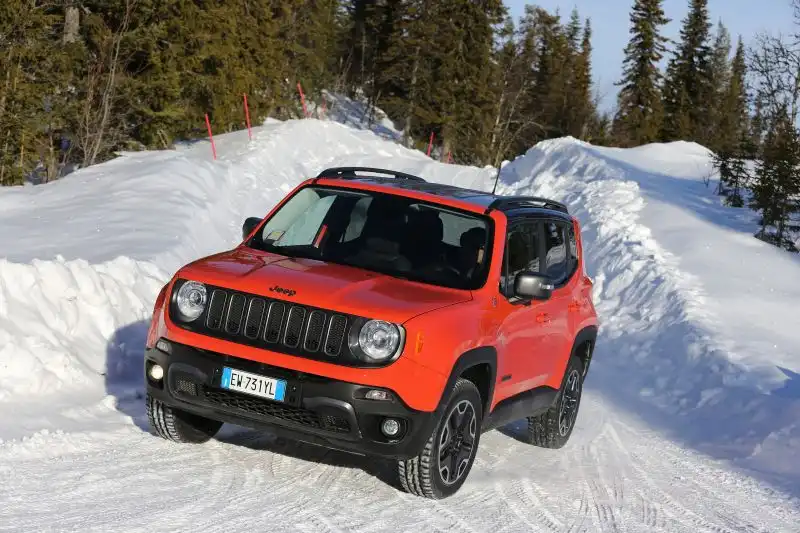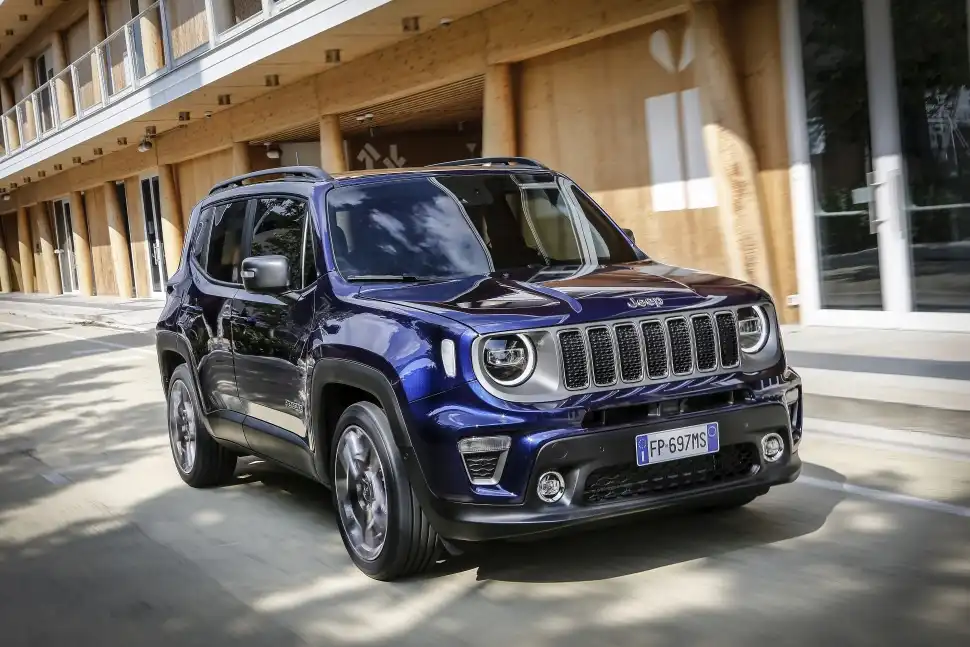
The Jeep Renegade 1.6 Multijet (130 hp) represents a diesel-powered variant of the globally-sold subcompact SUV, introduced as part of the facelift for the Renegade model in February 2021 and continuing through February 2022. Positioned as a fuel-efficient option within the Renegade lineup, it aimed to appeal to European buyers seeking a practical and economical crossover. This version utilized a smaller displacement diesel engine paired with a manual transmission, offering a balance between performance and running costs. It was a key offering in markets where diesel fuel remained popular, particularly in Europe, where it competed with similar offerings from Peugeot, Renault, and Volkswagen.
Technical Specifications
| Brand | Jeep |
| Model | Renegade |
| Generation | Renegade (facelift 2018) |
| Type (Engine) | 1.6 Multijet (130 Hp) |
| Start of production | February, 2021 |
| End of production | February, 2022 |
| Powertrain Architecture | Internal Combustion engine |
| Body type | SUV, Crossover |
| Seats | 5 |
| Doors | 5 |
| Fuel consumption (combined) | 5-5.3 l/100 km (47 – 44.4 US mpg, 56.5 – 53.3 UK mpg, 20 – 18.9 km/l) |
| CO2 emissions | 131-139 g/km |
| Fuel Type | Diesel |
| Acceleration 0 – 100 km/h | 10.4 sec |
| Acceleration 0 – 62 mph | 10.4 sec |
| Acceleration 0 – 60 mph | 9.9 sec |
| Maximum speed | 193 km/h (119.92 mph) |
| Emission standard | Euro 6D-FINAL |
| Weight-to-power ratio | 11 kg/Hp, 90.9 Hp/tonne |
| Weight-to-torque ratio | 4.5 kg/Nm, 223.8 Nm/tonne |
| Power | 130 Hp @ 3750 rpm |
| Power per litre | 81.4 Hp/l |
| Torque | 320 Nm @ 1500 rpm (236.02 lb.-ft. @ 1500 rpm) |
| Engine layout | Front, Transverse |
| Engine Model/Code | 46346020 |
| Engine displacement | 1598 cm3 (97.52 cu. in.) |
| Number of cylinders | 4 |
| Engine configuration | Inline |
| Cylinder Bore | 79.5 mm (3.13 in.) |
| Piston Stroke | 80.5 mm (3.17 in.) |
| Compression ratio | 16.5:1 |
| Number of valves per cylinder | 4 |
| Fuel injection system | Diesel Commonrail |
| Engine aspiration | Turbocharger, Intercooler |
| Engine oil capacity | 4.8 l (5.07 US qt | 4.22 UK qt) |
| Coolant | 6.1 l (6.45 US qt | 5.37 UK qt) |
| Kerb Weight | 1430 kg (3152.61 lbs.) |
| Trunk (boot) space – minimum | 351 l (12.4 cu. ft.) |
| Trunk (boot) space – maximum | 1297 l (45.8 cu. ft.) |
| Fuel tank capacity | 55 l (14.53 US gal | 12.1 UK gal) |
| AdBlue tank | 13 l (3.43 US gal | 2.86 UK gal) |
| Length | 4236 mm (166.77 in.) |
| Width | 1805 mm (71.06 in.) |
| Height | 1667 mm (65.63 in.) |
| Wheelbase | 2570 mm (101.18 in.) |
| Ride height (ground clearance) | 175 mm (6.89 in.) |
| Minimum turning circle | 11.07 m (36.32 ft.) |
| Drivetrain Architecture | The Internal combustion engine (ICE) drives the front wheels of the vehicle. |
| Drive wheel | Front wheel drive |
| Number of gears and type of gearbox | 6 gears, manual transmission |
| Assisting systems | ABS (Anti-lock braking system) |
| Steering type | Steering rack and pinion |
| Power steering | Electric Steering |
| Tires size | 215/65 R16; 215/60 R17 |
| Wheel rims size | 6.5J x 16; 6.5J x 17 |
Introduction
The Jeep Renegade 1.6 Multijet (130 hp) was introduced as part of the 2018 facelift of the Renegade, a subcompact SUV designed to broaden Jeep’s appeal beyond traditional off-road enthusiasts. Built on the Small Wide architecture (shared with the Fiat 500X), the Renegade aimed to offer a blend of Jeep’s rugged styling with European practicality and efficiency. The 1.6 Multijet variant, specifically, was targeted at markets prioritizing fuel economy and lower running costs, particularly in Europe. Production spanned from February 2021 to February 2022, making it a relatively short-lived but significant offering within the Renegade range.
Powertrain & Engine Architecture
At the heart of the Renegade 1.6 Multijet is the Fiat-sourced 1.6-liter inline-four cylinder diesel engine, designated with engine code 46346020. This engine utilizes a common-rail direct injection system, delivering fuel at extremely high pressure for optimized combustion. A turbocharger with an intercooler is employed to boost power output and improve torque across a wider rev range. The engine features four valves per cylinder and a compression ratio of 16.5:1, contributing to its efficiency. The 130 hp output is achieved at 3750 rpm, while peak torque of 320 Nm (236 lb-ft) is available from just 1500 rpm. This engine was paired exclusively with a six-speed manual transmission, prioritizing fuel efficiency over the convenience of an automatic.
Driving Characteristics
The Renegade 1.6 Multijet, with its 130 hp and manual transmission, offered a driving experience focused on practicality and fuel economy rather than outright performance. Acceleration from 0-100 km/h (0-62 mph) took approximately 10.4 seconds. The engine’s strong low-end torque made it reasonably responsive in everyday driving situations, particularly for overtaking and navigating urban environments. However, compared to higher-output Renegade variants like the 1.3-liter petrol or the Trailhawk models, the 1.6 Multijet felt noticeably less powerful, especially when fully loaded or tackling steep inclines. The six-speed manual transmission provided a good level of control, but the gear ratios were tuned for efficiency, meaning the engine could feel strained at higher speeds.
Equipment & Trim Levels
The 1.6 Multijet trim level typically sat in the mid-range of the Renegade lineup. Standard equipment generally included air conditioning, a touchscreen infotainment system with Bluetooth connectivity, alloy wheels, and basic safety features like ABS and multiple airbags. Higher trim levels offered upgrades such as a larger touchscreen, navigation system, parking sensors, a rearview camera, and more advanced safety technologies. Interior upholstery was typically cloth, with options for leather available on higher trims. Optional extras included a panoramic sunroof, heated seats, and various styling packages.
Chassis & Braking
The Renegade 1.6 Multijet utilized a front-wheel-drive configuration as standard, with all-wheel drive available as an option on some trim levels. The suspension consisted of MacPherson struts at the front and a twist-beam setup at the rear. Braking was typically handled by disc brakes on the front wheels and drum brakes on the rear, although some higher trims featured disc brakes all around. The steering system was an electric power-assisted rack and pinion setup, providing a reasonably light and responsive feel. Stabilizer bars were fitted to both the front and rear axles to reduce body roll during cornering.
Market Reception & Comparison
The Jeep Renegade 1.6 Multijet was generally well-received in markets where diesel engines were popular. Critics praised its fuel efficiency and practicality, but some noted its relatively modest performance compared to petrol-powered rivals. Compared to the 1.3-liter petrol version, the 1.6 Multijet offered significantly better fuel economy but less overall power. The 1.6 Multijet also provided a more refined driving experience than some of its competitors, such as the Suzuki Vitara, but it was often more expensive. Reliability reports were generally positive, with the 1.6 Multijet engine proving to be a durable and dependable unit.
Legacy
The Jeep Renegade 1.6 Multijet represents a significant chapter in the Renegade’s history, demonstrating Jeep’s commitment to offering fuel-efficient options in the European market. While the diesel engine is becoming less common due to tightening emissions regulations, the 1.6 Multijet-equipped Renegades remain a popular choice on the used car market, particularly for buyers seeking a practical, economical, and stylish subcompact SUV. The engine’s robust design and relatively simple mechanicals contribute to its long-term reliability, making it a potentially sound investment for budget-conscious buyers.