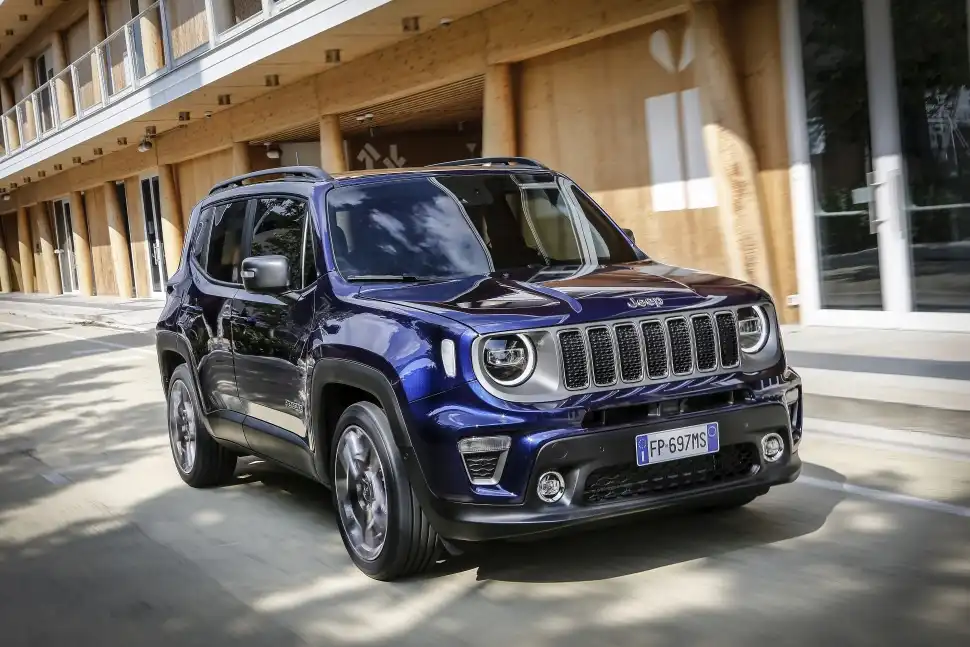
The Jeep Renegade 2.0 Multijet 4×4, produced from August 2018 to July 2020, represents a key variant within the facelifted first generation (BU/MK) Renegade lineup. Positioned as a mid-range offering, this model combined a fuel-efficient diesel engine with Jeep’s renowned four-wheel-drive capability, appealing to buyers seeking practicality and all-weather performance in a compact SUV package. It was primarily marketed in Europe and other regions where diesel engines remained popular, offering a balance between economy and capability. This version sat between the lower-powered diesel options and the more potent petrol-powered models, targeting customers who prioritized fuel efficiency and torque for everyday driving and occasional off-road excursions.
Technical Specifications
| Brand | Jeep |
| Model | Renegade |
| Generation | Renegade (facelift 2018) |
| Type (Engine) | 2.0 Multijet (140 Hp) 4×4 |
| Start of production | August, 2018 |
| End of production | July, 2020 |
| Powertrain Architecture | Internal Combustion engine |
| Body type | SUV, Crossover |
| Seats | 5 |
| Doors | 5 |
| Fuel consumption (urban) | 7.0-7.4 l/100 km (33.6 – 31.8 US mpg, 40.4 – 38.2 UK mpg, 14.3 – 13.5 km/l) |
| Fuel consumption (extra urban) | 4.6-4.9 l/100 km (51.1 – 48 US mpg, 61.4 – 57.6 UK mpg, 21.7 – 20.4 km/l) |
| Fuel consumption (combined) | 5.5-5.8 l/100 km (42.8 – 40.6 US mpg, 51.4 – 48.7 UK mpg, 18.2 – 17.2 km/l) |
| CO2 emissions | 145-154 g/km |
| Fuel Type | Diesel |
| Acceleration 0 – 100 km/h | 9.5 sec |
| Acceleration 0 – 62 mph | 9.5 sec |
| Acceleration 0 – 60 mph | 9 sec (Calculated) |
| Maximum speed | 182 km/h (113.09 mph) |
| Emission standard | Euro 6d-Temp |
| Weight-to-power ratio | 11 kg/Hp, 90.9 Hp/tonne |
| Weight-to-torque ratio | 4.4 kg/Nm, 227.3 Nm/tonne |
| Power | 140 Hp @ 3750 rpm |
| Torque | 350 Nm @ 1750 rpm (258.15 lb.-ft. @ 1750 rpm) |
| Engine layout | Front, Transverse |
| Engine Model/Code | 55284064 |
| Engine displacement | 1956 cm3 (119.36 cu. in.) |
| Number of cylinders | 4 |
| Engine configuration | Inline |
| Cylinder Bore | 83 mm (3.27 in.) |
| Piston Stroke | 90.4 mm (3.56 in.) |
| Compression ratio | 16.5:1 |
| Number of valves per cylinder | 4 |
| Fuel injection system | Diesel Commonrail |
| Engine aspiration | Turbocharger, Intercooler |
| Engine oil capacity | 4.3 l (4.54 US qt | 3.78 UK qt) |
| Coolant capacity | 6.5 l (6.87 US qt | 5.72 UK qt) |
| Kerb Weight | 1540 kg (3395.12 lbs.) |
| Max. weight | 2100 kg (4629.71 lbs.) |
| Max load | 560 kg (1234.59 lbs.) |
| Trunk (boot) space – minimum | 351 l (12.4 cu. ft.) |
| Trunk (boot) space – maximum | 1297 l (45.8 cu. ft.) |
| Fuel tank capacity | 55 l (14.53 US gal | 12.1 UK gal) |
| AdBlue tank capacity | 13 l (3.43 US gal | 2.86 UK gal) |
| Permitted trailer load with brakes (12%) | 1500 kg (3306.93 lbs.) |
| Permitted trailer load without brakes | 600 kg (1322.77 lbs.) |
| Length | 4236 mm (166.77 in.) |
| Width | 1805 mm (71.06 in.) |
| Height | 1684 mm (66.3 in.) |
| Wheelbase | 2570 mm (101.18 in.) |
| Front track | 1541 mm (60.67 in.) |
| Rear track | 1541 mm (60.67 in.) |
| Ride height (ground clearance) | 198 mm (7.8 in.) |
| Minimum turning circle | 11.07 m (36.32 ft.) |
| Approach angle | 21.0° |
| Departure angle | 32.1° |
| Ramp-over angle | 23.5° |
| Drive wheel | All wheel drive (4×4) |
| Number of gears and type of gearbox | 6 gears, manual transmission |
| Front suspension | Independent type McPherson |
| Rear suspension | McPherson |
| Front brakes | Disc |
| Rear brakes | Disc |
| Assisting systems | ABS (Anti-lock braking system) |
| Steering type | Steering rack and pinion |
| Power steering | Electric Steering |
| Tires size | 225/55 R18; 235/45 R19 |
| Wheel rims size | 18; 19 |
INTRODUCTION
The Jeep Renegade 2.0 Multijet 4×4, introduced with the 2018 facelift, is a compact SUV built on the Small Wide architecture, shared with the Fiat 500X. This platform allowed for a relatively lightweight and maneuverable vehicle while still offering the practicality of a five-door body style and available all-wheel drive. The 2.0 Multijet engine, a mainstay in the Fiat Chrysler Automobiles (FCA) lineup, provided a balance of fuel efficiency and torque, making it a popular choice for European drivers. The facelift brought subtle styling updates, improved interior materials, and enhanced technology features, further refining the Renegade’s appeal.
Powertrain & Engine Architecture
The heart of this Renegade variant is the 1.956-liter (119.36 cubic inches) four-cylinder diesel engine, designated as the 55284064 engine code. This engine utilizes a common-rail direct injection system, delivering fuel at extremely high pressure for optimized combustion. A turbocharger with an intercooler is employed to boost power and torque output. The engine features four valves per cylinder and a compression ratio of 16.5:1. The 2.0 Multijet produces 140 horsepower at 3750 rpm and 350 Nm (258.15 lb-ft) of torque at 1750 rpm. This engine is paired with a six-speed manual transmission, channeling power to all four wheels via Jeep’s Active Drive 4×4 system. This system allows for automatic switching between two-wheel drive and four-wheel drive, enhancing traction in various conditions.
Driving Characteristics
The 2.0 Multijet 4×4 Renegade offers a comfortable and capable driving experience. While not a performance-oriented vehicle, the engine provides sufficient power for everyday driving and highway cruising. The 350 Nm of torque is readily available from low engine speeds, resulting in strong acceleration in lower gears. The six-speed manual transmission allows for precise gear selection, although the shift action can feel slightly notchy. The 4×4 system provides enhanced grip on slippery surfaces, making it a confident performer in inclement weather. Compared to the lower-powered 1.6 Multijet variants, the 2.0 Multijet offers noticeably more power and responsiveness. However, it doesn’t match the outright performance of the petrol-powered 1.3 FireFly engine. The gear ratios are tuned for fuel efficiency, prioritizing economy over outright acceleration.
Equipment & Trim Levels
The 2.0 Multijet 4×4 Renegade typically came equipped with a reasonable level of standard features. These included air conditioning, power windows, power mirrors, a touchscreen infotainment system with Bluetooth connectivity, and a suite of safety features such as ABS, electronic stability control, and multiple airbags. Higher trim levels added features like automatic climate control, a larger touchscreen display, navigation system, parking sensors, and a rearview camera. Interior upholstery typically consisted of cloth or a combination of cloth and leatherette. Optional extras included a panoramic sunroof, premium audio system, and advanced driver-assistance systems like adaptive cruise control and lane departure warning.
Chassis & Braking
The Renegade utilizes an independent McPherson strut suspension setup at the front and a McPherson strut rear suspension. This configuration provides a comfortable ride quality and decent handling characteristics. The steering is electrically assisted, offering light and precise control. The braking system consists of disc brakes on all four wheels, providing adequate stopping power. ABS (Anti-lock Braking System) is standard, enhancing safety during emergency braking situations. The Renegade’s relatively compact size and lightweight construction contribute to its agility and maneuverability.
Market Reception & Comparison
The Jeep Renegade 2.0 Multijet 4×4 was generally well-received by automotive critics. It was praised for its fuel efficiency, all-wheel-drive capability, and distinctive styling. However, some critics noted the engine could be somewhat noisy and that the interior materials, while improved with the facelift, still weren’t quite up to par with some competitors. Compared to other trims in the Renegade lineup, the 2.0 Multijet 4×4 offered a compelling balance of performance and economy. It was more expensive than the 1.6 Multijet variants but provided a significant power boost. Fuel economy figures were competitive with other diesel-powered compact SUVs in its class.
Legacy
The 2.0 Multijet engine has proven to be a relatively reliable powertrain, although regular maintenance is crucial. Common issues include diesel particulate filter (DPF) clogging, particularly with frequent short trips. The Renegade’s 4×4 system is generally robust, but it’s important to ensure that the transfer case and differentials are serviced according to the manufacturer’s recommendations. On the used car market, the 2.0 Multijet 4×4 Renegade represents a good value proposition for buyers seeking a practical and capable compact SUV. Its fuel efficiency and all-wheel-drive capability make it a suitable choice for a wide range of driving conditions. However, potential buyers should carefully inspect the vehicle’s service history and ensure that the DPF has been properly maintained.