Technical Specifications
| Brand | Jeep |
| Model | Renegade |
| Generation | Renegade (facelift 2018) |
| Type (Engine) | 2.4 MultiAir2 TIGERSHARK (182 Hp) 4×4 Automatic |
| Start of production | 2019 |
| Powertrain Architecture | Internal Combustion engine |
| Body type | SUV, Crossover |
| Seats | 5 |
| Doors | 5 |
| Fuel consumption (urban) | 13.5 l/100 km (17.4 US mpg, 20.9 UK mpg, 7.4 km/l) |
| Fuel consumption (extra urban) | 9.7 l/100 km (24.2 US mpg, 29.1 UK mpg, 10.3 km/l) |
| Fuel consumption (combined) | 11.8 l/100 km (19.9 US mpg, 23.9 UK mpg, 8.5 km/l) |
| Fuel Type | Petrol (Gasoline) |
| Weight-to-power ratio | 8.3 kg/Hp, 120.6 Hp/tonne |
| Weight-to-torque ratio | 6.4 kg/Nm, 157.1 Nm/tonne |
| Power | 182 Hp @ 6400 rpm |
| Power per litre | 77.1 Hp/l |
| Torque | 237 Nm @ 3900 rpm (174.8 lb.-ft. @ 3900 rpm) |
| Maximum engine speed | 6400 rpm |
| Engine layout | Front, Transverse |
| Engine Model/Code | 50052375 |
| Engine displacement | 2360 cm3 (144.02 cu. in.) |
| Number of cylinders | 4 |
| Engine configuration | Inline |
| Cylinder Bore | 87.88 mm (3.46 in.) |
| Piston Stroke | 97.02 mm (3.82 in.) |
| Compression ratio | 10:1 |
| Number of valves per cylinder | 4 |
| Fuel injection system | Multi-port manifold injection |
| Engine aspiration | Naturally aspirated engine |
| Valvetrain | SOHC |
| Engine oil capacity | 5.2 l (5.49 US qt | 4.58 UK qt) |
| Coolant capacity | 6.4 l (6.76 US qt | 5.63 UK qt) |
| Kerb Weight | 1509 kg (3326.78 lbs.) |
| Trunk (boot) space – minimum | 525 l (18.54 cu. ft.) |
| Trunk (boot) space – maximum | 1438 l (50.78 cu. ft.) |
| Fuel tank capacity | 48 l (12.68 US gal | 10.56 UK gal) |
| Permitted trailer load with brakes (12%) | 907 kg (1999.59 lbs.) |
| Length | 4232 mm (166.61 in.) |
| Width with mirrors folded | 1885 mm (74.21 in.) |
| Width including mirrors | 2022 mm (79.61 in.) |
| Height | 1689 mm (66.5 in.) |
| Wheelbase | 2570 mm (101.18 in.) |
| Front track | 1539 mm (60.59 in.) |
| Rear (Back) track | 1539 mm (60.59 in.) |
| Ride height (ground clearance) | 203 mm (7.99 in.) |
| Minimum turning circle (turning diameter) | 11.07 m (36.32 ft.) |
| Approach angle | 21° |
| Departure angle | 32.1° |
| Ramp-over (brakeover) angle | 24° |
| Drive wheel | All wheel drive (4×4) |
| Number of gears and type of gearbox | 9 gears, automatic transmission |
| Front suspension | Independent, type McPherson with coil spring and anti-roll bar |
| Rear suspension | Independent coil spring |
| Front brakes | Ventilated discs |
| Rear brakes | Disc |
| Assisting systems | ABS (Anti-lock braking system) |
| Steering type | Steering rack and pinion |
| Power steering | Electric Steering |
| Tires size | 215/60 R17; 215/65 R17; 225/55 R18 |
| Wheel rims size | 17; 18 |
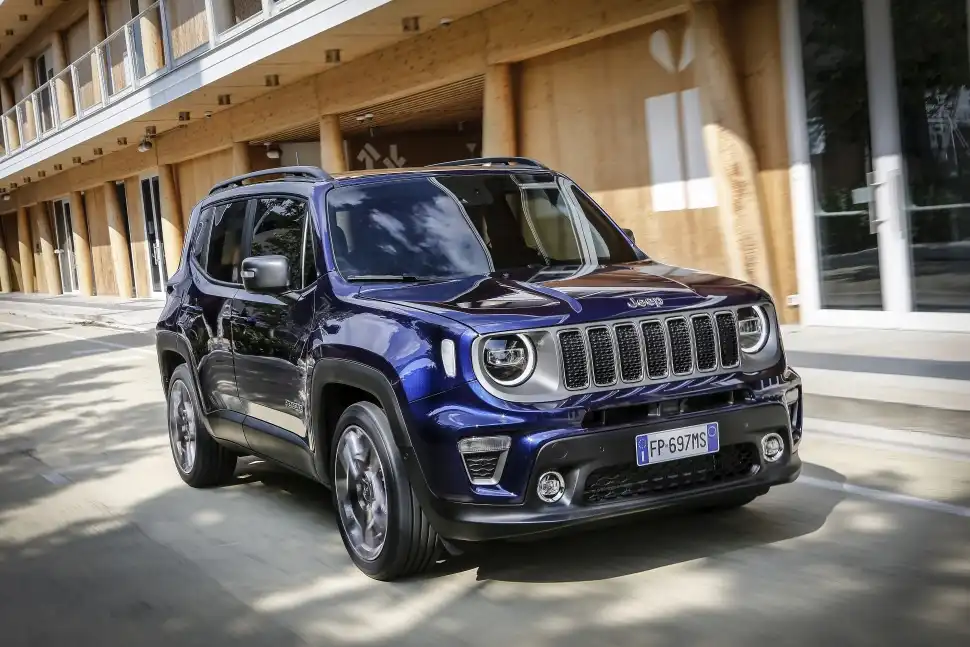
The Jeep Renegade, specifically the facelifted model introduced in 2019 with the 2.4 MultiAir2 Tigershark engine paired with a 9-speed automatic transmission and four-wheel drive (4×4), represents a significant offering in the subcompact SUV segment for the North American market. This variant arrived as part of the broader Renegade refresh, building upon the initial launch of the model in 2014. Positioned as a mid-range option within the Renegade lineup, it aimed to provide a balance of capability, fuel efficiency, and modern features for buyers seeking a versatile and stylish vehicle. The Renegade, built in Italy, was a key component of Jeep’s strategy to expand its reach into a more accessible price point and attract a younger demographic.
Powertrain & Engine Architecture
The heart of this Renegade variant is the 2.4-liter MultiAir2 Tigershark inline-four cylinder engine. This engine, designated with code 50052375, utilizes Fiat Chrysler Automobiles’ (FCA) MultiAir technology, a fully variable valve lift system. MultiAir electro-hydraulically controls the opening and closing of the intake valves, allowing for optimized combustion efficiency and reduced emissions. The engine features a single overhead camshaft (SOHC) design and multi-port fuel injection. It produces 182 horsepower at 6400 rpm and 174.8 lb-ft of torque at 3900 rpm. Paired with this engine is a ZF-sourced 9-speed automatic transmission, designed to improve fuel economy and provide smooth shifting. This transmission offers a wide gear ratio spread, contributing to both acceleration and highway cruising efficiency. The 4×4 system is typically an Active Drive Low system, providing automatic engagement of the rear axle when traction is needed.
Driving Characteristics
The 2.4L Tigershark engine with the 9-speed automatic delivers adequate, though not exhilarating, performance. Acceleration is reasonable for everyday driving, but the Renegade doesn’t feel particularly quick. The 9-speed transmission, while offering a wide range, can sometimes exhibit hesitant or jerky shifts, particularly at lower speeds. Compared to the available 1.4L turbocharged engine, the 2.4L provides more consistent power delivery across the rev range, but lacks the turbocharged engine’s initial burst of acceleration. Compared to a manual transmission equipped Renegade, the automatic sacrifices some driver engagement and responsiveness. The 4×4 system provides enhanced traction in inclement weather and on light off-road trails, making it a capable all-weather vehicle.
Equipment & Trim Levels
The 2.4L MultiAir2 Tigershark 4×4 Automatic was typically offered in mid-level trim configurations, such as the Latitude and Limited. Standard features generally included air conditioning, a 7-inch touchscreen infotainment system with Apple CarPlay and Android Auto compatibility, a rearview camera, and keyless entry. Higher trims added features like leather upholstery, heated front seats, a larger touchscreen display, and advanced safety technologies such as blind-spot monitoring and rear cross-path detection. Optional extras included a panoramic sunroof, premium audio systems, and various appearance packages.
Chassis & Braking
The Renegade utilizes a unibody construction. The front suspension consists of an independent McPherson strut setup with coil springs and an anti-roll bar, while the rear suspension employs an independent coil spring design. Brakes are ventilated discs at the front and solid discs at the rear. The steering system is an electric power-assisted rack and pinion setup. The Renegade’s relatively short wheelbase and compact dimensions contribute to its maneuverability in urban environments. Ground clearance of 7.99 inches provides reasonable off-road capability.
Market Reception & Comparison
Critics generally praised the Renegade’s distinctive styling and available four-wheel drive system. However, the 2.4L engine and 9-speed automatic combination received mixed reviews. Some testers found the powertrain to be adequate for daily driving, while others criticized its lack of refinement and occasional transmission quirks. Fuel economy was considered average for the segment. Compared to competitors like the Honda HR-V and Mazda CX-5, the Renegade offered a more rugged aesthetic and a more capable 4×4 system, but often fell short in terms of driving dynamics and interior quality.
Legacy
The 2.4L MultiAir2 Tigershark engine, while generally reliable, has been known to exhibit issues with oil consumption and the MultiAir valve control system in some cases. Regular maintenance, including oil changes and inspections of the MultiAir system, is crucial for long-term reliability. On the used car market, the 2019-2021 Renegade with this powertrain represents a relatively affordable entry point into Jeep ownership. Its combination of style, capability, and available features continues to appeal to buyers seeking a versatile and distinctive subcompact SUV.