
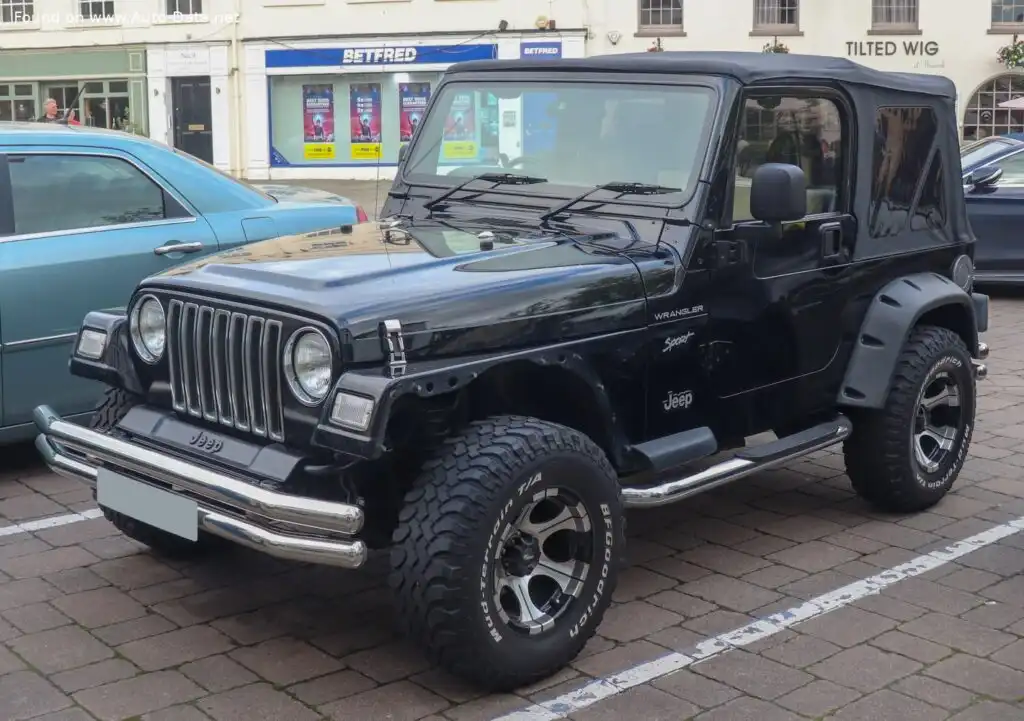
The Jeep Wrangler TJ, produced from 1997 through 2006, represented a significant leap forward for the iconic off-road vehicle. Replacing the YJ model, the TJ brought back the round headlights that had become synonymous with the Wrangler nameplate, appealing to enthusiasts who favored the classic look. The 2.5-liter inline-four cylinder engine, producing 118 horsepower, was offered throughout the TJ’s production run and served as the entry-level powertrain option. This variant, typically paired with a five-speed manual transmission (though an automatic was available), occupied the base trim level, focusing on affordability and core off-road capability rather than luxury or high performance. Production of the 2.5i model spanned from 1997 to 2000, before being offered alongside the 4.0L engine.
Technical Specifications
| Brand | Jeep |
| Model | Wrangler |
| Generation | Wrangler II (TJ) |
| Type (Engine) | 2.5 i (118 Hp) |
| Start of production | 1997 |
| End of production | 2000 |
| Powertrain Architecture | Internal Combustion engine |
| Body type | Off-road vehicle |
| Seats | 5 |
| Doors | 2 |
| Fuel consumption (urban) | 15 l/100 km (15.7 US mpg, 18.8 UK mpg, 6.7 km/l) |
| Fuel consumption (extra urban) | 8.9 l/100 km (26.4 US mpg, 31.7 UK mpg, 11.2 km/l) |
| Fuel Type | Petrol (Gasoline) |
| Acceleration 0 – 100 km/h | 14.8 sec |
| Acceleration 0 – 62 mph | 14.8 sec |
| Acceleration 0 – 60 mph | 14.1 sec |
| Maximum speed | 142 km/h (88.23 mph) |
| Weight-to-power ratio | 12.8 kg/Hp, 78.1 Hp/tonne |
| Weight-to-torque ratio | 7.6 kg/Nm, 131.1 Nm/tonne |
| Power | 118 Hp @ 5200 rpm |
| Power per litre | 47.9 Hp/l |
| Torque | 198 Nm @ 3450 rpm (146.04 lb.-ft. @ 3450 rpm) |
| Engine layout | Front, Longitudinal |
| Engine Model/Code | P00 |
| Engine displacement | 2464 cm3 (150.36 cu. in.) |
| Number of cylinders | 4 |
| Engine configuration | Inline |
| Cylinder Bore | 98.4 mm (3.87 in.) |
| Piston Stroke | 81 mm (3.19 in.) |
| Compression ratio | 9.2:1 |
| Number of valves per cylinder | 2 |
| Fuel injection system | Multi-port manifold injection |
| Engine aspiration | Naturally aspirated engine |
| Engine oil capacity | 3.8 l (4.02 US qt | 3.34 UK qt) |
| Coolant | 8.5 l (8.98 US qt | 7.48 UK qt) |
| Kerb Weight | 1510 kg (3328.98 lbs.) |
| Max. weight | 1925 kg (4243.9 lbs.) |
| Max load | 415 kg (914.92 lbs.) |
| Trunk (boot) space – minimum | 1925 l (67.98 cu. ft.) |
| Trunk (boot) space – maximum | 2000 l (70.63 cu. ft.) |
| Fuel tank capacity | 72 l (19.02 US gal | 15.84 UK gal) |
| Length | 3883 mm (152.87 in.) |
| Width | 1740 mm (68.5 in.) |
| Height | 1748 mm (68.82 in.) |
| Wheelbase | 2373 mm (93.43 in.) |
| Front track | 1473 mm (57.99 in.) |
| Rear (Back) track | 1473 mm (57.99 in.) |
| Drive wheel | All wheel drive (4×4) |
| Number of gears | 5 gears, manual transmission |
| Front suspension | Coil spring |
| Rear suspension | Coil spring |
| Front brakes | Ventilated discs |
| Rear brakes | Drum |
| Assisting systems | ABS (Anti-lock braking system) |
| Steering type | Steering rack and pinion |
| Power steering | Hydraulic Steering |
| Tires size | 215/75 R15 |
Powertrain & Engine Architecture
The heart of the 2.5i Wrangler TJ is the 2.5-liter (2464 cc) inline-four cylinder engine, designated as the P00 engine code. This engine, a descendant of AMC’s long-running 150 cubic inch four-cylinder, featured a cast iron block and aluminum cylinder head. It utilized a multi-port fuel injection system, providing adequate fuel delivery for the engine’s modest power output. The engine’s valvetrain consisted of two valves per cylinder, operated by a single overhead camshaft. The 2.5L engine was known for its simplicity and durability, though it lacked the refinement and power of the optional 4.0-liter inline-six. The standard transmission for this variant was a five-speed manual, though a three-speed automatic transmission was available as an option. The automatic, while offering convenience, further diminished the already modest acceleration performance.
Driving Characteristics
The 2.5-liter Wrangler TJ, particularly when equipped with the manual transmission, offered a utilitarian driving experience. Acceleration was slow, with 0-60 mph times hovering around 14 seconds. The engine required frequent downshifting to maintain momentum, especially when climbing hills or carrying a load. The automatic transmission exacerbated this issue, resulting in sluggish performance and a tendency to hunt for gears. However, the engine’s low-end torque proved adequate for most off-road situations, allowing for controlled crawling over obstacles. The Wrangler’s short wheelbase and solid axles provided exceptional articulation and maneuverability on challenging terrain. Compared to the 4.0L models, the 2.5i felt noticeably underpowered, especially on the highway.
Equipment & Trim Levels
The 2.5-liter Wrangler TJ typically came with a basic level of equipment. Standard features included manual windows and locks, a basic AM/FM radio, and vinyl upholstery. Air conditioning was often an optional extra. The interior was designed for practicality and ease of cleaning, with minimal frills. Higher trim levels, such as the Sport and Sahara, offered additional features like upgraded upholstery, alloy wheels, and a premium sound system. However, the base 2.5i model focused on providing a capable and affordable off-road vehicle.
Chassis & Braking
The Wrangler TJ utilized a body-on-frame construction, providing a robust and durable platform for off-road adventures. The suspension consisted of coil springs at all four corners, offering a comfortable ride on paved roads and excellent articulation off-road. The front brakes were ventilated discs, while the rear brakes were drums. This configuration was adequate for the vehicle’s weight and performance, but lacked the stopping power of the disc brakes found on higher trim levels. A stabilizer bar was fitted to the front suspension to reduce body roll during cornering.
Market Reception & Comparison
The 2.5-liter Wrangler TJ was generally well-received as an affordable and capable entry-level off-road vehicle. Critics acknowledged its limitations in terms of power and refinement, but praised its ruggedness and off-road prowess. Compared to the 4.0-liter models, the 2.5i offered better fuel economy, but at the expense of performance. The 2.5L engine was often seen as a good choice for drivers who primarily used their Wrangler for casual off-roading or as a daily driver, while the 4.0L was preferred by those who demanded more power and performance. The 2.5i was also more affordable to purchase and maintain than its larger-engined siblings.
Legacy
The 2.5-liter Wrangler TJ powertrain has proven to be remarkably durable and reliable over the years. While not known for its blistering speed, the engine is capable of racking up high mileage with proper maintenance. Today, the 2.5i Wrangler TJ remains a popular choice in the used car market, particularly among those seeking an affordable and capable off-road vehicle. Its simplicity and ease of repair make it an attractive option for DIY mechanics. While it may not offer the same level of performance or refinement as more modern SUVs, the 2.5i Wrangler TJ continues to embody the spirit of the original Jeep, offering a rugged and capable off-road experience.
