
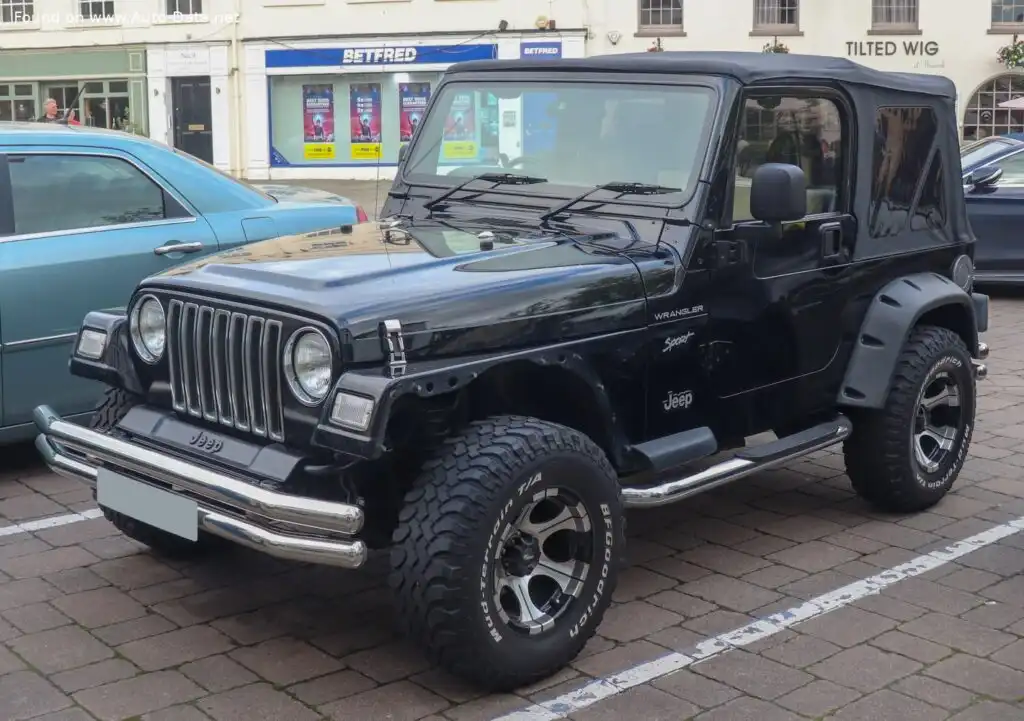
The Jeep Wrangler TJ, produced from 1997 to 2006, represented a significant leap forward for the iconic off-road vehicle. The 2.5-liter inline-four cylinder variant, available from 2000 to 2003, offered a more affordable entry point into the Wrangler lineup. This model, designated internally as the TJ, moved away from the previous YJ generation’s solid front axle and incorporated coil spring suspension, dramatically improving on-road ride quality while maintaining the Wrangler’s legendary off-road capability. The 2.5i (121 hp) model served as the base engine option, appealing to buyers prioritizing utility and affordability over outright performance. It was primarily sold in the North American market, where the Wrangler held a unique position as a highly customizable and capable off-road vehicle with a strong cultural following.
Technical Specifications
| Brand | Jeep |
| Model | Wrangler |
| Generation | Wrangler II (TJ) |
| Type (Engine) | 2.5 i (121 Hp) |
| Start of production | 2000 year |
| End of production | 2003 year |
| Powertrain Architecture | Internal Combustion engine |
| Body type | Off-road vehicle |
| Seats | 4 |
| Doors | 3 |
| Fuel consumption (economy) – urban | 12.4 l/100 km (19 US mpg, 22.8 UK mpg, 8.1 km/l) |
| Fuel consumption (economy) – extra urban | 11.2 l/100 km (21 US mpg, 25.2 UK mpg, 8.9 km/l) |
| Fuel Type | Petrol (Gasoline) |
| Acceleration 0 – 100 km/h | 11 sec |
| Acceleration 0 – 62 mph | 11 sec |
| Acceleration 0 – 60 mph | 10.5 sec |
| Maximum speed | 144 km/h (89.48 mph) |
| Weight-to-power ratio | 11.9 kg/Hp, 84.3 Hp/tonne |
| Weight-to-torque ratio | 7.6 kg/Nm, 132.4 Nm/tonne |
| Power | 121 Hp @ 5400 rpm |
| Power per litre | 49.1 Hp/l |
| Torque | 190 Nm @ 3500 rpm (140.14 lb.-ft. @ 3500 rpm) |
| Engine layout | Front, Longitudinal |
| Engine displacement | 2464 cm3 (150.36 cu. in.) |
| Number of cylinders | 4 |
| Engine configuration | Inline |
| Cylinder Bore | 98.4 mm (3.87 in.) |
| Piston Stroke | 81 mm (3.19 in.) |
| Compression ratio | 9.2:1 |
| Number of valves per cylinder | 2 |
| Fuel injection system | Multi-port manifold injection |
| Engine aspiration | Naturally aspirated engine |
| Engine oil capacity | 3.8 l (4.02 US qt | 3.34 UK qt) |
| Coolant | 8.5 l (8.98 US qt | 7.48 UK qt) |
| Kerb Weight | 1435 kg (3163.63 lbs.) |
| Max. weight | 1925 kg (4243.9 lbs.) |
| Max load | 490 kg (1080.27 lbs.) |
| Trunk (boot) space – minimum | 315 l (11.12 cu. ft.) |
| Trunk (boot) space – maximum | 1515 l (53.5 cu. ft.) |
| Fuel tank capacity | 57 l (15.06 US gal | 12.54 UK gal) |
| Length | 3886 mm (152.99 in.) |
| Width | 1693 mm (66.65 in.) |
| Height | 1767 mm (69.57 in.) |
| Wheelbase | 2373 mm (93.43 in.) |
| Front track | 1473 mm (57.99 in.) |
| Rear (Back) track | 1473 mm (57.99 in.) |
| Drive wheel | All wheel drive (4×4) |
| Number of gears and type of gearbox | 5 gears, manual transmission |
| Front suspension | Coil spring |
| Rear suspension | Coil spring |
| Front brakes | Ventilated discs |
| Rear brakes | Drum |
| Assisting systems | ABS (Anti-lock braking system) |
| Power steering | Hydraulic Steering |
| Tires size | 205/75 R15 |
Powertrain & Engine Architecture
The heart of the 2.5i Wrangler TJ is the 2.5-liter (2464 cc) inline-four cylinder engine. This engine, internally known as the 4.0L PowerTech despite its 2.5L displacement, is a relatively simple and robust design. It features a cast iron block and aluminum cylinder head, utilizing a multi-port fuel injection system for fuel delivery. The engine employs a single overhead camshaft (SOHC) design with two valves per cylinder. The 2.5L engine produced 121 horsepower at 5400 rpm and 190 lb-ft of torque at 3500 rpm. This engine was paired with a standard five-speed manual transmission. The transmission featured relatively deep gear ratios, optimized for low-speed crawling and off-road traction. While an automatic transmission was available, it was a three-speed unit, further impacting performance.
Driving Characteristics
The 2.5-liter engine and five-speed manual transmission combination in the Wrangler TJ provided adequate, but not exhilarating, performance. Acceleration from 0-60 mph took around 10.5 seconds, and top speed was limited to approximately 89 mph. The engine’s torque curve was relatively flat, providing usable power across a wide RPM range, which was beneficial for off-road driving. However, on the highway, the engine could feel strained when passing or climbing hills. Compared to the optional 4.0-liter inline-six engine, the 2.5L offered significantly less power and refinement. The 4.0L provided a more relaxed driving experience, especially at highway speeds. The three-speed automatic transmission further diminished performance, resulting in slower acceleration and less engine braking. The deep gear ratios of the manual transmission, while excellent for off-roading, meant higher engine speeds at highway cruising, contributing to increased noise and fuel consumption.
Equipment & Trim Levels
The 2.5i Wrangler TJ typically came with a relatively basic level of equipment. Standard features included air conditioning, a tilt steering wheel, and cloth upholstery. The interior was utilitarian in design, prioritizing durability and ease of cleaning over luxury. Options included a CD player, upgraded sound system, and power windows and locks. The SE trim level, a popular upgrade, added features like alloy wheels, upgraded interior trim, and a premium sound system. The Sahara trim offered even more luxury features, including leather upholstery and a body-colored hardtop. The 2.5i model was often chosen by buyers who intended to heavily modify their Wrangler for off-road use, as the base model provided a cost-effective platform for customization.
Chassis & Braking
The Wrangler TJ represented a significant improvement in ride quality compared to its predecessor, thanks to the adoption of coil spring suspension. The front suspension utilized a multi-link design, while the rear featured a solid axle with coil springs. This setup provided improved articulation for off-road driving while also offering a more comfortable ride on paved roads. The braking system consisted of ventilated discs at the front and drum brakes at the rear. ABS was standard equipment. The steering was hydraulically assisted, providing relatively easy maneuverability. The Wrangler TJ’s relatively narrow track width and high center of gravity contributed to a noticeable degree of body roll in corners.
Market Reception & Comparison
The 2.5i Wrangler TJ was generally well-received as an affordable and capable off-road vehicle. Critics praised its improved ride quality compared to the YJ generation, as well as its rugged durability. However, the 2.5-liter engine was often criticized for its lack of power, particularly when paired with the automatic transmission. Fuel economy was average for its class, with EPA estimates of around 19 mpg city and 21 mpg highway. Compared to the 4.0-liter inline-six engine, the 2.5L offered lower purchase price but compromised performance. The 2.5L model was often seen as a good choice for buyers who primarily used their Wrangler for casual off-roading or as a daily driver, while the 4.0L was preferred by those who demanded more power and refinement.
Legacy
The 2.5-liter engine in the Wrangler TJ is known for its reliability and durability. With proper maintenance, these engines can easily exceed 200,000 miles. However, they are not without their potential issues. Common problems include oil leaks, particularly from the valve cover and rear main seal, and occasional issues with the fuel injection system. In the used car market, the 2.5i Wrangler TJ remains a popular choice for budget-minded buyers looking for a capable and iconic off-road vehicle. Its affordability and simplicity make it a good option for those who enjoy working on their own vehicles. The TJ generation, as a whole, is highly regarded by Jeep enthusiasts for its blend of classic Jeep styling and modern features.
