
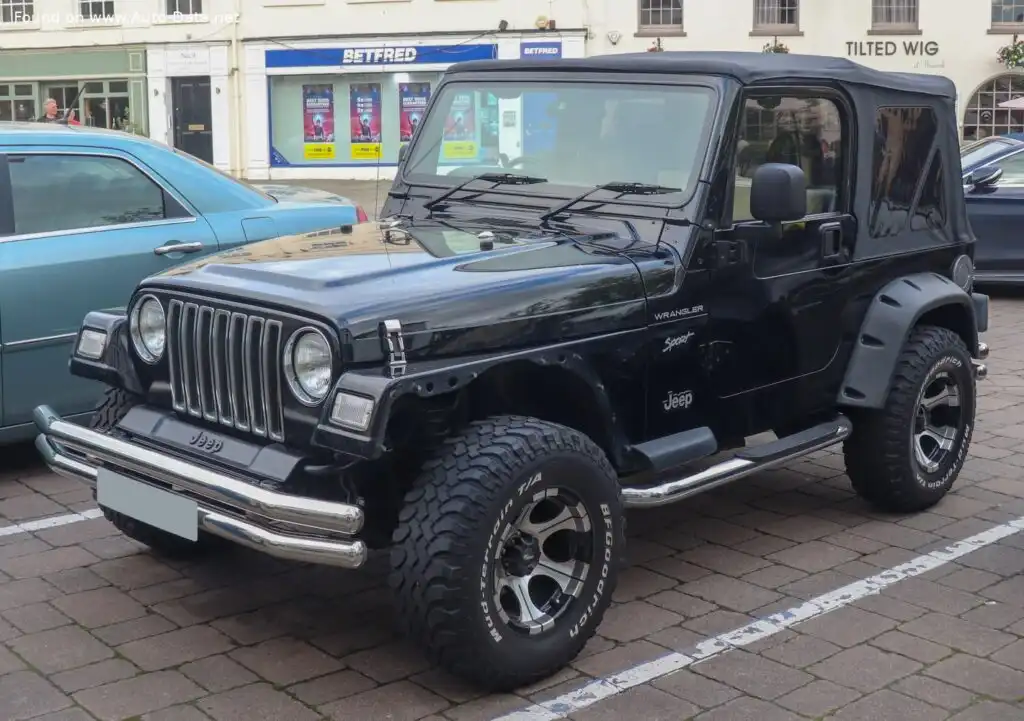
The Jeep Wrangler TJ, produced from 1997 to 2006, represented a significant leap forward for the iconic off-road vehicle. The 2.5-liter inline-four cylinder variant, often equipped with a soft top, was a mainstay of the TJ lineup from 2000-2006. This model served as the entry point into the Wrangler world, offering a balance of affordability, capability, and the classic Jeep experience. It was positioned below the more powerful 4.0L inline-six and, later, the 4.2L, catering to buyers prioritizing fuel economy and everyday usability over outright performance. The TJ generation marked a return to the round headlights that had become synonymous with the Wrangler nameplate, after the square headlights of the YJ model.
Technical Specifications
| Brand | Jeep |
| Model | Wrangler |
| Generation | Wrangler II (TJ) |
| Type | 2.5 i Soft Top (118 Hp) |
| Start of production | 2000 year |
| End of production | 2006 year |
| Powertrain Architecture | Internal Combustion engine |
| Body type | Off-road vehicle |
| Seats | 4 |
| Doors | 2 |
| Fuel consumption (urban) | 15 l/100 km (15.7 US mpg, 18.8 UK mpg, 6.7 km/l) |
| Fuel consumption (extra urban) | 8.9 l/100 km (26.4 US mpg, 31.7 UK mpg, 11.2 km/l) |
| Fuel Type | Petrol (Gasoline) |
| Acceleration 0 – 100 km/h | 14.8 sec |
| Acceleration 0 – 62 mph | 14.8 sec |
| Acceleration 0 – 60 mph | 14.1 sec |
| Maximum speed | 142 km/h (88.23 mph) |
| Weight-to-power ratio | 12.2 kg/Hp, 82.2 Hp/tonne |
| Weight-to-torque ratio | 7.2 kg/Nm, 138 Nm/tonne |
| Power | 118 Hp @ 5200 rpm |
| Power per litre | 47.9 Hp/l |
| Torque | 198 Nm @ 3450 rpm (146.04 lb.-ft. @ 3450 rpm) |
| Engine layout | Front, Longitudinal |
| Engine Model/Code | P00 |
| Engine displacement | 2464 cm3 (150.36 cu. in.) |
| Number of cylinders | 4 |
| Engine configuration | Inline |
| Cylinder Bore | 98.4 mm (3.87 in.) |
| Piston Stroke | 81 mm (3.19 in.) |
| Compression ratio | 9.2:1 |
| Number of valves per cylinder | 2 |
| Fuel injection system | Multi-port manifold injection |
| Engine aspiration | Naturally aspirated engine |
| Engine oil capacity | 3.8 l (4.02 US qt | 3.34 UK qt) |
| Coolant capacity | 8.5 l (8.98 US qt | 7.48 UK qt) |
| Kerb Weight | 1435 kg (3163.63 lbs.) |
| Max. weight | 1925 kg (4243.9 lbs.) |
| Max load | 490 kg (1080.27 lbs.) |
| Trunk (boot) space – minimum | 326 l (11.51 cu. ft.) |
| Trunk (boot) space – maximum | 1563 l (55.2 cu. ft.) |
| Fuel tank capacity | 72 l (19.02 US gal | 15.84 UK gal) |
| Length | 3886 mm (152.99 in.) |
| Width | 1693 mm (66.65 in.) |
| Height | 1805 mm (71.06 in.) |
| Wheelbase | 2373 mm (93.43 in.) |
| Front track | 1473 mm (57.99 in.) |
| Rear track | 1473 mm (57.99 in.) |
| Drive wheel | All wheel drive (4×4) |
| Number of gears | 5 gears, manual transmission |
| Front suspension | Coil spring |
| Rear suspension | Coil spring |
| Front brakes | Ventilated discs |
| Rear brakes | Drum |
| Power steering | Hydraulic Steering |
| Tires size | 215/75 R15 |
Powertrain & Engine Architecture
The heart of the 2.5i Wrangler TJ is the 2.5-liter (2464 cc) inline-four cylinder engine, designated the P00 engine code. This engine is a relatively simple design, featuring a cast iron block and aluminum cylinder head. It utilizes a multi-port fuel injection system, providing adequate fuel delivery for its modest power output. The engine employs a single overhead camshaft (SOHC) design with two valves per cylinder. This configuration prioritized simplicity and reliability over high-performance breathing. The 5-speed manual transmission was the standard offering, providing a reasonable spread of gears for both on-road cruising and off-road crawling. The transmission was chosen for its durability and relatively low cost, aligning with the entry-level positioning of this Wrangler variant.
Driving Characteristics
The 118 horsepower and 146 lb-ft of torque produced by the 2.5L engine resulted in a leisurely driving experience. Acceleration was not a strong point, with 0-60 mph times hovering around 14.1 seconds. However, the engine’s torque curve was relatively flat, providing usable power at lower RPMs, which was beneficial for off-road situations. The manual transmission allowed for precise control, but required frequent shifting to maintain momentum, especially when climbing hills or carrying a load. Compared to the 4.0L inline-six, the 2.5L felt noticeably underpowered, particularly at highway speeds. However, the lighter engine weight contributed to slightly improved handling and fuel economy.
Equipment & Trim Levels
The 2.5L Wrangler TJ typically came with a fairly basic level of equipment. Standard features included a soft top, manual windows and locks, and a basic AM/FM radio. The interior was utilitarian, with durable cloth upholstery and plastic trim. Optional extras included air conditioning, a CD player, upgraded speakers, and a tow package. The SE trim level added some additional features, such as color-matched fender flares and upgraded interior trim. The focus was on providing a functional and affordable off-road vehicle, rather than luxury or refinement.
Chassis & Braking
The Wrangler TJ utilized a body-on-frame construction, providing excellent durability and off-road capability. The suspension consisted of coil springs at all four corners, offering a comfortable ride on and off-road. Front brakes were ventilated discs, providing adequate stopping power, while rear brakes were drums. This configuration was a cost-saving measure, but sufficient for the vehicle’s weight and intended use. The standard tire size was 215/75R15, providing a good balance of on-road comfort and off-road traction. A stabilizer bar was fitted to the front suspension to reduce body roll during cornering.
Market Reception & Comparison
The 2.5L Wrangler TJ was generally well-received as an affordable and capable entry-level off-road vehicle. Critics praised its ruggedness, simplicity, and off-road prowess. However, the engine’s lack of power was a common complaint. Compared to the 4.0L inline-six, the 2.5L offered significantly lower performance, but also better fuel economy. The 2.5L was a popular choice for buyers who primarily used their Wrangler for commuting and light off-roading, while the 4.0L was preferred by those who demanded more power for serious off-road adventures.
Legacy
The 2.5L engine in the TJ Wrangler is known for its reliability and durability. While not a powerhouse, it is a relatively simple engine that is easy to maintain and repair. Today, these Wranglers are popular in the used car market, particularly among those looking for an affordable and capable off-road vehicle. The 2.5L variant remains a viable option for those who prioritize simplicity, reliability, and fuel economy over outright performance. Parts availability is generally good, and the engine is relatively inexpensive to rebuild. The TJ generation, as a whole, is considered a highly desirable Wrangler model, and the 2.5L variant offers a unique entry point into the world of Jeep ownership.
