
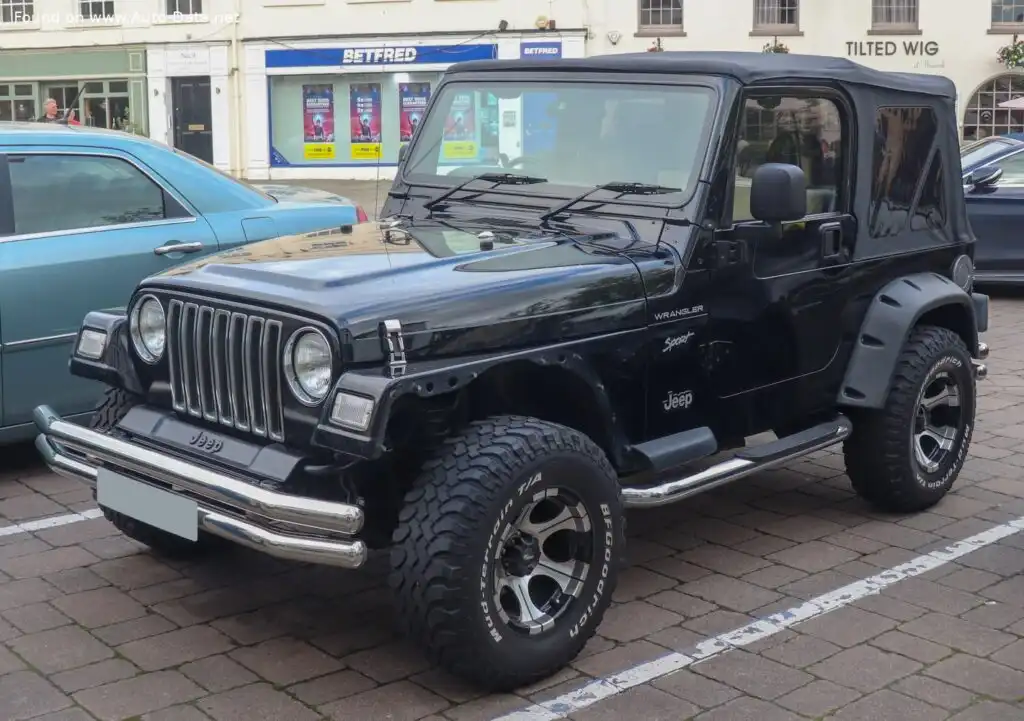
The Jeep Wrangler TJ, produced from 1997 to 2006, represented a significant leap forward for the iconic off-road vehicle. The 4.0i variant, equipped with the 4.0-liter inline-six engine and a four-speed automatic transmission, was a mainstay of the TJ lineup from 2000 through 2006. This configuration aimed to provide a balance of capability and convenience, appealing to a broader range of drivers than the manual transmission options. It occupied a mid-range position within the TJ family, offering more power and refinement than the base 2.5-liter four-cylinder models, but remaining more accessible than the more specialized Rubicon trims.
Technical Specifications
| Brand | Jeep |
| Model | Wrangler |
| Generation | Wrangler II (TJ) |
| Type (Engine) | 4.0 i (183 Hp) Automatic |
| Start of production | 2000 year |
| End of production | 2006 year |
| Powertrain Architecture | Internal Combustion engine |
| Body type | Off-road vehicle |
| Seats | 4 |
| Doors | 2 |
| Fuel consumption (urban) | 15.7 l/100 km (15 US mpg / 18 UK mpg) |
| Fuel consumption (extra urban) | 13.1 l/100 km (18 US mpg / 21.6 UK mpg) |
| Fuel Type | Petrol (Gasoline) |
| Acceleration 0 – 100 km/h | 9.5 sec |
| Acceleration 0 – 62 mph | 9.5 sec |
| Acceleration 0 – 60 mph | 9 sec |
| Maximum speed | 160 km/h (99.42 mph) |
| Weight-to-power ratio | 8.2 kg/Hp |
| Weight-to-torque ratio | 5 kg/Nm |
| Power | 183 Hp @ 4600 rpm |
| Torque | 301 Nm @ 2800 rpm (222.01 lb.-ft. @ 2800 rpm) |
| Engine layout | Front, Longitudinal |
| Engine Model/Code | ERH |
| Engine displacement | 3956 cm3 (241.41 cu. in.) |
| Number of cylinders | 6 |
| Engine configuration | Inline |
| Cylinder Bore | 98.4 mm (3.87 in.) |
| Piston Stroke | 86.7 mm (3.41 in.) |
| Compression ratio | 8.8:1 |
| Number of valves per cylinder | 2 |
| Fuel injection system | Multi-port manifold injection |
| Engine aspiration | Naturally aspirated |
| Engine oil capacity | 5.7 l (6.02 US qt / 5.02 UK qt) |
| Coolant capacity | 9.9 l (10.46 US qt / 8.71 UK qt) |
| Kerb Weight | 1495 kg (3295.91 lbs.) |
| Max. weight | 1965 kg (4332.08 lbs.) |
| Max load | 470 kg (1036.17 lbs.) |
| Trunk (boot) space – minimum | 315 l (11.12 cu. ft.) |
| Trunk (boot) space – maximum | 1515 l (53.5 cu. ft.) |
| Fuel tank capacity | 57 l (15.06 US gal / 12.54 UK gal) |
| Length | 3886 mm (152.99 in.) |
| Width | 1693 mm (66.65 in.) |
| Height | 1767 mm (69.57 in.) |
| Wheelbase | 2373 mm (93.43 in.) |
| Front track | 1473 mm (57.99 in.) |
| Rear track | 1473 mm (57.99 in.) |
| Drive wheel | All wheel drive (4×4) |
| Number of gears | 3 |
| Gearbox type | Automatic transmission |
| Front suspension | Coil spring |
| Rear suspension | Coil spring |
| Front brakes | Ventilated discs |
| Rear brakes | Drum |
| Power steering | Hydraulic |
| Tires size | 215/75 R15 |
| Wheel rims size | 15 |
Introduction
The Jeep Wrangler TJ 4.0i Automatic, produced between 2000 and 2006, was a popular iteration of the TJ generation (1997-2006). The TJ marked a return to Jeep’s roots with its coil-spring suspension and more refined interior compared to its predecessor, the YJ. The 4.0-liter inline-six engine, paired with a four-speed automatic transmission, provided a comfortable and capable driving experience, making it a versatile choice for both daily driving and off-road adventures. This combination was particularly well-suited for drivers who preferred the ease of an automatic transmission without sacrificing significant performance.
Powertrain & Engine Architecture
The heart of the Wrangler TJ 4.0i is the 4.0-liter (3956 cc) inline-six cylinder engine, designated the ERH code. This engine, a descendant of the AMC 258 cubic inch inline-six, was known for its durability and relatively simple design. It featured a cast iron block and cylinder head, and utilized a multi-port fuel injection system. The engine produced 183 horsepower at 4600 rpm and 222 lb-ft of torque at 2800 rpm. The four-speed automatic transmission (42RLE) was chosen for its reliability and ease of use. While not as sporty as a manual transmission, it provided smooth shifts and made navigating challenging terrain less demanding. The transmission featured overdrive for improved highway fuel economy.
Driving Characteristics
The 4.0i Automatic Wrangler TJ offered a comfortable and predictable driving experience. The automatic transmission, while not offering the direct control of a manual, provided smooth acceleration and made off-roading less fatiguing. The 4.0-liter engine delivered adequate power for most situations, although it wasn’t particularly quick. Acceleration from 0-60 mph took around 9 seconds. The automatic transmission’s gear ratios were optimized for both on-road cruising and low-speed off-road crawling. Compared to the five-speed manual transmission, the automatic sacrificed some responsiveness, but gained in convenience. The 4.0L engine’s torque curve was relatively flat, providing usable power across a wide range of engine speeds.
Equipment & Trim Levels
The 4.0i Automatic typically came standard with features like air conditioning, a tilt steering wheel, and a basic sound system. Interior upholstery was typically cloth, though leather options were available. Trim levels varied, but generally included options for upgraded sound systems, power windows and locks, and alloy wheels. The Sport trim was the most common, offering a good balance of features and affordability. The Sahara trim added more luxurious touches, such as upgraded interior materials and exterior trim. Optional extras included a tow package, a hardtop, and various off-road accessories.
Chassis & Braking
The Wrangler TJ featured a robust body-on-frame construction, providing excellent durability and off-road capability. The suspension utilized coil springs at all four corners, a significant improvement over the leaf springs of the previous YJ generation. This provided a more comfortable ride and improved articulation for off-road use. The front brakes were ventilated discs, while the rear brakes were drums. Hydraulic power steering was standard. The tires were typically 215/75R15, providing a good balance of on-road comfort and off-road traction.
Market Reception & Comparison
The Wrangler TJ 4.0i Automatic was generally well-received by critics and consumers. It was praised for its off-road capability, comfortable ride, and user-friendly automatic transmission. Compared to the 2.5-liter four-cylinder models, the 4.0i offered significantly more power and refinement. Compared to the Rubicon trim, which featured upgraded axles, a transfer case, and other off-road enhancements, the 4.0i was more affordable and practical for daily driving. Fuel economy was a common criticism, averaging around 15-18 mpg in city driving and 18-21 mpg on the highway. Reliability was generally good, although some owners reported issues with the automatic transmission over the long term.
Legacy
The Jeep Wrangler TJ 4.0i Automatic remains a popular choice in the used car market today. Its robust construction, capable powertrain, and iconic styling have made it a favorite among Jeep enthusiasts. The 4.0-liter inline-six engine is known for its longevity, and with proper maintenance, can provide many years of reliable service. While the four-speed automatic transmission isn’t as sophisticated as modern transmissions, it is relatively simple and durable. The TJ generation, and particularly the 4.0i Automatic variant, represents a sweet spot in the Wrangler lineage, offering a blend of classic Jeep character and modern convenience.
