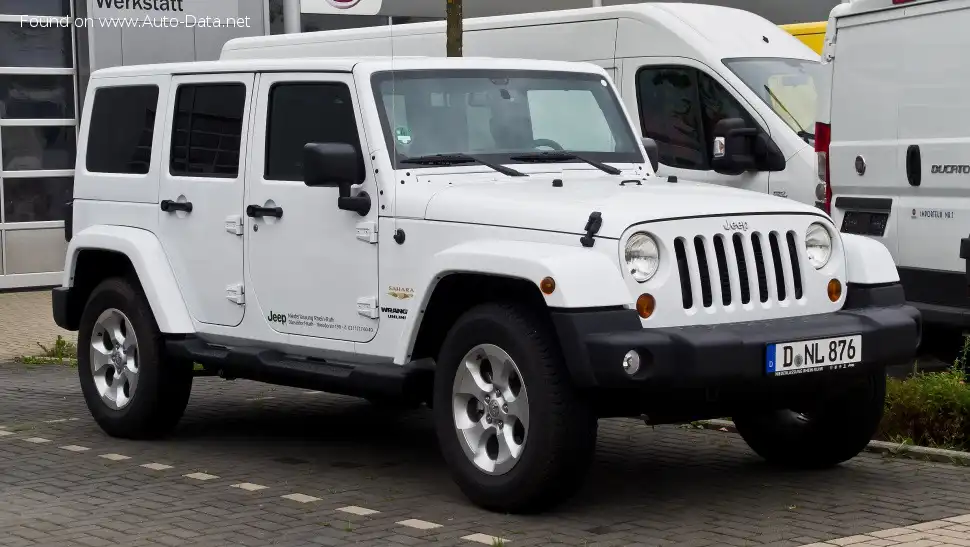
The Jeep Wrangler JK Unlimited Sahara 3.8i V6, produced from 2010 to 2011, represents a significant iteration of the iconic Wrangler lineage. Falling within the third generation (JK) of the Wrangler, the Unlimited designation signifies the four-door configuration, offering increased passenger and cargo space compared to the two-door models. This Sahara trim, powered by the 3.8-liter V6 engine paired with a four-speed automatic transmission, was positioned as a mid-range offering, balancing off-road capability with a degree of comfort and convenience. It served as a popular choice for buyers seeking a versatile vehicle suitable for both daily driving and weekend adventures.
Technical Specifications
| Brand | Jeep |
| Model | Wrangler |
| Generation | Wrangler III Unlimited (JK) |
| Type | Sahara 3.8i V6 12V (202 Hp) 4×4 Automatic |
| Start of production | 2010 |
| End of production | 2011 |
| Powertrain Architecture | Internal Combustion engine |
| Body type | Off-road vehicle |
| Seats | 5 |
| Doors | 4 |
| Fuel consumption (urban) | 15.7 l/100 km (15 US mpg, 18 UK mpg, 6.4 km/l) |
| Fuel consumption (extra urban) | 12.4 l/100 km (19 US mpg, 22.8 UK mpg, 8.1 km/l) |
| Fuel consumption (combined) | 13.8 l/100 km (17 US mpg, 20.5 UK mpg, 7.2 km/l) |
| Fuel Type | Petrol (Gasoline) |
| Weight-to-power ratio | 9.9 kg/Hp, 101.5 Hp/tonne |
| Weight-to-torque ratio | 6.2 kg/Nm, 161.2 Nm/tonne |
| Power | 202 Hp @ 5000 rpm |
| Power per litre | 53.5 Hp/l |
| Torque | 321 Nm @ 4000 rpm (236.76 lb.-ft. @ 4000 rpm) |
| Engine layout | Front, Longitudinal |
| Engine Model/Code | EGT |
| Engine displacement | 3778 cm3 (230.55 cu. in.) |
| Number of cylinders | 6 |
| Engine configuration | V-engine |
| Cylinder Bore | 96 mm (3.78 in.) |
| Piston Stroke | 87 mm (3.43 in.) |
| Compression ratio | 9.6:1 |
| Number of valves per cylinder | 2 |
| Fuel injection system | Multi-port manifold injection |
| Engine aspiration | Naturally aspirated engine |
| Valvetrain | OHV |
| Engine oil capacity | 5.7 l (6.02 US qt | 5.02 UK qt) |
| Coolant capacity | 12 l (12.68 US qt | 10.56 UK qt) |
| Kerb Weight | 1991 kg (4389.4 lbs.) |
| Max. weight | 2475 kg (5456.44 lbs.) |
| Max load | 484 kg (1067.04 lbs.) |
| Trunk (boot) space – maximum | 2322 l (82 cu. ft.) |
| Fuel tank capacity | 85 l (22.45 US gal | 18.7 UK gal) |
| Length | 4404 mm (173.39 in.) |
| Width | 1877 mm (73.9 in.) |
| Height | 1836 mm (72.28 in.) |
| Wheelbase | 2946 mm (115.98 in.) |
| Front track | 1572 mm (61.89 in.) |
| Rear (Back) track | 1572 mm (61.89 in.) |
| Ride height (ground clearance) | 259 mm (10.2 in.) |
| Drag coefficient (Cd) | 0.495 |
| Minimum turning circle (turning diameter) | 12.25 m (40.19 ft.) |
| Approach angle | 44.4° |
| Departure angle | 40.7° |
| Ramp-over (brakeover) angle | 20.9° |
| Drive wheel | All wheel drive (4×4) |
| Number of gears and type of gearbox | 4 gears, automatic transmission |
| Front suspension | Rigid axle suspension |
| Rear suspension | Rigid axle suspension |
| Front brakes | Ventilated discs |
| Rear brakes | Disc |
| Assisting systems | ABS (Anti-lock braking system) |
| Tires size | 255/70 R18 |
| Wheel rims size | 18 |
Powertrain & Engine Architecture
The heart of the JK Unlimited Sahara is the 3.8-liter (230.55 cubic inch) EGT V6 engine. This engine, a descendant of the AMC 199 inline-six, utilizes a 90-degree V-configuration. It features a cast iron block and aluminum cylinder heads, incorporating a single overhead valve (OHV) valvetrain with two valves per cylinder. Fuel delivery is managed by a multi-port fuel injection system, providing adequate, though not exceptional, performance. The engine produces 202 horsepower at 5000 rpm and 236.76 lb-ft of torque at 4000 rpm. The four-speed automatic transmission (42RLE) was a common pairing for this engine, offering relatively smooth shifts but lacking the efficiency of more modern transmissions. This transmission was chosen for its durability and cost-effectiveness, rather than outright performance.
Driving Characteristics
The 3.8L V6 with the four-speed automatic delivers adequate, but not thrilling, performance in the JK Unlimited Sahara. Acceleration is leisurely, and passing maneuvers require planning. The automatic transmission’s gear ratios are geared more towards low-end torque for off-roading than quick acceleration. Compared to the optional 3.6-liter Pentastar V6 introduced in later JK models, or even the manual transmission versions of the 3.8L, this combination feels noticeably less responsive. However, the automatic transmission provides ease of use, particularly in challenging off-road situations, allowing the driver to focus on steering and obstacle negotiation. The low-range gearing, a hallmark of the Wrangler, provides substantial torque multiplication for tackling steep inclines and rocky terrain.
Equipment & Trim Levels
The Sahara trim level, even in its base configuration, offered a good level of standard equipment. This included air conditioning, power windows and locks, cruise control, and a premium audio system. Interior upholstery consisted of cloth seats, though leather was available as an option. The dashboard featured a straightforward layout with easy-to-use controls. Popular optional extras included a power sunroof, upgraded sound system, and various off-road packages featuring heavy-duty axles and suspension components. The Sahara trim also included unique exterior styling cues, such as body-colored fender flares and polished aluminum wheels.
Chassis & Braking
The JK Unlimited Sahara utilizes a robust body-on-frame construction, providing excellent durability and off-road capability. The suspension consists of a solid front and rear axle setup, with coil springs and shock absorbers. The front axle features a stabilizer bar to reduce body roll during on-road driving. Braking duties are handled by ventilated discs at the front and solid discs at the rear. The anti-lock braking system (ABS) is standard, enhancing safety in emergency braking situations. The relatively high ground clearance (10.2 inches) and impressive approach, departure, and breakover angles contribute to the Wrangler’s renowned off-road prowess.
Market Reception & Comparison
The JK Unlimited Sahara 3.8i V6 Automatic received generally positive reviews, particularly for its blend of off-road capability and everyday usability. Critics noted the engine’s adequate power, but often pointed out its lack of refinement compared to competitors. Fuel economy was a common complaint, with the 3.8L V6 proving relatively thirsty. Compared to the manual transmission versions of the same engine, the automatic offered less engaging driving experience but greater convenience. The later introduction of the 3.6-liter Pentastar V6 significantly improved performance and fuel economy, eventually eclipsing the 3.8L in popularity.
Legacy
The 3.8L V6 engine, while not known for its longevity or high performance, proved to be reasonably reliable in the JK Wrangler. Common issues include oil leaks and occasional sensor failures. However, with proper maintenance, these engines can provide many years of service. In the used car market, JK Unlimited Saharas equipped with the 3.8L automatic are generally more affordable than those with the Pentastar V6. They remain popular choices for buyers seeking a capable and iconic off-road vehicle at a reasonable price point. The JK generation, as a whole, is considered a significant step forward for the Wrangler, offering improved on-road manners and comfort without sacrificing its legendary off-road abilities.