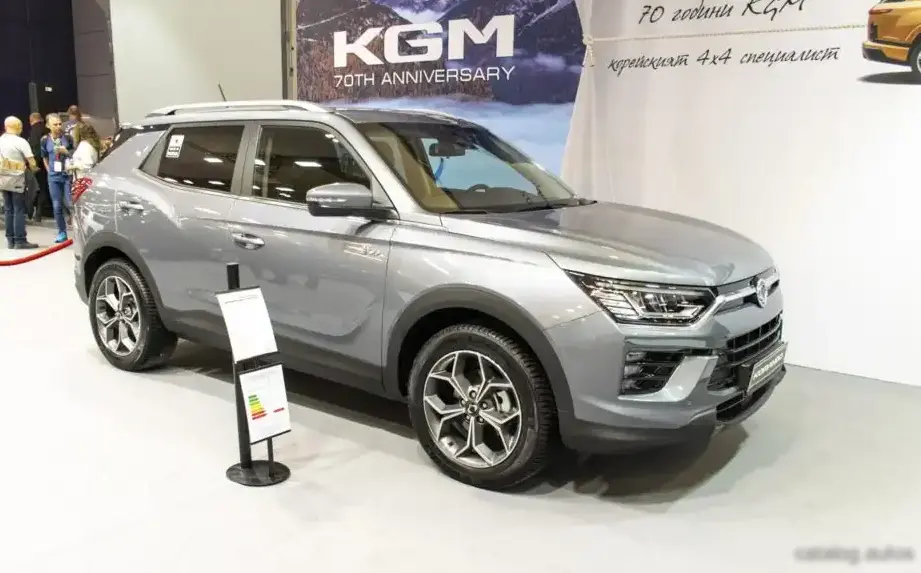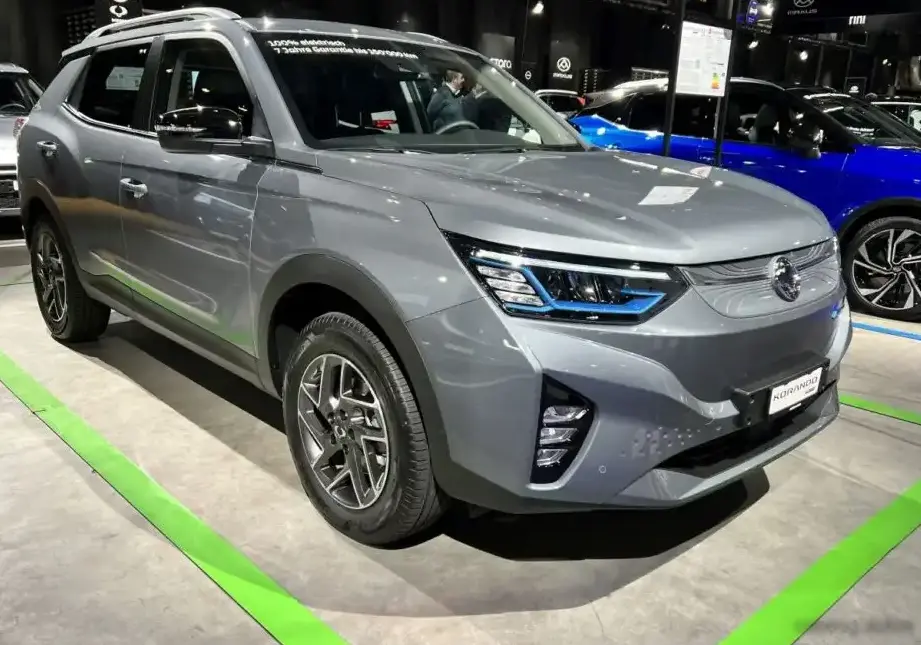
The KGM Korando e-Motion, introduced in 2023, represents KGM’s (formerly SsangYong) foray into the all-electric SUV market. This variant, equipped with a 61.5 kWh battery pack and a 190 horsepower electric motor, is positioned as a mainstream electric offering, aiming to provide a balance of range, performance, and practicality. The e-Motion is built upon the Korando platform, a vehicle already established in the European and Asian markets, but significantly altered to accommodate its fully electric powertrain. It marks a pivotal shift for KGM, signaling their commitment to electrification and a move away from traditional internal combustion engines.
Technical Specifications
| Brand | KGM |
| Model | Korando |
| Type (Engine) | e-Motion 61.5 kWh (190 Hp) |
| Start of production | 2023 |
| Powertrain Architecture | BEV (Electric Vehicle) |
| Body type | SUV |
| Seats | 5 |
| Doors | 5 |
| Fuel Type | Electricity |
| Acceleration 0 – 100 km/h | 8.5 sec |
| Acceleration 0 – 62 mph | 8.5 sec |
| Acceleration 0 – 60 mph | 8.1 sec |
| Maximum speed | 156 km/h (96.93 mph) |
| Weight-to-power ratio | 9.3 kg/Hp, 107.6 Hp/tonne |
| Weight-to-torque ratio | 4.9 kg/Nm, 204 Nm/tonne |
| Gross battery capacity | 61.5 kWh |
| Net (usable) battery capacity | 55.3 kWh |
| Battery voltage | 400 V |
| Battery technology | Lithium-ion (Li-Ion) |
| Battery location | Below the floor |
| All-electric range (WLTP) | 339-346 km (210.64 – 214.99 mi) |
| Average Energy consumption (WLTP) | 16.8-19.4 kWh/100 km (27.04 – 31.22 kWh/100 mi) |
| MPGe | 125 – 108 |
| km/kWh | 6 – 5.2 |
| mi/kWh | 3.7 – 3.2 |
| Electric motor power | 190 Hp |
| Electric motor Torque | 360 Nm (265.52 lb.-ft.) |
| Electric motor location | Front axle, Transverse |
| Electric motor type | Synchronous |
| System power | 190 Hp |
| System torque | 360 Nm (265.52 lb.-ft.) |
| Kerb Weight | 1765-1822 kg (3891.16 – 4016.82 lbs.) |
| Max. weight | 2250 kg (4960.4 lbs.) |
| Max load | 428-485 kg (943.58 – 1069.24 lbs.) |
| Trunk (boot) space – minimum | 551 l (19.46 cu. ft.) |
| Trunk (boot) space – maximum | 1248 l (44.07 cu. ft.) |
| Permitted trailer load with brakes (12%) | 1500 kg (3306.93 lbs.) |
| Permitted trailer load without brakes | 500 kg (1102.31 lbs.) |
| Length | 4465 mm (175.79 in.) |
| Width | 1870 mm (73.62 in.) |
| Height | 1635 mm (64.37 in.) |
| Wheelbase | 2675 mm (105.31 in.) |
| Front track | 1590 mm (62.6 in.) |
| Rear (Back) track | 1610 mm (63.39 in.) |
| Front overhang | 922 mm (36.3 in.) |
| Rear overhang | 868 mm (34.17 in.) |
| Ride height (ground clearance) | 169 mm (6.65 in.) |
| Minimum turning circle | 10.7 m (35.1 ft.) |
| Approach angle | 19.5° |
| Departure angle | 25° |
| Ramp-over angle | 15° |
| Drivetrain Architecture | One electric motor drives the front wheels. |
| Drive wheel | Front wheel drive |
| Number of gears | 1 |
| Type of gearbox | automatic transmission |
| Front suspension | Independent type McPherson |
| Rear suspension | Independent multi-link suspension |
| Front brakes | Ventilated discs |
| Rear brakes | Disc |
| Assisting systems | ABS (Anti-lock braking system) |
| Steering type | Steering rack and pinion |
| Power steering | Electric Steering |
| Tires size | 215/65 R17 |
| Wheel rims size | 6.5J x 17 |
Powertrain & Engine Architecture
The KGM Korando e-Motion utilizes a single, front-mounted synchronous electric motor producing 190 horsepower and 360 Nm (265.52 lb.-ft.) of torque. This motor is powered by a 61.5 kWh lithium-ion battery pack located under the vehicle floor, contributing to a lower center of gravity and improved handling. The battery operates at 400V, a common voltage for current electric vehicles. The powertrain employs a single-speed automatic transmission, typical for electric vehicles, delivering seamless acceleration. The e-Motion doesn’t feature a traditional internal combustion engine, eliminating the need for components like a fuel tank, exhaust system, or multi-speed gearbox.
Driving Characteristics
The e-Motion offers brisk acceleration, achieving 0-60 mph in approximately 8.1 seconds. The instant torque delivery characteristic of electric motors provides responsive performance in everyday driving situations. While not as dynamically focused as some performance-oriented EVs, the Korando e-Motion provides adequate power for highway merging and overtaking. The single-speed transmission ensures smooth and linear acceleration, without the gear changes associated with internal combustion engines. Compared to potential future higher-performance variants, this 190 hp version prioritizes efficiency and usability over outright speed.
Equipment & Trim Levels
The KGM Korando e-Motion typically comes well-equipped as standard. Features generally include an 8-inch touchscreen infotainment system with Apple CarPlay and Android Auto compatibility, a digital instrument cluster, automatic climate control, and a suite of advanced driver-assistance systems (ADAS) such as lane keeping assist, forward collision warning, and automatic emergency braking. Interior upholstery is typically cloth or synthetic leather, with higher trims offering genuine leather options. Optional extras may include a panoramic sunroof, heated and ventilated front seats, and a premium audio system.
Chassis & Braking
The Korando e-Motion utilizes an independent McPherson strut suspension at the front and an independent multi-link suspension at the rear, providing a comfortable ride quality. The lower weight of the battery pack, compared to a traditional engine, contributes to improved handling and stability. The braking system consists of ventilated discs at the front and solid discs at the rear, coupled with an Anti-lock Braking System (ABS) for enhanced safety. The vehicle’s electronic stability control system further enhances handling and prevents skidding.
Market Reception & Comparison
The KGM Korando e-Motion has been generally well-received as a competitively priced electric SUV. Critics have praised its spacious interior, comfortable ride, and comprehensive standard equipment. However, some reviews have noted that its range is slightly less than some of its rivals, such as the Hyundai Kona Electric or Kia Niro EV. Fuel economy, expressed as kWh per 100km, falls within the typical range for electric SUVs of its class. Reliability data is still emerging, given the vehicle’s recent introduction, but KGM has a reputation for building durable and dependable vehicles.
Legacy
The KGM Korando e-Motion represents a significant step for KGM in the electric vehicle market. Its long-term reliability will depend on the durability of its battery pack and electric motor. As the electric vehicle market matures, the e-Motion is likely to become a more common sight on roads, offering a practical and affordable electric SUV option. The success of this model will be crucial for KGM’s future as they transition towards a fully electric lineup. The powertrain, while not groundbreaking, provides a solid foundation for future electric vehicle development by KGM.