
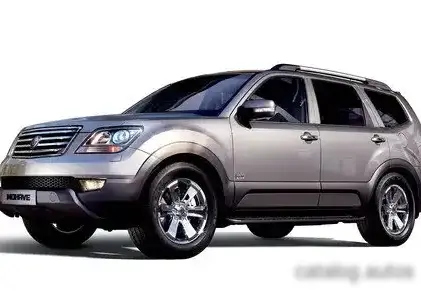
The Kia Borrego 3.0 CRDi, produced from 2008 to 2016, represents Kia’s entry into the mid-size SUV segment, primarily aimed at markets outside of North America where larger SUVs remained popular. Positioned as a more rugged and capable alternative to the Sorento, the Borrego (also known as the Mohave in some regions) offered a body-on-frame construction and a powerful diesel engine option. The 3.0 CRDi variant, generating 250 horsepower, was a key offering, providing a balance of performance and fuel efficiency for buyers seeking a capable tow vehicle and comfortable family transport. It was a significant model for Kia, demonstrating their ambition to compete with established brands in the SUV market.
Technical Specifications
| Brand | Kia |
| Model | Borrego |
| Generation | Borrego |
| Type (Engine) | 3.0 CRDi (250 Hp) |
| Start of production | 2008 |
| End of production | 2016 |
| Powertrain Architecture | Internal Combustion engine |
| Body type | SUV |
| Seats | 5 |
| Doors | 5 |
| Fuel consumption (combined) | 10.8 l/100 km (21.8 US mpg, 26.2 UK mpg, 9.3 km/l) |
| Fuel Type | Diesel |
| Emission standard | Euro 5 |
| Power | 250 Hp @ 3800 rpm |
| Power per litre | 86.1 Hp/l |
| Torque | 550 Nm @ 2000 rpm (405.66 lb.-ft. @ 2000 rpm) |
| Engine layout | Front, Longitudinal |
| Engine Model/Code | D6EA |
| Engine displacement | 2903 cm3 (177.15 cu. in.) |
| Number of cylinders | 6 |
| Engine configuration | V-engine |
| Number of valves per cylinder | 4 |
| Fuel injection system | Diesel Commonrail |
| Engine aspiration | Turbocharger, Intercooler |
| Valvetrain | DOHC |
| Engine oil capacity | 7.4 l (7.82 US qt | 6.51 UK qt) |
| Coolant | 14.7 l (15.53 US qt | 12.93 UK qt) |
| Fuel tank capacity | 82 l (21.66 US gal | 18.04 UK gal) |
| Length | 4880 mm (192.13 in.) |
| Width | 1915 mm (75.39 in.) |
| Height | 1810 mm (71.26 in.) |
| Wheelbase | 2895 mm (113.98 in.) |
| Front track | 1630 mm (64.17 in.) |
| Rear track | 1640 mm (64.57 in.) |
| Drive wheel | All wheel drive (4×4) |
| Number of gears and type of gearbox | 6 gears, automatic transmission |
| Front brakes | Disc |
| Rear brakes | Disc |
| Assisting systems | ABS (Anti-lock braking system) |
| Steering type | Steering rack and pinion |
| Power steering | Hydraulic Steering |
Powertrain & Engine Architecture
The heart of the Borrego 3.0 CRDi is the D6EA engine, a 2.9-liter V6 diesel. This engine utilizes a common-rail direct injection system, delivering fuel at extremely high pressure for improved combustion efficiency and reduced emissions. The D6EA is a turbocharged and intercooled engine, enhancing power output and torque. The turbocharger forces more air into the cylinders, while the intercooler cools the compressed air, further increasing density and performance. The engine features a double overhead camshaft (DOHC) valvetrain, optimizing valve timing for improved engine breathing. The six-speed automatic transmission was specifically chosen for its ability to handle the engine’s substantial torque output and provide smooth shifting. This transmission was not a particularly advanced unit, prioritizing durability and reliability over outright performance.
Driving Characteristics
The 3.0 CRDi Borrego offered a distinctly different driving experience compared to its gasoline-powered counterparts. The high torque output of the diesel engine, readily available from 2000 rpm, provided strong acceleration and effortless towing capability. While not a sports SUV, the Borrego felt confident and composed on the road. The automatic transmission, while smooth, wasn’t particularly quick to downshift, meaning drivers sometimes needed to anticipate acceleration needs. Compared to a hypothetical Borrego with a smaller, less powerful engine, the 3.0 CRDi offered a significantly more relaxed and capable driving experience, especially when fully loaded or towing. The six-speed automatic’s gear ratios were tuned for fuel efficiency and towing, rather than sporty acceleration.
Equipment & Trim Levels
The Borrego 3.0 CRDi typically came well-equipped, even in base trim levels. Standard features often included air conditioning, power windows and locks, a basic audio system, and alloy wheels. Higher trim levels added features such as leather upholstery, a sunroof, a more advanced audio system with navigation, and parking sensors. The interior design was functional and durable, prioritizing practicality over luxury. Optional extras included a rear entertainment system and upgraded sound systems. The overall interior ambiance was comfortable but not particularly refined, reflecting the Borrego’s focus on rugged capability.
Chassis & Braking
The Borrego’s body-on-frame construction contributed to its robust feel and towing capacity. The suspension system consisted of independent double wishbones at the front and a multi-link setup at the rear. This configuration provided a comfortable ride, although it wasn’t as agile as a unibody SUV. Braking duties were handled by disc brakes on all four wheels, coupled with an Anti-lock Braking System (ABS) for enhanced safety. The steering system utilized a hydraulic rack and pinion setup, providing a reasonably direct and responsive feel. Stabilizer bars were fitted to both the front and rear axles to reduce body roll during cornering.
Market Reception & Comparison
The Kia Borrego 3.0 CRDi was generally well-received by automotive critics, who praised its spacious interior, strong diesel engine, and capable off-road performance. However, some reviewers noted the somewhat dated interior design and the lack of a truly luxurious feel. Compared to other SUVs in its class, such as the Toyota 4Runner or Mitsubishi Pajero, the Borrego offered a competitive price point and a generous amount of standard equipment. Fuel economy was respectable for a vehicle of its size and weight, but not class-leading. Reliability proved to be generally good, although diesel engines can be more complex to maintain than gasoline engines.
Legacy
The Kia Borrego 3.0 CRDi has established a reputation as a reliable and capable SUV, particularly in regions where diesel engines are popular. The D6EA engine, while not without its complexities, has proven to be durable when properly maintained. On the used car market, Borregos with the 3.0 CRDi engine tend to hold their value reasonably well, especially those that have been well-maintained and have a documented service history. The Borrego represents a significant step forward for Kia, demonstrating their ability to produce a competitive SUV that could challenge established brands. While it wasn’t a massive sales success in all markets, it laid the groundwork for Kia’s continued expansion into the SUV segment.
