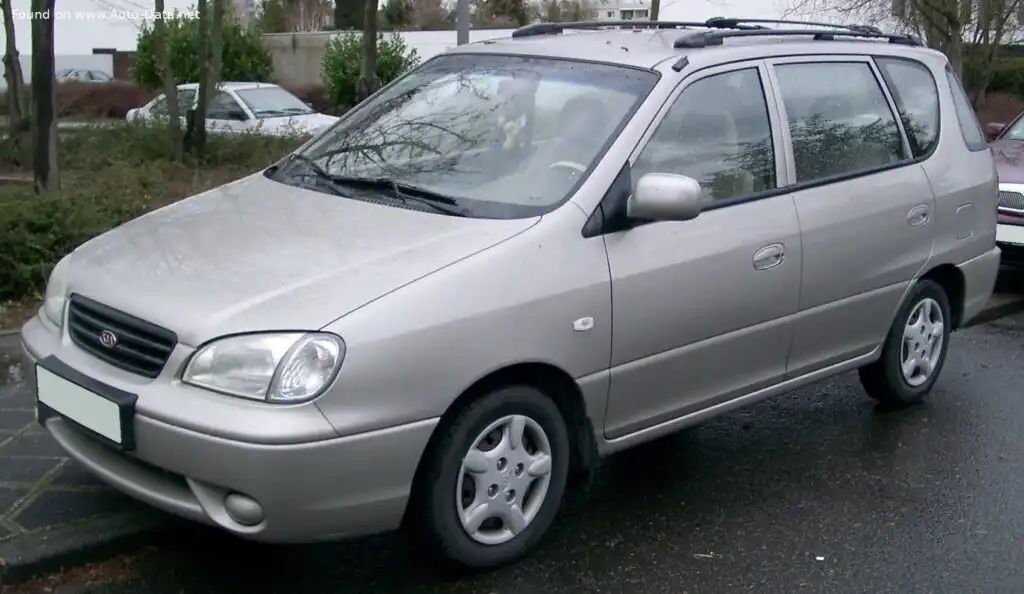
The Kia Carens first generation (codenamed DJ) was produced from 2002 to 2006, representing Kia’s entry into the compact multi-purpose vehicle (MPV) segment. The 2.0 CRDi variant with 113 horsepower and an automatic transmission, introduced mid-way through the production run, aimed to offer a balance of fuel efficiency, practicality, and convenience for family buyers. This model occupied a mid-range position within the Carens lineup, positioned above the base gasoline engines and below the more powerful diesel options. It was primarily marketed in Europe and other international markets where diesel engines were favored for their fuel economy.
Technical Specifications
| Brand | Kia |
| Model | Carens |
| Generation | Carens I |
| Type (Engine) | 2.0 CRDi (113 Hp) Automatic |
| Start of production | 2002 |
| End of production | 2006 |
| Powertrain Architecture | Internal Combustion engine |
| Body type | MPV |
| Seats | 7 |
| Doors | 5 |
| Fuel consumption (urban) | 10.9 l/100 km (21.6 US mpg) |
| Fuel consumption (extra urban) | 5.5 l/100 km (42.8 US mpg) |
| Fuel consumption (combined) | 9.6 l/100 km (24.5 US mpg) |
| Fuel Type | Diesel |
| Acceleration 0 – 100 km/h | 13.5 sec |
| Acceleration 0 – 62 mph | 13.5 sec |
| Acceleration 0 – 60 mph | 12.8 sec |
| Maximum speed | 172 km/h (106.88 mph) |
| Weight-to-power ratio | 13.7 kg/Hp |
| Weight-to-torque ratio | 6.3 kg/Nm |
| Power | 113 Hp @ 4000 rpm |
| Torque | 245 Nm @ 2000 rpm (180.7 lb.-ft. @ 2000 rpm) |
| Engine layout | Front, Transverse |
| Engine Model/Code | D4EA |
| Engine displacement | 1991 cm3 (121.5 cu. in.) |
| Number of cylinders | 4 |
| Engine configuration | Inline |
| Cylinder Bore | 83 mm (3.27 in.) |
| Piston Stroke | 92 mm (3.62 in.) |
| Compression ratio | 17.7:1 |
| Number of valves per cylinder | 4 |
| Fuel injection system | Diesel Commonrail |
| Engine aspiration | Turbocharger, Intercooler |
| Valvetrain | OHC |
| Engine oil capacity | 5.9 l (6.23 US qt | 5.19 UK qt) |
| Coolant capacity | 7.7 l (8.14 US qt | 6.78 UK qt) |
| Kerb Weight | 1549 kg (3414.96 lbs.) |
| Max. weight | 1965 kg (4332.08 lbs.) |
| Max load | 416 kg (917.12 lbs.) |
| Trunk (boot) space – minimum | 422 l (14.9 cu. ft.) |
| Trunk (boot) space – maximum | 1632 l (57.63 cu. ft.) |
| Fuel tank capacity | 55 l (14.53 US gal | 12.1 UK gal) |
| Length | 4493 mm (176.89 in.) |
| Width | 1748 mm (68.82 in.) |
| Height | 1609 mm (63.35 in.) |
| Wheelbase | 2560 mm (100.79 in.) |
| Front track | 1490 mm (58.66 in.) |
| Rear track | 1483 mm (58.39 in.) |
| Drivetrain | Front wheel drive |
| Number of gears | 4 |
| Gearbox type | Automatic transmission |
| Front suspension | Spring Strut |
| Rear suspension | Coil spring |
| Front brakes | Ventilated discs |
| Rear brakes | Disc |
| Assisting systems | ABS (Anti-lock braking system) |
| Steering type | Steering rack and pinion |
| Power steering | Hydraulic Steering |
| Tires size | 205/60 R15 |
| Wheel rims size | 15 |
Powertrain & Engine Architecture
The heart of this Carens variant is the Kia D4EA 2.0-liter inline-four cylinder diesel engine. This engine, a product of Kia’s ongoing development of diesel technology, utilizes a common rail direct injection system. This system, supplied by Bosch, allowed for precise fuel delivery and optimized combustion, contributing to both power output and fuel efficiency. The engine is turbocharged and intercooled, further enhancing performance. The turbocharger boosts power by forcing more air into the cylinders, while the intercooler cools the compressed air, increasing its density and further improving combustion. The engine employs an overhead camshaft (OHC) valvetrain with four valves per cylinder, optimizing gas flow for improved performance. The four-speed automatic transmission was a key feature, offering convenience for drivers, particularly in urban environments. While not as sophisticated as modern transmissions, it provided smooth shifts and adequate performance for the vehicle’s intended use.
Driving Characteristics
The 113 horsepower and 245 Nm (180.7 lb-ft) of torque delivered by the 2.0 CRDi engine, coupled with the four-speed automatic transmission, resulted in a driving experience geared towards practicality rather than outright performance. Acceleration from 0-60 mph took around 12.8 seconds, and top speed was approximately 106.88 mph. Compared to the manual transmission version of the same engine, the automatic offered slightly reduced acceleration due to transmission losses. It also felt less responsive during quick overtaking maneuvers. However, the automatic transmission provided a smoother and more relaxed driving experience, particularly in city traffic. The gear ratios were tuned for fuel economy and drivability, prioritizing comfortable cruising over sporty acceleration. The relatively high kerb weight of 1549 kg (3414.96 lbs) further contributed to the less-than-sporty feel.
Equipment & Trim Levels
The 2.0 CRDi Automatic trim typically included features such as air conditioning, power windows, central locking, and an integrated audio system. Interior upholstery was generally cloth, with options for upgraded materials available. Safety features included ABS (Anti-lock Braking System) as standard. Optional extras could include alloy wheels, a sunroof, and upgraded audio systems. The Carens was designed with family use in mind, offering a spacious interior and flexible seating arrangements. The seven-seat configuration provided ample space for passengers and luggage, making it a practical choice for larger families.
Chassis & Braking
The Carens I utilized a conventional suspension setup, with MacPherson strut coil springs at the front and a coil spring arrangement at the rear. This setup provided a comfortable ride quality, suitable for everyday driving. The front brakes were ventilated discs, offering good stopping power, while the rear brakes were solid discs. The hydraulic power steering provided light and easy steering, making it maneuverable in urban environments. The 205/60 R15 tires offered a good balance of grip and ride comfort.
Market Reception & Comparison
The Kia Carens 2.0 CRDi Automatic was generally well-received by critics as a practical and affordable MPV. It offered a good level of equipment for its price point and provided a comfortable and spacious interior. However, some reviewers noted that the engine was somewhat underpowered, particularly when fully loaded with passengers and luggage. Compared to other MPVs in its class, such as the Renault Scenic or Citroen Xsara Picasso, the Carens offered a more value-oriented proposition. Fuel economy was a strong point, with combined fuel consumption of around 24.5 US mpg. Reliability was generally good, although some owners reported minor issues with the automatic transmission.
Legacy
The Kia Carens I 2.0 CRDi Automatic has proven to be a relatively reliable vehicle in the used car market. The D4EA engine is known for its durability, and the automatic transmission, while not the most advanced, has generally held up well over time. However, as with any used vehicle, regular maintenance is crucial. Common issues to look out for include wear and tear on suspension components and potential problems with the turbocharger. Today, these Carens models represent an affordable and practical option for buyers seeking a spacious and economical MPV. They remain a testament to Kia’s growing reputation for building reliable and value-for-money vehicles.