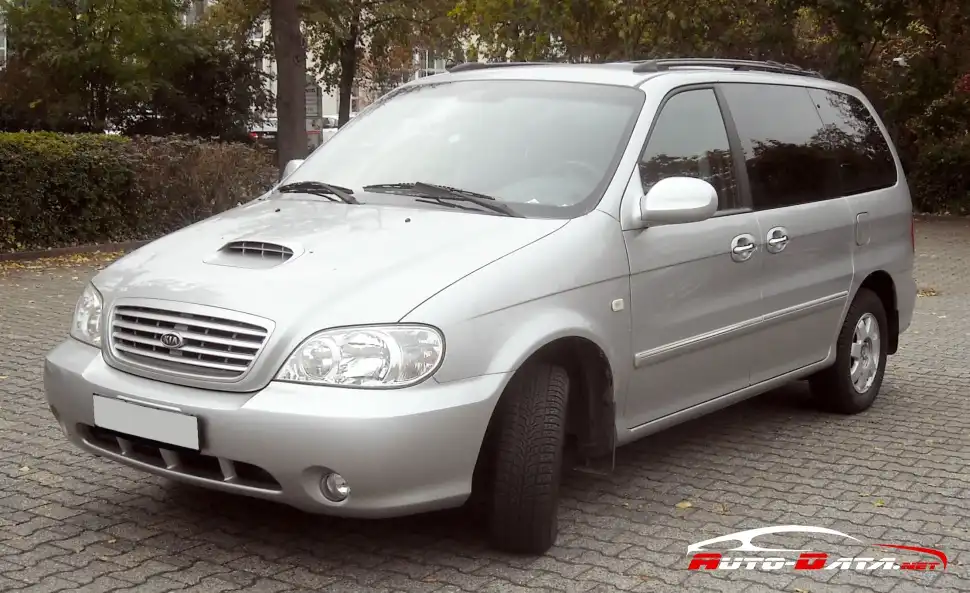
The Kia Carnival, known as the Sedona in the North American market, represented Kia’s initial foray into the highly competitive minivan segment. Introduced in 1998, the first generation (UP/GQ) aimed to provide a more affordable and feature-rich alternative to established players like the Dodge Caravan and Toyota Sienna. The facelifted version, launched in 2001 and produced through 2006, brought revised styling and refinements to the original design. This article focuses specifically on the 2.5i V6 variant, equipped with a 2.5-liter engine producing 150 horsepower, and its role within the Carnival lineup.
Technical Specifications
| Brand | Kia |
| Model | Carnival |
| Generation | Carnival I (UP/GQ, facelift 2001) |
| Type (Engine) | 2.5i V6 (150 Hp) |
| Start of production | 2001 |
| End of production | 2006 |
| Powertrain Architecture | Internal Combustion engine |
| Body type | Minivan |
| Seats | 7 |
| Doors | 5 |
| Fuel consumption (urban) | 14.1 l/100 km (16.7 US mpg, 20 UK mpg) |
| Fuel consumption (extra urban) | 9 l/100 km (26.1 US mpg, 31.4 UK mpg) |
| Fuel consumption (combined) | 10.9 l/100 km (21.6 US mpg, 25.9 UK mpg) |
| Fuel Type | Petrol (Gasoline) |
| Weight-to-power ratio | 13.3 kg/Hp (75.5 Hp/tonne) |
| Weight-to-torque ratio | 8.9 kg/Nm (112.7 Nm/tonne) |
| Power | 150 Hp @ 5600 rpm |
| Power per litre | 60.1 Hp/l |
| Torque | 224 Nm @ 4000 rpm (165.21 lb.-ft. @ 4000 rpm) |
| Engine layout | Front, Transverse |
| Engine Model/Code | KV6 |
| Engine displacement | 2497 cm3 (152.38 cu. in.) |
| Number of cylinders | 6 |
| Engine configuration | V-engine |
| Cylinder Bore | 80 mm (3.15 in.) |
| Piston Stroke | 82.8 mm (3.26 in.) |
| Compression ratio | 10.4:1 |
| Number of valves per cylinder | 4 |
| Fuel injection system | Multi-port manifold injection |
| Engine aspiration | Naturally aspirated engine |
| Valvetrain | DOHC |
| Engine oil capacity | 5.8 l (6.13 US qt | 5.1 UK qt) |
| Coolant capacity | 9.4 l (9.93 US qt | 8.27 UK qt) |
| Kerb Weight | 1988 kg (4382.79 lbs.) |
| Max. weight | 2555 kg (5632.81 lbs.) |
| Max load | 567 kg (1250.02 lbs.) |
| Fuel tank capacity | 75 l (19.81 US gal | 16.5 UK gal) |
| Length | 4925 mm (193.9 in.) |
| Width | 1900 mm (74.8 in.) |
| Height | 1730 mm (68.11 in.) |
| Wheelbase | 2905 mm (114.37 in.) |
| Front track | 1625 mm (63.98 in.) |
| Rear track | 1600 mm (62.99 in.) |
| Ride height (ground clearance) | 170 mm (6.69 in.) |
| Minimum turning circle | 13 m (42.65 ft.) |
| Drivetrain Architecture | Front wheel drive |
| Number of gears | 5 |
| Gearbox type | Manual transmission |
| Front suspension | Wishbone |
| Rear suspension | Coil spring |
| Front brakes | Ventilated discs |
| Rear brakes | Drum |
| Assisting systems | ABS (Anti-lock braking system) |
| Steering type | Steering rack and pinion |
| Power steering | Hydraulic Steering |
| Tires size | 215/65 R15 |
| Wheel rims size | 15 |
INTRODUCTION
The 2001-2006 Kia Carnival, particularly the 2.5i V6 model, was positioned as the entry-level offering in the Carnival range in many markets. It aimed to provide a spacious and practical family vehicle at a competitive price point. Built on the UP/GQ platform, the facelift brought subtle cosmetic changes and improvements to interior materials. This variant was primarily sold in markets where larger engines were not a necessity or were subject to higher taxation, offering a balance between affordability and usability. It served as a stepping stone for customers considering the more powerful V6 options.
Powertrain & Engine Architecture
The heart of the 2.5i V6 Carnival is the KV6 engine, a 2.5-liter, naturally aspirated V6. This engine utilizes a 60-degree V-angle configuration, contributing to a relatively compact engine bay layout. The KV6 employs multi-port fuel injection (MPI) for precise fuel delivery, and a double overhead camshaft (DOHC) valvetrain for efficient cylinder filling and exhaust scavenging. The engine’s 150 horsepower output at 5600 rpm and 224 Nm (165 lb-ft) of torque at 4000 rpm were considered adequate for everyday driving and family hauling. The 5-speed manual transmission was the standard pairing for this engine, offering a direct connection between the engine and the front wheels. The transmission’s gear ratios were tuned for a balance of fuel efficiency and acceptable acceleration.
Driving Characteristics
The 2.5i V6 Carnival with a manual transmission offered a reasonably engaging driving experience for a minivan. While not particularly sporty, the engine provided sufficient power for merging onto highways and overtaking slower traffic. The 5-speed manual allowed drivers to maintain control over the engine’s revs, optimizing for either fuel economy or performance. Compared to the more powerful V6 variants, the 2.5i felt noticeably less responsive, especially when fully loaded with passengers and cargo. The manual transmission, while offering more driver involvement, required more effort than the available automatic option. The front-wheel-drive configuration provided predictable handling, but lacked the all-weather capability of an all-wheel-drive system.
Equipment & Trim Levels
The 2.5i V6 Carnival typically came with a standard equipment list focused on practicality and family comfort. This included features like air conditioning, power windows and locks, and a basic audio system. Interior upholstery was typically cloth, with durable plastics used throughout the cabin. Higher trim levels, available as options, added features such as alloy wheels, upgraded audio systems, and additional convenience items like a sunroof. Safety features were relatively basic for the time, typically including dual front airbags and ABS brakes. The overall interior design prioritized functionality and space over luxury.
Chassis & Braking
The Carnival’s chassis was designed to provide a comfortable ride and stable handling. The front suspension utilized a wishbone configuration, while the rear suspension employed a coil spring setup. This combination aimed to absorb bumps and provide a relatively smooth ride, even on uneven road surfaces. The braking system featured ventilated discs on the front wheels and drum brakes on the rear. ABS (Anti-lock Braking System) was standard, enhancing braking performance and stability in emergency situations. The steering system was a rack and pinion setup with hydraulic power assistance, providing responsive and precise steering control.
Market Reception & Comparison
The 2.5i V6 Carnival was generally well-received as an affordable and practical minivan option. Critics praised its spacious interior, comfortable ride, and competitive price. However, the engine’s performance was often cited as a weakness, particularly when compared to the more powerful V6 models. Fuel economy was considered average for its class. Compared to the larger engine options, the 2.5i was favored by buyers prioritizing affordability and fuel efficiency over outright performance. The manual transmission, while appreciated by some, was less popular than the available automatic option in many markets.
Legacy
The Kia Carnival 2.5i V6, while not the most powerful or technologically advanced minivan of its era, established Kia as a viable contender in the family vehicle segment. The KV6 engine proved to be reasonably reliable, although regular maintenance was crucial to prevent oil consumption issues. Today, these Carnivals can be found in the used car market at very affordable prices. They represent a practical and spacious option for families on a budget, but potential buyers should be aware of the engine’s potential for oil consumption and the age-related wear and tear common to vehicles of this era. The 2.5i V6 variant remains a testament to Kia’s early efforts to provide value and practicality in the minivan market.