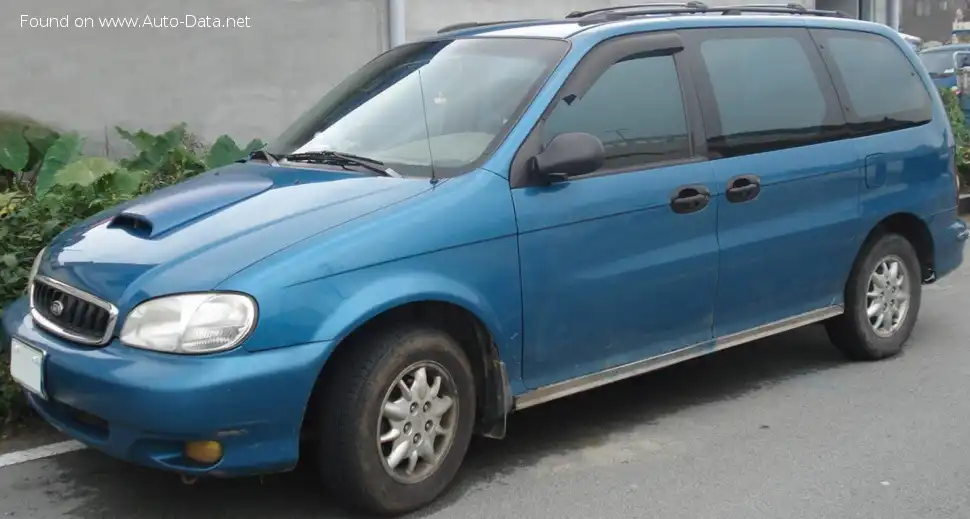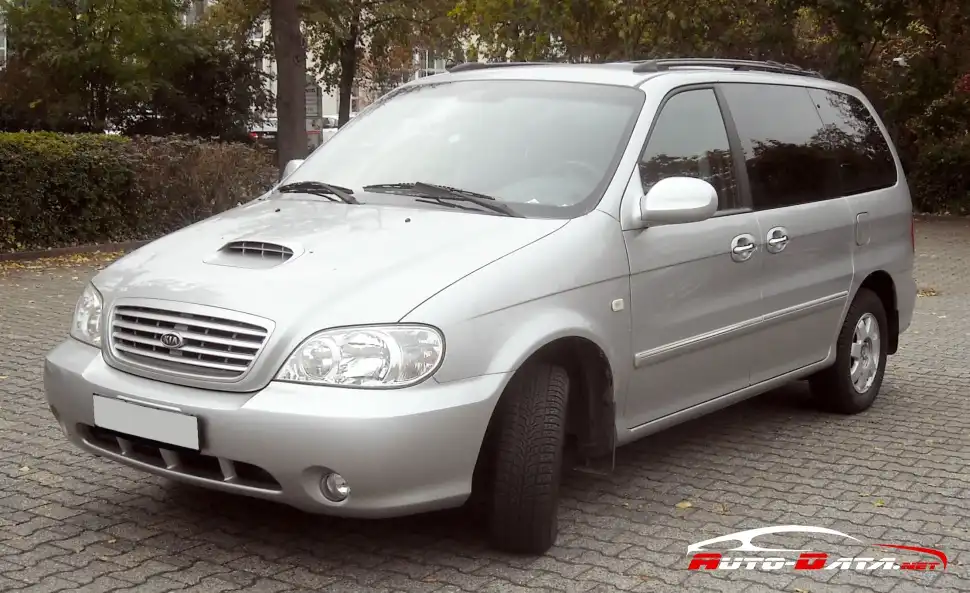
The Kia Carnival, marketed as the Sedona in North America, marked Kia’s initial foray into the highly competitive minivan segment. The first generation, internally designated UP/GQ, was manufactured from 1998 to 2005, undergoing a substantial facelift in 2001. This refresh brought with it modernized styling, enhanced interior materials, and a revised selection of engine options. The 2.9 TD (130 hp) Automatic variant, produced between 2001 and 2005, was primarily targeted towards European and Asian markets, where diesel engines were favored for their fuel efficiency and substantial torque output. It occupied a mid-range position within the Carnival lineup, striking a balance between performance and economy, positioned below the more powerful gasoline engine options and above the base-level trims.
Technical Specifications
| Brand | Kia |
| Model | Carnival |
| Generation | Carnival I (UP/GQ, facelift 2001) |
| Type (Engine) | 2.9 TD (130 Hp) Automatic |
| Start of production | 2001 |
| End of production | 2005 |
| Powertrain Architecture | Internal Combustion engine |
| Body type | Minivan |
| Seats | 7 |
| Doors | 5 |
| Fuel Type | Diesel |
| Weight-to-power ratio | 14.3 kg/Hp, 69.7 Hp/tonne |
| Weight-to-torque ratio | 5.8 kg/Nm, 173.7 Nm/tonne |
| Power | 130 Hp @ 3800 rpm |
| Power per litre | 44.8 Hp/l |
| Torque | 324 Nm @ 1800 rpm (238.97 lb.-ft. @ 1800 rpm) |
| Engine layout | Front, Transverse |
| Engine Model/Code | J3 |
| Engine displacement | 2902 cm3 (177.09 cu. in.) |
| Number of cylinders | 4 |
| Engine configuration | Inline |
| Cylinder Bore | 97.1 mm (3.82 in.) |
| Piston Stroke | 98 mm (3.86 in.) |
| Compression ratio | 19:1 |
| Number of valves per cylinder | 4 |
| Fuel injection system | Diesel Commonrail |
| Engine aspiration | Turbocharger, Intercooler |
| Valvetrain | DOHC |
| Engine oil capacity | 6.6 l (6.97 US qt | 5.81 UK qt) |
| Coolant | 9.4 l (9.93 US qt | 8.27 UK qt) |
| Kerb Weight | 1865 kg (4111.62 lbs.) |
| Fuel tank capacity | 75 l (19.81 US gal | 16.5 UK gal) |
| Length | 4925 mm (193.9 in.) |
| Width | 1900 mm (74.8 in.) |
| Height | 1735 mm (68.31 in.) |
| Wheelbase | 2905 mm (114.37 in.) |
| Front track | 1625 mm (63.98 in.) |
| Rear (Back) track | 1600 mm (62.99 in.) |
| Minimum turning circle | 13 m (42.65 ft.) |
| Drivetrain Architecture | The Internal combustion engine (ICE) drives the front wheels of the vehicle. |
| Drive wheel | Front wheel drive |
| Number of gears and type of gearbox | 4 gears, automatic transmission |
| Front suspension | Coil spring |
| Rear suspension | Coil spring |
| Front brakes | Ventilated discs |
| Rear brakes | Drum |
| Assisting systems | ABS (Anti-lock braking system) |
| Steering type | Steering rack and pinion |
| Power steering | Hydraulic Steering |
| Tires size | 215/70 R15 |
| Wheel rims size | 15 |
Powertrain & Engine Architecture
The 2.9-liter inline-four cylinder diesel engine, designated J3, forms the core of this Carnival variant’s powertrain. This engine incorporates a turbocharger coupled with an intercooler to enhance both power and efficiency. A key advancement was the implementation of a diesel common rail fuel injection system, enabling more precise fuel delivery, reduced emissions, and improved overall refinement compared to earlier diesel injection technologies. The engine features a double overhead camshaft (DOHC) valvetrain, operating four valves per cylinder, which contributes to its efficient breathing characteristics. The four-speed automatic transmission is a conventional hydraulic unit, selected for its relative simplicity and cost-effectiveness. While it doesn’t offer the smoothness or efficiency of more contemporary transmissions, it provides convenient operation for drivers prioritizing ease of use.
Driving Characteristics
The 2.9 TD engine delivers 130 horsepower and 324 Nm (239 lb-ft) of torque, providing adequate, though not particularly spirited, performance for the Carnival. The automatic transmission, while generally smooth during normal driving, can feel somewhat hesitant during rapid acceleration or overtaking. The gear ratios are optimized for fuel economy and relaxed cruising rather than outright speed. In comparison to the gasoline engine options, the diesel offers significantly greater low-end torque, making it better suited for transporting a full complement of passengers and luggage. However, it lacks the higher-revving power of the gasoline engines. Within the Carnival diesel range, this 130 hp version represents a middle ground, offering a compromise between the lower-powered base diesels and the more expensive, higher-output alternatives.
Equipment & Trim Levels
The 2.9 TD Automatic trim level typically includes standard features such as air conditioning, power windows, central locking, and an AM/FM radio. Higher trim levels offered optional extras like alloy wheels, a sunroof, upgraded interior upholstery, and a more advanced audio system. Safety features were relatively basic for the period, generally comprising ABS brakes and driver/passenger airbags. The interior typically featured cloth upholstery with plastic trim accents. The dashboard layout is functional and straightforward, prioritizing usability over luxurious aesthetics.
Chassis & Braking
The Carnival’s chassis utilizes a coil spring suspension system at both the front and rear, providing a comfortable ride quality. The front brakes are ventilated discs, offering good stopping power, while the rear brakes are drums, a cost-saving measure common in vehicles of this class. The steering system employs hydraulic power steering, providing light and effortless steering. Stabilizer bars are fitted to both the front and rear axles to minimize body roll during cornering. The suspension tuning prioritizes comfort and stability over sporty handling characteristics.
Market Reception & Comparison
The 2.9 TD Automatic Carnival was generally well-received in markets where diesel minivans were popular. Reviewers praised its fuel efficiency, spacious interior, and comfortable ride. However, some critics noted the engine’s relative lack of refinement compared to gasoline alternatives and the automatic transmission’s somewhat dated feel. Compared to competitors such as the Renault Espace or Volkswagen Sharan, the Carnival offered a more affordable price point but lacked the same level of brand prestige or sophisticated technology. Fuel economy was a key selling point, consistently surpassing that of the gasoline-powered Carnival models.
Legacy
The Kia Carnival I, and specifically the 2.9 TD Automatic variant, has proven to be a relatively reliable vehicle in the used car market. The J3 diesel engine, while not without its potential issues, is generally durable and capable of achieving high mileage with proper maintenance. Common concerns include wear and tear on the turbocharger, fuel injector problems, and occasional issues with the automatic transmission. However, parts availability is generally good, and repair costs are typically reasonable. Today, these Carnivals are often sought after by budget-conscious buyers seeking a spacious and practical family vehicle. While not considered a collector’s item, the 2.9 TD Automatic represents a significant advancement for Kia in terms of design, engineering, and overall quality.