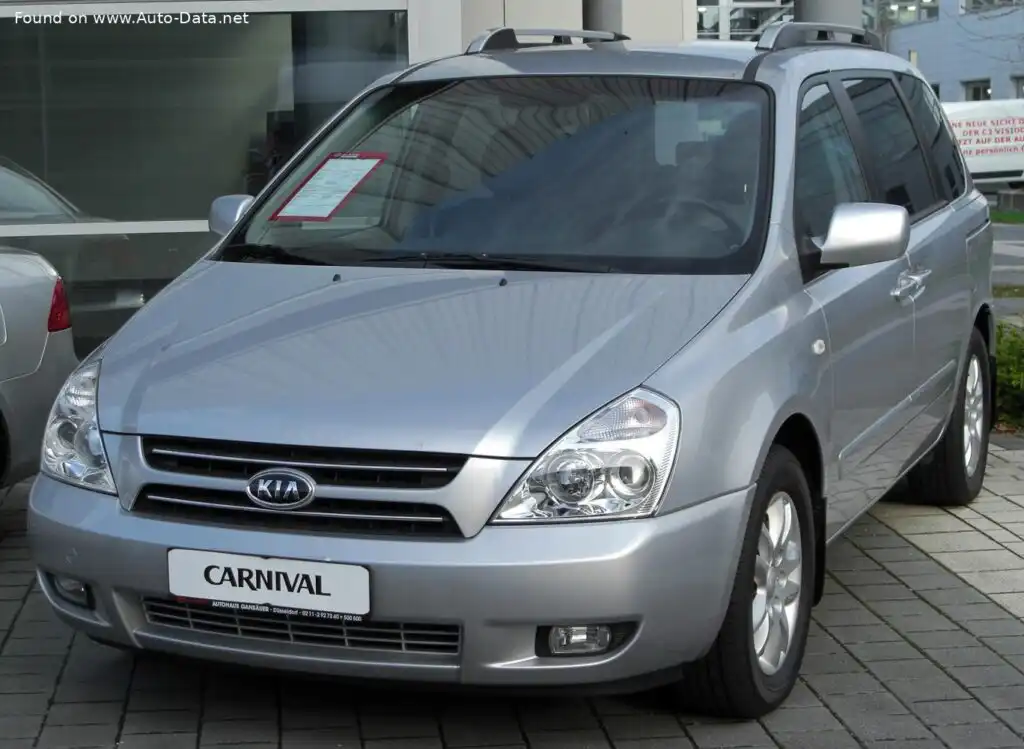
The Kia Carnival II (VQ), produced from 2006 to 2010, represented Kia’s second generation of its popular minivan, marketed globally under various names like the Sedona in North America. This generation saw a significant refinement in design and features compared to its predecessor. The 2.7i V6 Automatic variant, equipped with the Mu/G6EA engine, was a key offering in many markets, positioned as a mid-range option balancing performance and affordability within the Carnival II lineup. It served as a practical family vehicle, offering seven-passenger seating and a spacious interior, competing with established minivans from Honda, Toyota, and Chrysler.
Technical Specifications
| Brand | Kia |
| Model | Carnival |
| Generation | Carnival II (VQ) |
| Type (Engine) | 2.7i V6 (189 Hp) Automatic |
| Start of production | 2006 |
| End of production | 2010 |
| Powertrain Architecture | Internal Combustion engine |
| Body type | Minivan |
| Seats | 7 |
| Doors | 5 |
| Fuel consumption (urban) | 15 l/100 km (15.7 US mpg, 18.8 UK mpg, 6.7 km/l) |
| Fuel consumption (extra urban) | 8.6 l/100 km (27.4 US mpg, 32.8 UK mpg, 11.6 km/l) |
| Fuel consumption (combined) | 10.9 l/100 km (21.6 US mpg, 25.9 UK mpg, 9.2 km/l) |
| Fuel Type | Petrol (Gasoline) |
| Maximum speed | 182 km/h (113.09 mph) |
| Weight-to-power ratio | 10.4 kg/Hp, 95.9 Hp/tonne |
| Weight-to-torque ratio | 8 kg/Nm, 124.8 Nm/tonne |
| Power | 189 Hp @ 6000 rpm |
| Power per litre | 71.2 Hp/l |
| Torque | 246 Nm @ 4000 rpm (181.44 lb.-ft. @ 4000 rpm) |
| Engine layout | Front, Transverse |
| Engine Model/Code | Mu / G6EA |
| Engine displacement | 2656 cm3 (162.08 cu. in.) |
| Number of cylinders | 6 |
| Engine configuration | V-engine |
| Cylinder Bore | 86.7 mm (3.41 in.) |
| Piston Stroke | 75 mm (2.95 in.) |
| Compression ratio | 10.4:1 |
| Number of valves per cylinder | 4 |
| Fuel injection system | Multi-port manifold injection |
| Engine aspiration | Naturally aspirated engine |
| Engine oil capacity | 4.5 l (4.76 US qt | 3.96 UK qt) |
| Coolant capacity | 10.7 l (11.31 US qt | 9.41 UK qt) |
| Kerb Weight | 1971 kg (4345.31 lbs.) |
| Max. weight | 2785 kg (6139.87 lbs.) |
| Max load | 814 kg (1794.56 lbs.) |
| Trunk (boot) space – minimum | 241 l (8.51 cu. ft.) |
| Trunk (boot) space – maximum | 1666 l (58.83 cu. ft.) |
| Fuel tank capacity | 80 l (21.13 US gal | 17.6 UK gal) |
| Length | 4810 mm (189.37 in.) |
| Width | 1985 mm (78.15 in.) |
| Height | 1815 mm (71.46 in.) |
| Wheelbase | 2890 mm (113.78 in.) |
| Front track | 1685 mm (66.34 in.) |
| Rear (Back) track | 1685 mm (66.34 in.) |
| Drag coefficient (Cd) | 0.34 |
| Minimum turning circle | 11.64 m (38.19 ft.) |
| Drivetrain Architecture | The Internal combustion engine (ICE) drives the front wheels of the vehicle. |
| Drive wheel | Front wheel drive |
| Number of gears and type of gearbox | 4 gears, automatic transmission |
| Front suspension | Independent type McPherson |
| Rear suspension | Dependent spring suspension with transverse stabilizer |
| Front brakes | Ventilated discs |
| Rear brakes | Drum |
| Assisting systems | ABS (Anti-lock braking system) |
| Steering type | Steering rack and pinion |
| Tires size | 235/60 R17H |
| Wheel rims size | 17 |
Powertrain & Engine Architecture
The heart of the 2.7i V6 variant is the Kia-developed Mu engine, specifically the G6EA code. This 2.7-liter, naturally aspirated V6 engine utilizes a 60-degree V-angle configuration. It features a cast iron block with an aluminum cylinder head, contributing to a reasonable balance between durability and weight. The engine employs multi-point fuel injection, delivering fuel directly to each intake port. The valvetrain consists of dual overhead camshafts (DOHC) with four valves per cylinder, optimizing airflow for improved performance. The automatic transmission paired with this engine is a conventional four-speed unit. While not the most modern transmission available at the time, it provided smooth shifts and adequate performance for everyday driving. The transmission was chosen for its reliability and cost-effectiveness, aligning with the Carnival II’s positioning as a value-oriented minivan.
Driving Characteristics
The 189 horsepower and 181 lb-ft of torque produced by the 2.7i V6, when coupled with the four-speed automatic, resulted in adequate, but not exhilarating, performance. Acceleration from 0 to 60 mph was typically in the 9-10 second range. The automatic transmission’s gear ratios were tuned for fuel efficiency and comfortable cruising rather than sporty acceleration. Compared to the available manual transmission or higher-output engine options (if offered in certain markets), the 2.7i Automatic felt noticeably less responsive. However, it provided a more relaxed driving experience, particularly in urban environments. The transmission’s shift points were generally smooth, and the engine provided sufficient power for highway merging and overtaking, although it required downshifting in some situations.
Equipment & Trim Levels
The 2.7i V6 Automatic trim typically included features such as air conditioning, power windows and locks, a basic audio system, and standard safety equipment like dual front airbags and ABS. Higher trim levels, often denoted by “LX” or “EX” designations, added features like alloy wheels, upgraded audio systems, a sunroof, and leather upholstery. Interior upholstery was generally cloth in the base trims, with optional leather available on higher-end models. The dashboard layout was functional and straightforward, prioritizing ease of use over stylistic flair. Optional extras included a rear entertainment system, navigation, and upgraded sound systems.
Chassis & Braking
The Carnival II utilized a front-wheel-drive layout. The front suspension employed an independent McPherson strut design, providing a comfortable ride and reasonable handling. The rear suspension featured a dependent multi-link setup with a transverse stabilizer bar, which helped to reduce body roll during cornering. Braking duties were handled by ventilated discs at the front and drum brakes at the rear. While adequate for normal driving conditions, the rear drum brakes were a cost-saving measure and didn’t offer the same stopping power as disc brakes. The steering system was a rack-and-pinion setup, providing responsive and predictable steering feel.
Market Reception & Comparison
The 2.7i V6 Automatic Carnival II was generally well-received as a practical and affordable family minivan. Critics praised its spacious interior, comfortable ride, and value for money. However, some reviewers noted that the engine and transmission combination lacked the refinement and performance of competitors like the Honda Odyssey or Toyota Sienna. Fuel economy was considered average for its class. Compared to other Carnival II trims, the 2.7i Automatic offered a good balance between price and features, making it a popular choice for budget-conscious buyers. The 2.7L engine was known for its relative reliability, though regular maintenance was crucial.
Legacy
The Kia Carnival II (VQ) 2.7i V6 Automatic has established a reputation as a reliable and durable minivan in the used car market. The Mu engine, while not known for exceptional performance, is generally considered to be robust and long-lasting when properly maintained. Common maintenance items include regular oil changes, timing belt replacements (if applicable), and inspection of the cooling system. Today, these vehicles can be found at affordable prices, making them an attractive option for families seeking a spacious and practical vehicle. While not a performance icon, the 2.7i V6 Automatic Carnival II remains a testament to Kia’s growing reputation for building value-driven vehicles.