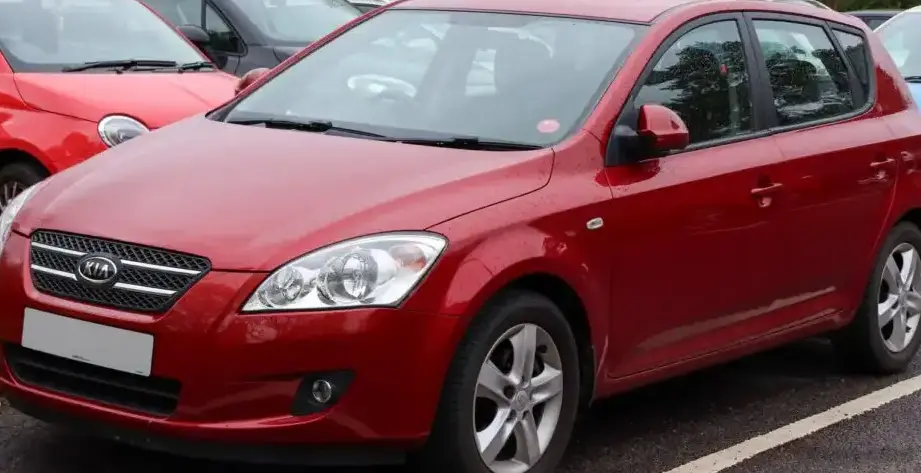
The Kia Cee’d 1.6 CVVT Automatic, produced between 2007 and 2009, represented Kia’s initial foray into the European compact hatchback market with a vehicle specifically tailored to those preferences. Positioned as a mid-range offering within the first generation Cee’d (BD) lineup – internally designated the 1HX – this variant aimed to provide a balance of affordability, practicality, and ease of use with its four-speed automatic transmission. The Cee’d was a significant vehicle for Kia, marking a departure from previous models and a commitment to building cars designed for, and tested in, Europe. This particular 1.6L engine and automatic transmission combination was intended to appeal to buyers prioritizing comfort and convenience over outright performance.
Technical Specifications
| Brand | Kia |
| Model | Cee’d |
| Generation | Cee’d I |
| Type (Engine) | 1.6 CVVT (122 Hp) Automatic |
| Start of production | 2007 |
| End of production | 2009 |
| Powertrain Architecture | Internal Combustion engine |
| Body type | Hatchback |
| Seats | 5 |
| Doors | 5 |
| Fuel consumption (economy) – urban (NEDC) | 9 l/100 km (26.1 US mpg, 31.4 UK mpg, 11.1 km/l) |
| Fuel consumption (economy) – extra urban (NEDC) | 5.8 l/100 km (40.6 US mpg, 48.7 UK mpg, 17.2 km/l) |
| Fuel consumption (economy) – combined (NEDC) | 7 l/100 km (33.6 US mpg, 40.4 UK mpg, 14.3 km/l) |
| CO2 emissions (NEDC) | 166 g/km |
| Fuel Type | Petrol (Gasoline) |
| Acceleration 0 – 100 km/h | 11.4 sec |
| Acceleration 0 – 62 mph | 11.4 sec |
| Acceleration 0 – 60 mph | 10.8 sec |
| Maximum speed | 187 km/h (116.2 mph) |
| Emission standard | Euro 4 |
| Weight-to-power ratio | 10.6 kg/Hp, 94.5 Hp/tonne |
| Weight-to-torque ratio | 8.4 kg/Nm, 119.3 Nm/tonne |
| Power | 122 Hp @ 6200 rpm |
| Power per litre | 76.7 Hp/l |
| Torque | 154 Nm @ 5200 rpm (113.58 lb.-ft. @ 5200 rpm) |
| Engine layout | Front, Transverse |
| Engine Model/Code | G4FC |
| Engine displacement | 1591 cm3 (97.09 cu. in.) |
| Number of cylinders | 4 |
| Engine configuration | Inline |
| Cylinder Bore | 77 mm (3.03 in.) |
| Piston Stroke | 85.44 mm (3.36 in.) |
| Compression ratio | 10.5:1 |
| Number of valves per cylinder | 4 |
| Fuel injection system | Multi-port manifold injection |
| Engine aspiration | Naturally aspirated engine |
| Valvetrain | DOHC CVVT |
| Engine oil capacity | 3.3 l (3.49 US qt | 2.9 UK qt) |
| Coolant | 5.5 l (5.81 US qt | 4.84 UK qt) |
| Kerb Weight | 1291-1373 kg (2846.17 – 3026.95 lbs.) |
| Max. weight | 1730 kg (3814 lbs.) |
| Max load | 357-439 kg (787.05 – 967.83 lbs.) |
| Trunk (boot) space – minimum | 340 l (12.01 cu. ft.) |
| Trunk (boot) space – maximum | 1300 l (45.91 cu. ft.) |
| Fuel tank capacity | 53 l (14 US gal | 11.66 UK gal) |
| Max. roof load | 80 kg (176.37 lbs.) |
| Permitted trailer load with brakes (12%) | 1200 kg (2645.55 lbs.) |
| Permitted trailer load without brakes | 550 kg (1212.54 lbs.) |
| Permitted towbar download | 55 kg (121.25 lbs.) |
| Length | 4235 mm (166.73 in.) |
| Width | 1790 mm (70.47 in.) |
| Height | 1480 mm (58.27 in.) |
| Wheelbase | 2650 mm (104.33 in.) |
| Front track | 1546 mm (60.87 in.) |
| Rear (Back) track | 1544 mm (60.79 in.) |
| Front overhang | 865 mm (34.06 in.) |
| Rear overhang | 720 mm (28.35 in.) |
| Minimum turning circle (turning diameter) | 10.8 m (35.43 ft.) |
| Drivetrain Architecture | The Internal combustion engine (ICE) drives the front wheels of the vehicle. |
| Drive wheel | Front wheel drive |
| Number of gears and type of gearbox | 4 gears, automatic transmission |
| Front suspension | Independent type McPherson |
| Rear suspension | Independent multi-link suspension, Transverse stabilizer |
| Front brakes | Ventilated discs, 280 mm |
| Rear brakes | Disc, 262 mm |
| Assisting systems | ABS (Anti-lock braking system) |
| Steering type | Steering rack and pinion |
| Power steering | Electric Steering |
| Tires size | 185/65 R15; 195/65 R15; 205/55 R16; 225/45 R17 |
| Wheel rims size | 5.5J x 15; 6J x 16; 7J x 17 |
Powertrain & Engine Architecture
The heart of this Cee’d variant is the Kia-developed 1.6-liter (1591 cc) inline-four cylinder gasoline engine, designated G4FC. This engine utilizes a multi-point fuel injection system and a double overhead camshaft (DOHC) configuration with continuously variable valve timing (CVVT) on both intake and exhaust valves. The CVVT system optimizes valve timing based on engine speed and load, improving both performance and fuel efficiency. The engine produces 122 horsepower at 6200 rpm and 154 Nm (113.58 lb-ft) of torque at 5200 rpm. Paired with this engine is a four-speed automatic transmission, a relatively conventional unit for the time, prioritizing smooth shifts over rapid acceleration. The transmission’s gear ratios were tuned for comfortable cruising and everyday drivability rather than sporty performance.
Driving Characteristics
The 1.6L Automatic Cee’d offered a comfortable, if not particularly exhilarating, driving experience. Acceleration from 0-60 mph took around 10.8 seconds, and 0-100 km/h in 11.4 seconds, making it slower than the manual transmission versions or those equipped with larger engines. The four-speed automatic, while smooth, lacked the responsiveness of a manual gearbox or more modern automatic transmissions with additional gears. Power delivery was linear, but the engine felt strained when pushed hard, particularly during overtaking maneuvers. The automatic transmission’s shift points were programmed for fuel economy, which sometimes resulted in the engine bogging down before downshifting. However, for urban driving and highway cruising, the combination proved adequate and user-friendly.
Equipment & Trim Levels
The 1.6 CVVT Automatic typically came with a reasonable level of standard equipment. Base models included air conditioning, power windows, central locking, and an integrated audio system. Higher trim levels, often denoted by suffixes like “LS” or “EX”, added features such as alloy wheels, fog lights, a trip computer, and upgraded interior trim. Interior upholstery was typically cloth, with options for different colors and patterns. Optional extras included a sunroof, leather upholstery, and a more advanced audio system with CD changer. Safety features included dual front airbags, ABS brakes, and seatbelt pretensioners.
Chassis & Braking
The Cee’d utilized a front-wheel-drive layout with an independent McPherson strut suspension at the front and an independent multi-link suspension at the rear. The rear suspension incorporated a transverse stabilizer bar to reduce body roll. Braking duties were handled by ventilated discs at the front and solid discs at the rear. The braking system was assisted by ABS (Anti-lock Braking System) to enhance stability during emergency stops. The suspension tuning prioritized ride comfort over sporty handling, resulting in a compliant ride quality that absorbed bumps and imperfections in the road surface effectively.
Market Reception & Comparison
The Kia Cee’d 1.6 CVVT Automatic was generally well-received by automotive critics as a practical and affordable family hatchback. However, the automatic transmission was often criticized for its lack of responsiveness and limited number of gears. Compared to the manual transmission versions, the automatic offered lower fuel economy and slower acceleration. The 1.6L engine was considered adequate for most driving situations, but it lacked the punch of the larger 2.0L engine available in other Cee’d trims. Despite these drawbacks, the 1.6L Automatic appealed to buyers who prioritized comfort and convenience over performance.
Legacy
The Kia Cee’d 1.6 CVVT Automatic, while not a performance standout, proved to be a reliable and durable vehicle. The G4FC engine, when properly maintained, is known for its longevity. The four-speed automatic transmission, while simple, is also relatively robust. In the used car market, these Cee’ds represent a good value proposition for buyers seeking an affordable and practical hatchback. Common issues are generally limited to routine maintenance items, such as timing belt replacement and sensor failures. The Cee’d’s success helped establish Kia as a credible competitor in the European market and paved the way for future models.