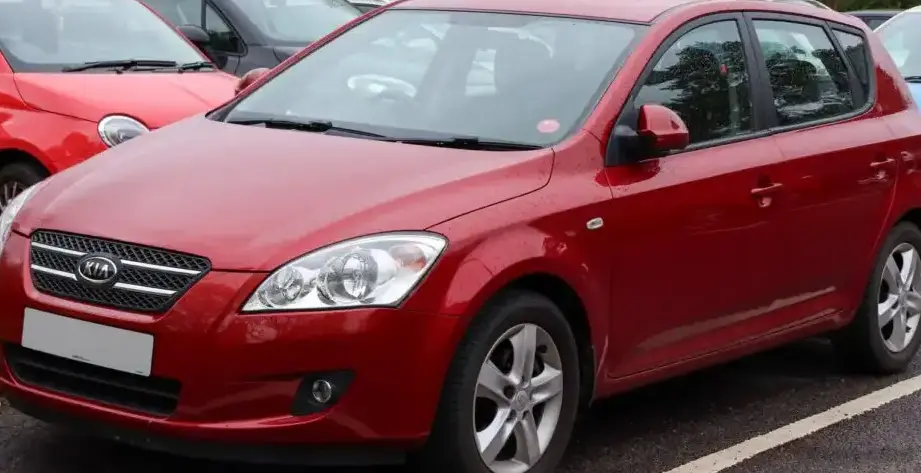
The Kia Cee’d, launched in 2006, represented Kia’s first foray into the European C-segment hatchback market. Designed specifically for European tastes, it aimed to provide a stylish and practical alternative to established rivals like the Ford Focus and Volkswagen Golf. Production of the first generation (Cee’d I) ran from 2006 to 2012, with a facelift occurring in 2009. The 2.0 CVVT (143 Hp) Automatic variant, produced from 2007 to 2009, occupied a mid-range position within the Cee’d lineup, offering a balance between performance and convenience. It was positioned above the base 1.4L models and below the more sporting trims, appealing to buyers seeking a comfortable and well-equipped hatchback with a larger engine.
Technical Specifications
| Brand | Kia |
| Model | Cee’d |
| Generation | Cee’d I |
| Type (Engine) | 2.0 CVVT (143 Hp) Automatic |
| Start of production | 2007 |
| End of production | 2009 |
| Powertrain Architecture | Internal Combustion engine |
| Body type | Hatchback |
| Seats | 5 |
| Doors | 5 |
| Fuel consumption (economy) – urban (NEDC) | 10.2 l/100 km (23.1 US mpg, 27.7 UK mpg, 9.8 km/l) |
| Fuel consumption (economy) – extra urban (NEDC) | 6.3 l/100 km (37.3 US mpg, 44.8 UK mpg, 15.9 km/l) |
| Fuel consumption (economy) – combined (NEDC) | 7.7 l/100 km (30.5 US mpg, 36.7 UK mpg, 13 km/l) |
| CO2 emissions (NEDC) | 184 g/km |
| Fuel Type | Petrol (Gasoline) |
| Acceleration 0 – 100 km/h | 10.4 sec |
| Acceleration 0 – 62 mph | 10.4 sec |
| Acceleration 0 – 60 mph | 9.9 sec |
| Maximum speed | 195 km/h (121.17 mph) |
| Emission standard | Euro 4 |
| Weight-to-power ratio | 9.4 kg/Hp, 106 Hp/tonne |
| Weight-to-torque ratio | 7.3 kg/Nm, 137.9 Nm/tonne |
| Power | 143 Hp @ 6000 rpm |
| Power per litre | 72.4 Hp/l |
| Torque | 186 Nm @ 4600 rpm (137.19 lb.-ft. @ 4600 rpm) |
| Engine layout | Front, Transverse |
| Engine Model/Code | G4GC |
| Engine displacement | 1975 cm3 (120.52 cu. in.) |
| Number of cylinders | 4 |
| Engine configuration | Inline |
| Cylinder Bore | 82 mm (3.23 in.) |
| Piston Stroke | 93.5 mm (3.68 in.) |
| Compression ratio | 10.1:1 |
| Number of valves per cylinder | 4 |
| Fuel injection system | Multi-port manifold injection |
| Engine aspiration | Naturally aspirated engine |
| Valvetrain | DOHC CVVT |
| Engine oil capacity | 4 l (4.23 US qt | 3.52 UK qt) |
| Coolant | 6.3 l (6.66 US qt | 5.54 UK qt) |
| Kerb Weight | 1349-1421 kg (2974.04 – 3132.77 lbs.) |
| Max. weight | 1780 kg (3924.23 lbs.) |
| Max load | 359-431 kg (791.46 – 950.19 lbs.) |
| Trunk (boot) space – minimum | 340 l (12.01 cu. ft.) |
| Trunk (boot) space – maximum | 1300 l (45.91 cu. ft.) |
| Fuel tank capacity | 53 l (14 US gal | 11.66 UK gal) |
| Max. roof load | 80 kg (176.37 lbs.) |
| Permitted trailer load with brakes (12%) | 1200 kg (2645.55 lbs.) |
| Permitted trailer load without brakes | 550 kg (1212.54 lbs.) |
| Permitted towbar download | 55 kg (121.25 lbs.) |
| Length | 4235 mm (166.73 in.) |
| Width | 1790 mm (70.47 in.) |
| Height | 1480 mm (58.27 in.) |
| Wheelbase | 2650 mm (104.33 in.) |
| Front track | 1546 mm (60.87 in.) |
| Rear (Back) track | 1544 mm (60.79 in.) |
| Front overhang | 865 mm (34.06 in.) |
| Rear overhang | 720 mm (28.35 in.) |
| Minimum turning circle (turning diameter) | 10.8 m (35.43 ft.) |
| Drivetrain Architecture | The Internal combustion engine (ICE) drives the front wheels of the vehicle. |
| Drive wheel | Front wheel drive |
| Number of gears and type of gearbox | 4 gears, automatic transmission |
| Front suspension | Independent type McPherson |
| Rear suspension | Independent multi-link suspension, Transverse stabilizer |
| Front brakes | Ventilated discs, 280 mm |
| Rear brakes | Disc, 262 mm |
| Assisting systems | ABS (Anti-lock braking system) |
| Steering type | Steering rack and pinion |
| Power steering | Electric Steering |
| Tires size | 185/65 R15; 195/65 R15; 205/55 R16; 225/45 R17 |
| Wheel rims size | 5.5J x 15; 6J x 16; 7J x 17 |
Powertrain & Engine Architecture
The heart of the Cee’d 2.0 CVVT Automatic is the G4GC engine, a 1.975-liter (120.52 cubic inches) inline-four cylinder gasoline engine. This engine utilizes a multi-point fuel injection system and a double overhead camshaft (DOHC) configuration with continuously variable valve timing (CVVT) on both intake and exhaust valves. The CVVT system optimizes valve timing based on engine speed and load, improving both performance and fuel efficiency. The engine produces 143 horsepower at 6000 rpm and 186 Nm (137.19 lb-ft) of torque at 4600 rpm. Paired with this engine is a four-speed automatic transmission, designed for smooth and convenient operation. This transmission, while not offering the efficiency of more modern gearboxes, provided a comfortable driving experience for everyday use.
Driving Characteristics
The 2.0L engine and four-speed automatic combination in the Cee’d offered a noticeable step up in performance compared to the smaller 1.4L engine options. Acceleration from 0-60 mph took approximately 9.9 seconds, and the car could reach a top speed of 195 km/h (121.17 mph). However, the four-speed automatic transmission meant that the engine often operated at higher RPMs during highway cruising, impacting fuel economy. Compared to the manual transmission versions of the 2.0L, the automatic offered less direct control and slightly slower acceleration. The gear ratios were tuned for comfort and drivability rather than outright performance. The power delivery was relatively linear, making it easy to modulate the throttle in urban environments.
Equipment & Trim Levels
The 2.0 CVVT Automatic trim typically included features such as air conditioning, power windows, central locking, and an integrated audio system. Higher trim levels added options like alloy wheels, fog lights, a trip computer, and upgraded interior upholstery. Interior materials were generally of good quality for the price point, with a focus on durability and practicality. The dashboard layout was straightforward and user-friendly, with logically placed controls. Optional extras included a sunroof, leather seats, and a more advanced audio system with CD changer.
Chassis & Braking
The Cee’d I featured an independent McPherson strut suspension at the front and an independent multi-link suspension at the rear, providing a comfortable and controlled ride. A transverse stabilizer bar was included on both axles to reduce body roll during cornering. The braking system consisted of ventilated discs at the front and solid discs at the rear. Anti-lock Braking System (ABS) was standard, enhancing safety and stability during emergency braking. The suspension tuning was geared towards comfort, prioritizing ride quality over sporty handling.
Market Reception & Comparison
The Kia Cee’d 2.0 CVVT Automatic was generally well-received by automotive critics as a practical and well-equipped hatchback. It offered a good value proposition compared to its European rivals, with a generous warranty and a competitive price. However, some reviewers noted that the four-speed automatic transmission felt dated compared to the more modern five- or six-speed automatics available in other vehicles. Fuel economy was also a point of criticism, as the 2.0L engine consumed more fuel than the smaller engine options. Compared to the 1.6L petrol or 1.6L diesel variants, the 2.0L offered more power but at the expense of fuel efficiency and slightly higher running costs.
Legacy
The Kia Cee’d I, particularly the 2.0 CVVT Automatic variant, has proven to be a relatively reliable vehicle in the used car market. The G4GC engine is known for its durability, and the four-speed automatic transmission, while not the most sophisticated, is generally robust. Common issues are typically related to wear and tear, such as suspension components and brake pads. Today, these vehicles represent an affordable and practical option for buyers seeking a dependable hatchback. While not a performance icon, the Cee’d 2.0 CVVT Automatic provided a comfortable and well-rounded driving experience, establishing Kia as a serious contender in the European C-segment.