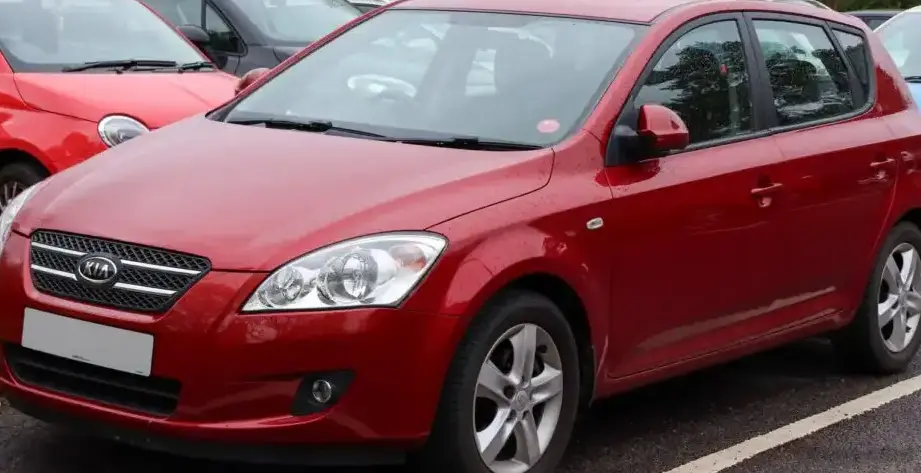
The Kia Cee’d, introduced in 2006, represented Kia’s first foray into the European compact hatchback market. The first generation (JD) aimed to provide a stylish and practical alternative to established European rivals. The facelifted version, launched in 2009 (often referred to as the Cee’d I facelift), brought revised styling, improved interior materials, and updated engine options. Among these, the 1.6-liter 16V engine paired with a four-speed automatic transmission was a significant offering, positioned as a comfortable and accessible entry point into the Cee’d range. Production of this specific configuration ran from 2009 to 2012.
Technical Specifications
| Brand | Kia |
| Model | Cee’d |
| Generation | Cee’d I (facelift 2009) |
| Type (Engine) | 1.6 16V (126 Hp) automatic |
| Start of production | 2009 |
| End of production | 2012 |
| Powertrain Architecture | Internal Combustion engine |
| Body type | Hatchback |
| Seats | 5 |
| Doors | 5 |
| Fuel consumption (urban) | 8.3 l/100 km (28.3 US mpg, 34 UK mpg, 12 km/l) |
| Fuel consumption (extra urban) | 5.7 l/100 km (41.3 US mpg, 49.6 UK mpg, 17.5 km/l) |
| Fuel consumption (combined) | 6.6 l/100 km (35.6 US mpg, 42.8 UK mpg, 15.2 km/l) |
| Fuel Type | Petrol (Gasoline) |
| Acceleration 0 – 100 km/h | 10.9 sec |
| Acceleration 0 – 62 mph | 10.9 sec |
| Acceleration 0 – 60 mph | 10.4 sec |
| Maximum speed | 187 km/h (116.2 mph) |
| Emission standard | Euro 5 |
| Weight-to-power ratio | 10.2 kg/Hp, 97.6 Hp/tonne |
| Weight-to-torque ratio | 8.4 kg/Nm, 119.3 Nm/tonne |
| Power | 126 Hp |
| Power per litre | 79.2 Hp/l |
| Torque | 154 Nm @ 4200 rpm (113.58 lb.-ft. @ 4200 rpm) |
| Engine layout | Front, Transverse |
| Engine Model/Code | G4FC |
| Engine displacement | 1591 cm3 (97.09 cu. in.) |
| Number of cylinders | 4 |
| Engine configuration | Inline |
| Number of valves per cylinder | 4 |
| Fuel injection system | Multi-port manifold injection |
| Engine aspiration | Naturally aspirated engine |
| Valvetrain | DOHC |
| Engine oil capacity | 3.3 l (3.49 US qt | 2.9 UK qt) |
| Coolant capacity | 5.5 l (5.81 US qt | 4.84 UK qt) |
| Kerb Weight | 1291 kg (2846.17 lbs.) |
| Max. weight | 1730 kg (3814 lbs.) |
| Max load | 439 kg (967.83 lbs.) |
| Trunk (boot) space – minimum | 340 l (12.01 cu. ft.) |
| Trunk (boot) space – maximum | 1300 l (45.91 cu. ft.) |
| Fuel tank capacity | 53 l (14 US gal | 11.66 UK gal) |
| Length | 4235 mm (166.73 in.) |
| Width | 1790 mm (70.47 in.) |
| Height | 1480 mm (58.27 in.) |
| Wheelbase | 2650 mm (104.33 in.) |
| Front track | 1538 mm (60.55 in.) |
| Rear track | 1536 mm (60.47 in.) |
| Minimum turning circle | 10.34 m (33.92 ft.) |
| Drivetrain | Front wheel drive |
| Number of gears | 4 |
| Gearbox type | automatic transmission |
| Front brakes | Ventilated discs |
| Rear brakes | Disc |
| Assisting systems | ABS (Anti-lock braking system) |
| Steering type | Steering rack and pinion |
| Tires size | 205/55 R16 |
| Wheel rims size | 16 |
Powertrain & Engine Architecture
The heart of this Cee’d variant is the Kia G4FC 1.6-liter inline-four cylinder engine. This engine, part of Kia’s Gamma family, utilizes a dual overhead camshaft (DOHC) valvetrain with four valves per cylinder. Fuel delivery is managed by a multi-point fuel injection system, a common setup for engines of this era. The G4FC is a naturally aspirated engine, meaning it doesn’t employ forced induction like a turbocharger or supercharger. The engine’s 126 horsepower and 113.58 lb-ft of torque are respectable for its displacement, but not particularly high-performance figures. Paired with this engine is a four-speed automatic transmission. This transmission, while providing convenience, is a relatively older design compared to the five or six-speed automatics becoming more prevalent at the time. It prioritizes smooth shifts over outright performance or fuel efficiency.
Driving Characteristics
The 1.6L automatic Cee’d offers a comfortable and predictable driving experience. Acceleration is adequate for everyday driving, with a 0-60 mph time of around 10.4 seconds. However, it’s noticeably slower than versions equipped with the manual transmission or the more powerful 2.0-liter engine. The four-speed automatic transmission contributes to this, as it lacks the closer gear ratios of more modern transmissions. This results in the engine feeling somewhat strained during hard acceleration. The automatic transmission’s shift points are tuned for economy and smoothness, rather than sporty responsiveness. In typical city and highway driving, the Cee’d 1.6 automatic provides sufficient power for most situations, but overtaking maneuvers require planning.
Equipment & Trim Levels
The 1.6-liter automatic Cee’d typically came with a reasonable level of standard equipment. Base models included air conditioning, power windows, central locking, and a basic audio system. Higher trim levels, such as the ‘2’ or ‘3’ trims, added features like alloy wheels, fog lights, a trip computer, and upgraded interior upholstery. Optional extras included a sunroof, parking sensors, and a more advanced audio system with Bluetooth connectivity. Interior materials were generally durable, though not particularly luxurious. The dashboard layout was functional and straightforward, prioritizing ease of use over aesthetic flair.
Chassis & Braking
The Cee’d I facelift utilized a MacPherson strut front suspension and a coupled torsion beam rear suspension. This setup provided a good balance between ride comfort and handling. The front brakes were ventilated discs, offering adequate stopping power, while the rear brakes were solid discs. Anti-lock Braking System (ABS) was standard, enhancing safety. The steering was a rack and pinion system, providing reasonably precise control. The suspension tuning was geared towards comfort, resulting in a slightly softer ride compared to sportier hatchbacks. Stabilizer bars were included to reduce body roll during cornering.
Market Reception & Comparison
The Kia Cee’d 1.6 automatic was generally well-received as a practical and affordable family hatchback. Critics praised its value for money, comfortable ride, and generous warranty. However, the engine and transmission combination was often criticized for being underpowered and lacking refinement compared to some of its rivals, such as the Volkswagen Golf or Ford Focus. Fuel economy was respectable, but not class-leading. Compared to the higher-output 2.0-liter Cee’d, the 1.6 automatic offered significantly less performance but was more fuel-efficient and generally cheaper to insure. The manual transmission version of the 1.6 offered better acceleration and fuel economy, making it a more appealing choice for drivers prioritizing performance.
Legacy
The Kia Cee’d I 1.6 automatic has proven to be a relatively reliable vehicle in the used car market. The G4FC engine is generally considered durable, and the four-speed automatic transmission, while not the most sophisticated, is known for its robustness. Common issues are typically related to wear and tear, such as suspension components and exhaust system parts. Today, these Cee’ds represent an affordable and practical option for budget-conscious buyers seeking a dependable hatchback. While not a performance standout, its combination of practicality, reliability, and value has ensured its continued presence on roads.