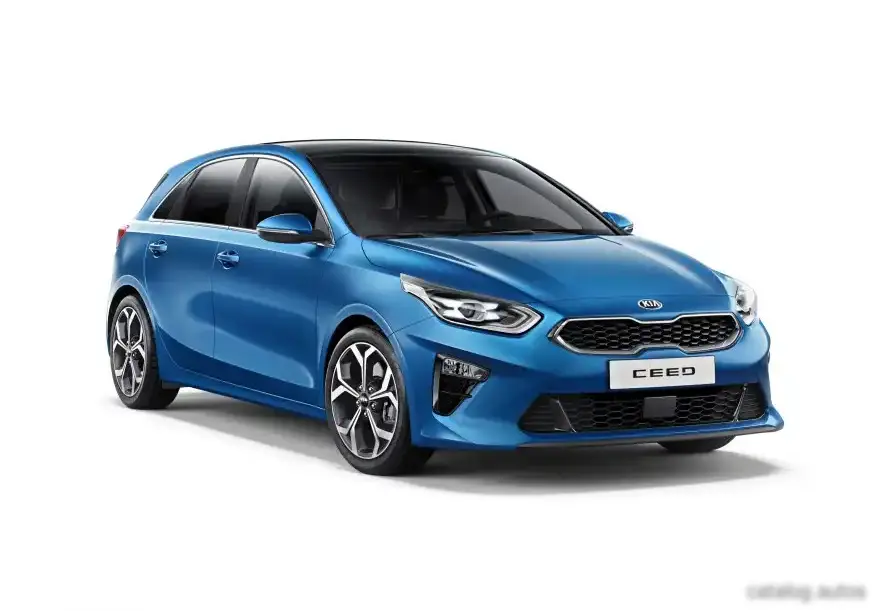
The Kia Ceed III 1.0 T-GDI, producing 100 horsepower, was a key variant in the third generation of Kia’s popular C-segment hatchback, sold from September 2019 to September 2021. Positioned as an entry-level offering within the Ceed lineup, it aimed to provide a balance of fuel efficiency, affordability, and modern features. This model represented Kia’s continued efforts to establish itself as a mainstream competitor in the European market, offering a compelling alternative to established brands like Volkswagen, Ford, and Opel/Vauxhall. The Ceed III, built on the K2 platform (shared with the Hyundai i30), represented a significant step forward in terms of design, technology, and overall refinement compared to its predecessors.
Technical Specifications
| Brand | Kia |
| Model | Cee’d |
| Generation | Ceed III |
| Type (Engine) | 1.0 T-GDI (100 Hp) |
| Start of production | September, 2019 |
| End of production | September, 2021 |
| Powertrain Architecture | Internal Combustion engine |
| Body type | Hatchback |
| Seats | 5 |
| Doors | 5 |
| Combined fuel consumption (WLTP) | 5.2-6.4 l/100 km (45.2 – 36.8 US mpg, 54.3 – 44.1 UK mpg, 19.2 – 15.6 km/l) |
| CO2 emissions (WLTP) | 119-145 g/km |
| Fuel consumption (economy) – urban (NEDC, WLTP equivalent) | 6.3-7.2 l/100 km (37.3 – 32.7 US mpg, 44.8 – 39.2 UK mpg, 15.9 – 13.9 km/l) |
| Fuel consumption (economy) – extra urban (NEDC, WLTP equivalent) | 4.3-5 l/100 km (54.7 – 47 US mpg, 65.7 – 56.5 UK mpg, 23.3 – 20 km/l) |
| Fuel consumption (economy) – combined (NEDC, WLTP equivalent) | 5.1-5.8 l/100 km (46.1 – 40.6 US mpg, 55.4 – 48.7 UK mpg, 19.6 – 17.2 km/l) |
| CO2 emissions (NEDC, WLTP equivalent) | 116-133 g/km |
| Fuel Type | Petrol (Gasoline) |
| Acceleration 0 – 100 km/h | 11.8 sec |
| Acceleration 0 – 62 mph | 11.8 sec |
| Acceleration 0 – 60 mph | 11.2 sec |
| Maximum speed | 183 km/h (113.71 mph) |
| Emission standard | Euro 6d |
| Weight-to-power ratio | 12.2 kg/Hp, 81.8 Hp/tonne |
| Weight-to-torque ratio | 7.1 kg/Nm, 140.8 Nm/tonne |
| Power | 100 Hp @ 4500 rpm |
| Power per litre | 100.2 Hp/l |
| Torque | 172 Nm @ 1500-4000 rpm (126.86 lb.-ft. @ 1500-4000 rpm) |
| Engine layout | Front, Transverse |
| Engine Model/Code | Kappa II / G3LC |
| Engine displacement | 998 cm3 (60.9 cu. in.) |
| Number of cylinders | 3 |
| Engine configuration | Inline |
| Cylinder Bore | 71 mm (2.8 in.) |
| Piston Stroke | 84 mm (3.31 in.) |
| Compression ratio | 10.5:1 |
| Number of valves per cylinder | 4 |
| Fuel injection system | Direct injection |
| Engine aspiration | Turbocharger, Intercooler |
| Valvetrain | DOHC |
| Engine oil capacity | 3.6 l (3.8 US qt | 3.17 UK qt) |
| Coolant | 5.5 l (5.81 US qt | 4.84 UK qt) |
| Kerb Weight | 1222-1352 kg (2694.05 – 2980.65 lbs.) |
| Max. weight | 1780-1800 kg (3924.23 – 3968.32 lbs.) |
| Max load | 448-558 kg (987.67 – 1230.18 lbs.) |
| Trunk (boot) space – minimum | 395 l (13.95 cu. ft.) |
| Trunk (boot) space – maximum | 1291 l (45.59 cu. ft.) |
| Fuel tank capacity | 50 l (13.21 US gal | 11 UK gal) |
| Max. roof load | 80 kg (176.37 lbs.) |
| Permitted trailer load with brakes (12%) | 1000 kg (2204.62 lbs.) |
| Permitted trailer load without brakes | 500 kg (1102.31 lbs.) |
| Permitted towbar download | 75 kg (165.35 lbs.) |
| Length | 4310 mm (169.69 in.) |
| Width | 1800 mm (70.87 in.) |
| Width including mirrors | 2055 mm (80.91 in.) |
| Height | 1447 mm (56.97 in.) |
| Wheelbase | 2650 mm (104.33 in.) |
| Front track | 1559-1573 mm (61.38 – 61.93 in.) |
| Rear (Back) track | 1567-1581 mm (61.69 – 62.24 in.) |
| Front overhang | 880 mm (34.65 in.) |
| Rear overhang | 780 mm (30.71 in.) |
| Minimum turning circle (turning diameter) | 10.6 m (34.78 ft.) |
| Drivetrain Architecture | The Internal combustion engine (ICE) drives the front wheels of the vehicle. |
| Drive wheel | Front wheel drive |
| Number of gears and type of gearbox | 6 gears, manual transmission |
| Front suspension | Independent, type McPherson with coil spring and anti-roll bar |
| Rear suspension | Independent multi-link spring suspension with stabilizer |
| Front brakes | Ventilated discs, 280×23 mm |
| Rear brakes | Disc, 272×10 mm |
| Assisting systems | ABS (Anti-lock braking system) |
| Steering type | Steering rack and pinion |
| Power steering | Electric Steering |
| Tires size | 195/65 R15; 205/55 R16; 225/45 R17 |
| Wheel rims size | 6J x 15; 6.5J x 16; 7J x 17 |
Powertrain & Engine Architecture
The heart of the Ceed III 1.0 T-GDI is Kia’s Kappa II engine, specifically the G3LC code. This is a 998cc, three-cylinder turbocharged gasoline engine. The engine utilizes direct fuel injection, a key technology for maximizing efficiency and reducing emissions. The turbocharger, coupled with an intercooler, helps to overcome the inherent power limitations of a small displacement engine, providing a reasonable level of performance. The engine features a double overhead camshaft (DOHC) valvetrain with four valves per cylinder, optimizing gas flow for improved power output. The engine’s relatively high compression ratio of 10.5:1 further contributes to its efficiency. The 1.0 T-GDI was typically paired with a six-speed manual transmission, although a seven-speed dual-clutch transmission (DCT) was also available as an option. The DCT offered quicker shifts and a more refined driving experience, but the manual was the more common choice in the base trim levels.
Driving Characteristics
The 100 hp 1.0 T-GDI Ceed offered adequate, though not exhilarating, performance. Acceleration from 0-60 mph took around 11.2 seconds, and top speed was approximately 113.71 mph. The engine’s 172 Nm (126.86 lb-ft) of torque, available from 1500-4000 rpm, provided sufficient pull for everyday driving situations. However, when fully loaded or tackling steep inclines, the engine could feel strained. Compared to the more powerful 1.4 T-GDI or diesel variants, the 1.0 T-GDI felt noticeably slower. The six-speed manual transmission was well-matched to the engine, with gear ratios designed to keep the engine within its optimal torque band. The steering was light and precise, making the car easy to maneuver in urban environments. The suspension provided a comfortable ride, absorbing bumps and imperfections in the road surface effectively.
Equipment & Trim Levels
The 1.0 T-GDI typically came in base or mid-level trim designations, such as ‘2’ or ‘3’ depending on the market. Standard equipment generally included air conditioning, a touchscreen infotainment system with Apple CarPlay and Android Auto compatibility, Bluetooth connectivity, and a suite of safety features including ABS, ESC (Electronic Stability Control), and multiple airbags. Higher trim levels added features like alloy wheels, a larger touchscreen display, a reversing camera, cruise control, and automatic headlights. Interior upholstery was typically cloth, with a functional and durable design. Optional extras included a panoramic sunroof, heated seats, and a premium audio system.
Chassis & Braking
The Ceed III utilized a McPherson strut front suspension and a multi-link rear suspension, providing a good balance of ride comfort and handling. The front brakes were ventilated discs, measuring 280x23mm, while the rear brakes were solid discs, measuring 272x10mm. ABS (Anti-lock Braking System) was standard, ensuring safe and controlled braking in emergency situations. Stabilizer bars were fitted to both the front and rear axles, reducing body roll during cornering. The Ceed’s chassis was designed to be lightweight yet rigid, contributing to its overall handling characteristics.
Market Reception & Comparison
The Kia Ceed III 1.0 T-GDI was generally well-received by critics as an affordable and efficient option in the C-segment hatchback market. Its fuel economy, ranging from 5.2-6.4 l/100 km, was a major selling point. However, some reviewers noted that the engine could feel underpowered, particularly when carrying passengers or luggage. Compared to the 1.4 T-GDI, the 1.0 T-GDI offered lower running costs but sacrificed performance. The diesel variants provided even better fuel economy but came with a higher purchase price and potential concerns about diesel emissions. The Ceed’s overall value proposition, combined with Kia’s seven-year warranty, made it a competitive choice against rivals like the Volkswagen Golf, Ford Focus, and Opel/Vauxhall Astra.
Legacy
The Kappa II 1.0 T-GDI engine has proven to be a relatively reliable powertrain, with few widespread issues reported. Its simple design and robust construction contribute to its longevity. On the used car market, the Ceed III 1.0 T-GDI represents a good value proposition for buyers seeking an affordable and fuel-efficient hatchback. Maintenance costs are generally reasonable, and parts availability is good. While not the most exciting car to drive, the Ceed III 1.0 T-GDI offers a practical and dependable transportation solution.