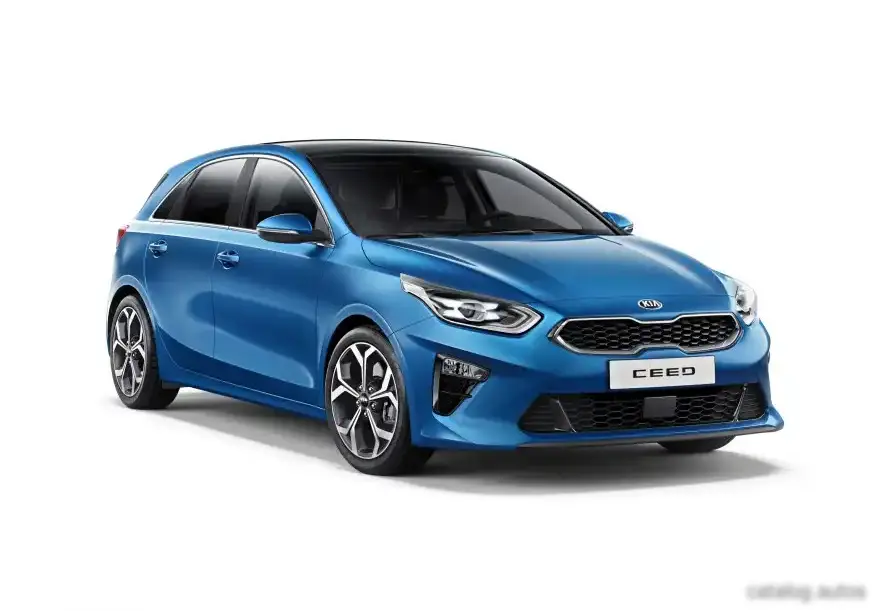
The Kia Ceed III 1.5 T-GDI (160 hp) Mild Hybrid DCT represents a significant step in Kia’s ongoing development of efficient and technologically advanced compact hatchbacks. Introduced in March 2021 and produced through September 2021, this variant occupied a mid-range position within the Ceed III lineup, offering a balance between performance, fuel economy, and modern features. It’s built on the 1HX0 platform, shared with the Hyundai i30, and aimed at the European market, where compact hatchbacks are a dominant segment. This version integrated a 48V mild-hybrid system to enhance fuel efficiency and reduce emissions, aligning with increasingly stringent European regulations.
Technical Specifications
| Brand | Kia |
| Model | Cee’d |
| Generation | Ceed III |
| Type (Engine) | 1.5 T-GDI (160 Hp) Mild Hybrid DCT |
| Start of production | March, 2021 |
| End of production | September, 2021 |
| Powertrain Architecture | MHEV (Mild Hybrid Electric Vehicle) |
| Body type | Hatchback |
| Seats | 5 |
| Doors | 5 |
| Combined fuel consumption (WLTP) | 5.6-6 l/100 km (42 – 39.2 US mpg) |
| CO2 emissions (WLTP) | 126-136 g/km |
| Fuel consumption (urban) | 6.4-6.6 l/100 km (36.8 – 35.6 US mpg) |
| Fuel consumption (extra urban) | 4.8-5.1 l/100 km (49 – 46.1 US mpg) |
| Fuel consumption (combined) | 5.4-5.6 l/100 km (43.6 – 42 US mpg) |
| CO2 emissions (NEDC) | 122-128 g/km |
| Fuel Type | Petrol (Gasoline) |
| Acceleration 0 – 100 km/h | 8.6 sec |
| Acceleration 0 – 62 mph | 8.6 sec |
| Acceleration 0 – 60 mph | 8.2 sec |
| Maximum speed | 210 km/h (130.49 mph) |
| Emission standard | Euro 6d |
| Weight-to-power ratio | 8.2 kg/Hp |
| Weight-to-torque ratio | 5.2 kg/Nm |
| Battery voltage | 48 V |
| Battery technology | Lithium-ion (Li-Ion) |
| Battery location | Under the trunk |
| Power | 160 Hp @ 5500 rpm |
| Torque | 253 Nm @ 1500-3500 rpm (186.6 lb.-ft.) |
| Engine layout | Front, Transverse |
| Engine Model/Code | Smartstream / G4LK |
| Engine displacement | 1482 cm3 (90.44 cu. in.) |
| Number of cylinders | 4 |
| Engine configuration | Inline |
| Cylinder Bore | 71.6 mm (2.82 in.) |
| Piston Stroke | 92 mm (3.62 in.) |
| Compression ratio | 10.5:1 |
| Number of valves per cylinder | 4 |
| Fuel injection system | Direct injection |
| Engine aspiration | Turbocharger, Intercooler |
| Valvetrain | DOHC |
| Engine oil capacity | 4.2 l (4.44 US qt | 3.7 UK qt) |
| Coolant capacity | 6.1 l (6.45 US qt | 5.37 UK qt) |
| Kerb Weight | 1315-1434 kg (2899.08 – 3161.43 lbs.) |
| Max. weight | 1860 kg (4100.6 lbs.) |
| Max load | 426-545 kg (939.17 – 1201.52 lbs.) |
| Trunk (boot) space – minimum | 357 l (12.61 cu. ft.) |
| Trunk (boot) space – maximum | 1253 l (44.25 cu. ft.) |
| Fuel tank capacity | 50 l (13.21 US gal | 11 UK gal) |
| Max. roof load | 80 kg (176.37 lbs.) |
| Permitted trailer load with brakes (12%) | 1410 kg (3108.52 lbs.) |
| Permitted trailer load without brakes | 600 kg (1322.77 lbs.) |
| Permitted towbar download | 75 kg (165.35 lbs.) |
| Length | 4310 mm (169.69 in.) |
| Width | 1800 mm (70.87 in.) |
| Width including mirrors | 2055 mm (80.91 in.) |
| Height | 1447 mm (56.97 in.) |
| Wheelbase | 2650 mm (104.33 in.) |
| Front track | 1559-1565 mm (61.38 – 61.61 in.) |
| Rear track | 1567-1573 mm (61.69 – 61.93 in.) |
| Front overhang | 880 mm (34.65 in.) |
| Rear overhang | 780 mm (30.71 in.) |
| Minimum turning circle | 10.6 m (34.78 ft.) |
| Drivetrain Architecture | Front wheel drive, MHEV |
| Number of gears | 7 |
| Type of gearbox | Automatic transmission DCT |
| Front suspension | Independent, McPherson with coil spring and anti-roll bar |
| Rear suspension | Independent multi-link with stabilizer |
| Front brakes | Ventilated discs, 305×25 mm |
| Rear brakes | Disc, 272×10 mm |
| Tires size | 205/55 R16; 225/45 R17 |
| Wheel rims size | 6.5J x 16; 7J x 17 |
INTRODUCTION
The Kia Ceed III 1.5 T-GDI (160 hp) Mild Hybrid DCT, launched in 2021, represents a key iteration of Kia’s popular C-segment hatchback. Positioned as a mid-range offering, it bridged the gap between more affordable base models and the higher-performance GT variants. This model year saw a refresh of the Ceed III, incorporating the 48V mild-hybrid system to improve fuel efficiency and lower emissions, responding to growing environmental concerns and tightening European regulations. The Ceed, meaning “Community” in Kia’s corporate branding, was designed to appeal to a broad European audience, offering a practical and well-equipped package.
Powertrain & Engine Architecture
At the heart of this Ceed variant lies the Smartstream G4LK 1.5-liter turbocharged four-cylinder engine. This engine, part of Kia’s next-generation Smartstream powertrain family, is characterized by its direct injection system and a cooled exhaust gas recirculation (EGR) system. The engine produces 160 horsepower at 5500 rpm and 253 Nm (186.6 lb-ft) of torque between 1500 and 3500 rpm. The turbocharger, coupled with an intercooler, provides a broad torque curve for responsive acceleration. The mild-hybrid system utilizes a 48V lithium-ion battery and a belt-driven starter generator (BSG). The BSG allows for extended engine-off coasting, regenerative braking to recapture energy, and a smoother start-stop function. The engine is paired with a 7-speed dual-clutch transmission (DCT), offering quick and precise gear changes. This DCT is known for its efficiency and responsiveness, contributing to the overall driving experience.
Driving Characteristics
The 1.5 T-GDI with the DCT delivers a balanced driving experience. While not as overtly sporty as the GT models, it provides ample power for everyday driving and highway cruising. The DCT transmission contributes to brisk acceleration, with a 0-60 mph time of around 8.2 seconds. The mild-hybrid system doesn’t dramatically alter the driving feel, but it does contribute to improved fuel economy, particularly in urban environments. The DCT’s gear ratios are tuned for a blend of efficiency and performance, providing adequate acceleration in most situations. Compared to the base 1.0 T-GDI engine, the 1.5 T-GDI offers a noticeable increase in power and torque, resulting in more confident overtaking and hill-climbing ability. It’s also more refined than the diesel options, offering smoother operation and reduced noise.
Equipment & Trim Levels
The Ceed III 1.5 T-GDI Mild Hybrid DCT typically came well-equipped, reflecting its mid-range positioning. Standard features often included an 8-inch touchscreen infotainment system with Apple CarPlay and Android Auto compatibility, a rear-view camera, automatic headlights, and rain-sensing wipers. Higher trim levels added features such as a larger 10.25-inch touchscreen, a digital instrument cluster, heated front seats, and a panoramic sunroof. Interior upholstery was typically a combination of cloth and leather, with a focus on comfort and durability. Safety features included lane keeping assist, forward collision avoidance assist, and driver attention warning.
Chassis & Braking
The Ceed III utilizes a McPherson strut front suspension and a multi-link rear suspension, providing a comfortable and controlled ride. The suspension is tuned to balance handling and ride quality, making it suitable for a variety of road conditions. Braking duties are handled by ventilated discs at the front and solid discs at the rear. Anti-lock braking system (ABS) and electronic stability control (ESC) are standard features, enhancing safety. The steering is electrically assisted, providing a light and precise feel.
Market Reception & Comparison
The Kia Ceed III 1.5 T-GDI Mild Hybrid DCT was generally well-received by automotive critics. It was praised for its fuel efficiency, comfortable ride, and well-equipped interior. Compared to its siblings, the 1.0 T-GDI offered lower running costs but less performance, while the GT models provided a more engaging driving experience but at a higher price point. The 1.6 CRDi diesel variants offered comparable fuel economy but were criticized for their noise and vibration. The mild-hybrid system was seen as a positive step towards reducing emissions, but some reviewers noted that the improvement in fuel economy was not dramatic.
Legacy
The Kia Ceed III 1.5 T-GDI Mild Hybrid DCT has proven to be a reliable and durable vehicle. The Smartstream engine has a good reputation for longevity, and the DCT transmission has generally been trouble-free. On the used car market, these models hold their value reasonably well, reflecting their popularity and reputation for reliability. The integration of the mild-hybrid system demonstrates Kia’s commitment to developing more sustainable and efficient vehicles, paving the way for future hybrid and electric models.