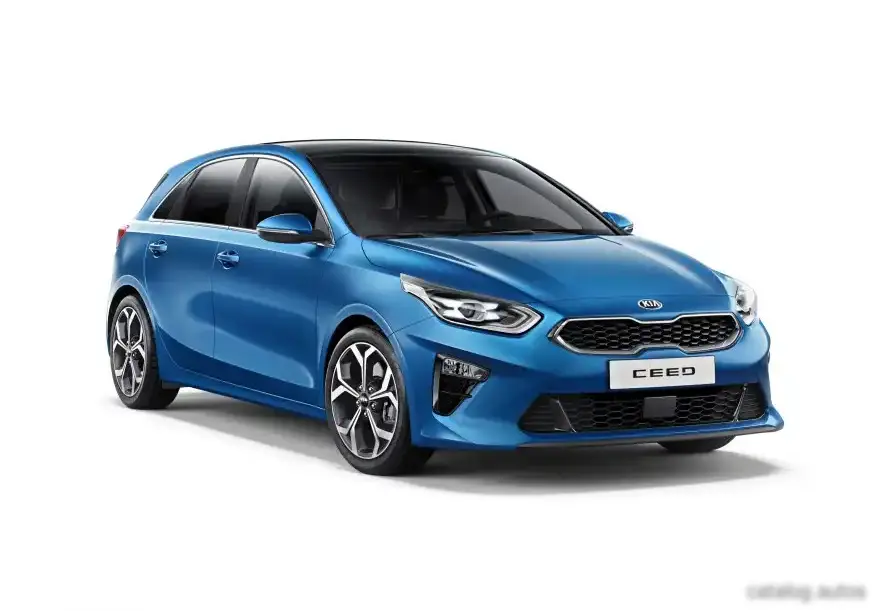
Technical Specifications
| Brand | Kia |
| Model | Cee’d |
| Generation | Ceed III |
| Type (Engine) | 1.6 CRDi (136 Hp) DCT |
| Start of production | June, 2018 |
| End of production | September, 2021 |
| Powertrain Architecture | Internal Combustion engine |
| Body type | Hatchback |
| Seats | 5 |
| Doors | 5 |
| Fuel consumption (urban) | 4.6 l/100 km (51.1 US mpg, 61.4 UK mpg, 21.7 km/l) |
| Fuel consumption (extra urban) | 4.1 l/100 km (57.4 US mpg, 68.9 UK mpg, 24.4 km/l) |
| Fuel consumption (combined) | 4.3 l/100 km (54.7 US mpg, 65.7 UK mpg, 23.3 km/l) |
| CO2 emissions | 111 g/km |
| Fuel Type | Diesel |
| Acceleration 0 – 100 km/h | 9.9 sec |
| Acceleration 0 – 62 mph | 9.9 sec |
| Acceleration 0 – 60 mph | 9.4 sec |
| Maximum speed | 200 km/h (124.27 mph) |
| Emission standard | Euro 6 d |
| Weight-to-power ratio | 9.9 kg/Hp, 101.5 Hp/tonne |
| Weight-to-torque ratio | 4.2 kg/Nm, 238.8 Nm/tonne |
| Power | 136 Hp @ 4000 rpm |
| Power per litre | 85.1 Hp/l |
| Torque | 320 Nm @ 2000-2250 rpm (236.02 lb.-ft. @ 2000-2250 rpm) |
| Engine layout | Front, Transverse |
| Engine Model/Code | D4FE |
| Engine displacement | 1598 cm3 (97.52 cu. in.) |
| Number of cylinders | 4 |
| Engine configuration | Inline |
| Cylinder Bore | 77 mm (3.03 in.) |
| Piston Stroke | 85.8 mm (3.38 in.) |
| Compression ratio | 15.9:1 |
| Number of valves per cylinder | 4 |
| Fuel injection system | Diesel Commonrail |
| Engine aspiration | Turbocharger, Intercooler |
| Engine oil capacity | 4.4 l (4.65 US qt | 3.87 UK qt) |
| Coolant | 7.7 l (8.14 US qt | 6.78 UK qt) |
| Kerb Weight | 1340 kg (2954.19 lbs.) |
| Max. weight | 1900 kg (4188.78 lbs.) |
| Max load | 560 kg (1234.59 lbs.) |
| Trunk (boot) space – minimum | 395 l (13.95 cu. ft.) |
| Trunk (boot) space – maximum | 1291 l (45.59 cu. ft.) |
| Fuel tank capacity | 50 l (13.21 US gal | 11 UK gal) |
| Max. roof load | 80 kg (176.37 lbs.) |
| Permitted trailer load with brakes (12%) | 1500 kg (3306.93 lbs.) |
| Permitted trailer load without brakes | 650 kg (1433 lbs.) |
| Permitted towbar download | 75 kg (165.35 lbs.) |
| Length | 4310 mm (169.69 in.) |
| Width | 1800 mm (70.87 in.) |
| Width including mirrors | 2055 mm (80.91 in.) |
| Height | 1447 mm (56.97 in.) |
| Wheelbase | 2650 mm (104.33 in.) |
| Front track | 1559-1573 mm (61.38 – 61.93 in.) |
| Rear (Back) track | 1567-1581 mm (61.69 – 62.24 in.) |
| Front overhang | 880 mm (34.65 in.) |
| Rear overhang | 780 mm (30.71 in.) |
| Minimum turning circle | 10.6 m (34.78 ft.) |
| Drivetrain Architecture | Front wheel drive |
| Number of gears and type of gearbox | 7 gears, automatic transmission DCT |
| Front suspension | Independent type McPherson |
| Rear suspension | Independent multi-link suspension |
| Front brakes | Ventilated discs |
| Rear brakes | Disc |
| Tires size | 195/65 R15; 205/55 R16; 225/45 R17 |
| Wheel rims size | 6.0J x 15; 6.5J x 16; 7.0J x 17 |
The Kia Ceed III 1.6 CRDi (136 Hp) DCT, launched in 2018, was a key component of Kia’s strategy to gain market share in the competitive European C-segment. This variant utilized a 1.6-liter turbocharged diesel engine paired with a 7-speed dual-clutch transmission (DCT), offering a blend of efficiency and convenience. It was positioned as a step up from the base 1.4-liter petrol engine, providing more torque and better fuel economy for drivers covering longer distances. The Ceed III represented a significant leap forward in terms of design, quality, and technology compared to its predecessors, and this particular engine/transmission combination was a popular choice for buyers prioritizing practicality and running costs.
Powertrain & Engine Architecture
The heart of this Ceed variant is the D4FE 1.6-liter four-cylinder diesel engine. This engine is a common-rail direct injection (CRDi) unit, meaning fuel is delivered directly into the cylinders at extremely high pressure for optimized combustion. The D4FE engine benefits from a turbocharger with an intercooler, boosting power output and improving torque delivery. The engine produces 136 horsepower at 4,000 rpm and a substantial 320 Nm (236 lb-ft) of torque between 2,000 and 2,250 rpm. This torque curve provides strong acceleration in everyday driving situations. The 7-speed DCT transmission offers quick and smooth gear changes, enhancing both performance and fuel efficiency. Unlike a traditional automatic, the DCT utilizes two separate clutches for odd and even gears, allowing for near-instantaneous shifts.
Driving Characteristics
The 1.6 CRDi DCT offers a composed and refined driving experience. While not a performance-oriented variant, the 320 Nm of torque provides ample power for overtaking and merging onto highways. The DCT transmission contributes to a responsive feel, and the gear ratios are well-suited for both urban and motorway driving. Compared to the 6-speed manual version of the same engine, the DCT offers greater convenience, particularly in stop-and-go traffic. However, some drivers may find the DCT slightly less engaging than a traditional manual gearbox. Acceleration from 0-60 mph takes approximately 9.4 seconds, which is respectable for a diesel-powered hatchback in this class. The engine is relatively quiet and refined, minimizing noise and vibration in the cabin.
Equipment & Trim Levels
The 1.6 CRDi DCT was typically offered in mid-range trim levels, such as ‘2’ or ‘3’ depending on the specific market. Standard equipment generally included air conditioning, a touchscreen infotainment system with Apple CarPlay and Android Auto compatibility, Bluetooth connectivity, and a suite of safety features including autonomous emergency braking, lane keeping assist, and hill-start assist. Higher trim levels added features like a larger touchscreen, navigation system, heated seats, a panoramic sunroof, and leather upholstery. Interior materials were of good quality for the price point, and the cabin was well-designed and ergonomic.
Chassis & Braking
The Ceed III utilizes a McPherson strut front suspension and a multi-link rear suspension, providing a comfortable and controlled ride. The suspension is tuned to prioritize comfort over outright sportiness, but it still offers decent handling characteristics. Braking duties are handled by ventilated discs at the front and solid discs at the rear. Anti-lock braking system (ABS) and electronic stability control (ESC) are standard features, enhancing safety and stability. The steering is electrically assisted, providing a light and precise feel.
Market Reception & Comparison
The Kia Ceed III 1.6 CRDi DCT was generally well-received by automotive critics. It was praised for its fuel efficiency, comfortable ride, and generous equipment levels. Compared to the petrol-powered variants, the diesel offered significantly better fuel economy, making it an attractive option for high-mileage drivers. Against competitors like the Volkswagen Golf and Ford Focus, the Ceed offered a compelling value proposition, often undercutting them on price while providing similar levels of equipment and performance. However, some critics noted that the interior design wasn’t quite as sophisticated as some of its rivals. The diesel engine, while efficient, faced increasing scrutiny due to tightening emissions regulations.
Legacy
The Kia Ceed III 1.6 CRDi DCT has proven to be a reliable and durable vehicle. The D4FE engine, while not without its potential issues (like diesel particulate filter clogging with short journeys), is generally considered robust and long-lasting. The DCT transmission, if properly maintained (regular fluid changes are crucial), is also relatively reliable. On the used car market, these models represent good value for money, offering a practical and economical option for buyers seeking a well-equipped and comfortable hatchback. However, potential buyers should be aware of the potential costs associated with diesel maintenance and the impact of future emissions regulations on diesel vehicle ownership.