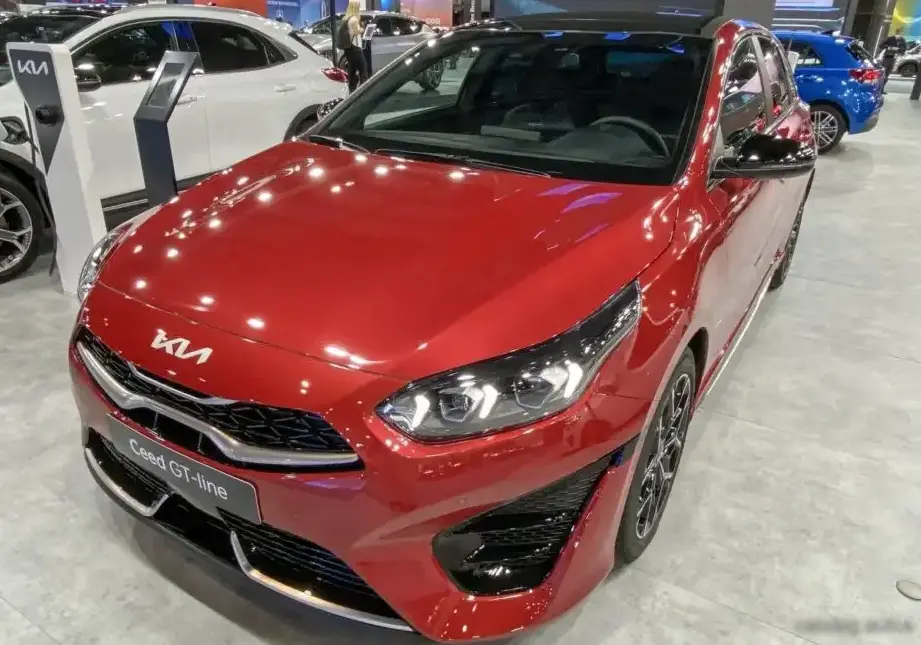
The Kia Ceed III (facelift, introduced in October 2021 and produced through April 2024) 1.6 CRDI (136 hp) Mild Hybrid represents a significant iteration within the third generation of Kia’s popular C-segment hatchback. Positioned as a fuel-efficient and practical option within the Ceed lineup, this variant aimed to appeal to buyers seeking a balance between economy, reasonable performance, and modern technology. It falls within the broader context of the CD (Ceed) platform, shared with the Hyundai i30, and represents Kia’s continued push towards electrification with its mild-hybrid system. This specific configuration was a key offering in European markets, where diesel engines remained popular due to their fuel efficiency and suitability for long-distance driving.
Technical Specifications
| Brand | Kia |
| Model | Cee’d |
| Generation | Ceed III (facelift 2021) |
| Type (Engine) | 1.6 CRDI (136 Hp) Mild Hybrid |
| Start of production | October, 2021 |
| End of production | April, 2024 |
| Powertrain Architecture | MHEV (Mild Hybrid Electric Vehicle) |
| Body type | Hatchback |
| Seats | 5 |
| Doors | 5 |
| Combined fuel consumption (WLTP) | 4.5 l/100 km (52.3 US mpg, 62.8 UK mpg, 22.2 km/l) |
| CO2 emissions (WLTP) | 118-127 g/km |
| Fuel consumption (urban, WLTP) | 4.2-4.5 l/100 km (56 – 52.3 US mpg, 67.3 – 62.8 UK mpg, 23.8 – 22.2 km/l) |
| Fuel consumption (extra urban, WLTP) | 3.7-4 l/100 km (63.6 – 58.8 US mpg, 76.3 – 70.6 UK mpg, 27 – 25 km/l) |
| Fuel consumption (combined, WLTP) | 3.9-4.2 l/100 km (60.3 – 56 US mpg, 72.4 – 67.3 UK mpg, 25.6 – 23.8 km/l) |
| CO2 emissions (NEDC, WLTP) | 102-109 g/km |
| Fuel Type | Diesel |
| Acceleration 0 – 100 km/h | 10.2 sec |
| Acceleration 0 – 62 mph | 10.2 sec |
| Acceleration 0 – 60 mph | 9.7 sec |
| Maximum speed | 200 km/h (124.27 mph) |
| Emission standard | Euro 6d |
| Weight-to-power ratio | 9.9 kg/Hp |
| Weight-to-torque ratio | 4.8 kg/Nm |
| Power | 136 Hp @ 4000 rpm |
| Torque | 280 Nm @ 1500-3000 rpm (206.52 lb.-ft.) |
| Engine layout | Front, Transverse |
| Engine Model/Code | D4FE |
| Engine displacement | 1598 cm3 (97.52 cu. in.) |
| Number of cylinders | 4 |
| Engine configuration | Inline |
| Cylinder Bore | 77 mm (3.03 in.) |
| Piston Stroke | 85.8 mm (3.38 in.) |
| Compression ratio | 15.9:1 |
| Number of valves per cylinder | 4 |
| Fuel injection system | Diesel Commonrail |
| Engine aspiration | Turbocharger, Intercooler |
| Engine oil capacity | 4.4 l (4.65 US qt, 3.87 UK qt) |
| Coolant capacity | 7.7 l (8.14 US qt, 6.78 UK qt) |
| Kerb Weight | 1343-1461 kg (2960.81 – 3220.95 lbs.) |
| Max. weight | 1890 kg (4166.74 lbs.) |
| Max load | 429-547 kg (945.78 – 1205.93 lbs.) |
| Trunk (boot) space – minimum | 357 l (12.61 cu. ft.) |
| Trunk (boot) space – maximum | 1253 l (44.25 cu. ft.) |
| Fuel tank capacity | 50 l (13.21 US gal, 11 UK gal) |
| AdBlue tank capacity | 12 l (3.17 US gal, 2.64 UK gal) |
| Max. roof load | 80 kg (176.37 lbs.) |
| Permitted trailer load (braked) | 1500 kg (3306.93 lbs.) |
| Permitted trailer load (unbraked) | 650 kg (1433 lbs.) |
| Permitted towbar download | 75 kg (165.35 lbs.) |
| Length | 4315-4325 mm (169.88 – 170.28 in.) |
| Width | 1800 mm (70.87 in.) |
| Width including mirrors | 2055 mm (80.91 in.) |
| Height | 1442-1447 mm (56.77 – 56.97 in.) |
| Wheelbase | 2650 mm (104.33 in.) |
| Front track | 1559-1565 mm (61.38 – 61.61 in.) |
| Rear track | 1567-1573 mm (61.69 – 61.93 in.) |
| Front overhang | 885 mm (34.84 in.) |
| Rear overhang | 780-790 mm (30.71 – 31.1 in.) |
| Minimum turning circle | 10.6 m (34.78 ft.) |
| Drivetrain | Front wheel drive, MHEV |
| Number of gears | 6 |
| Gearbox type | Manual transmission iMT |
| Front suspension | Independent type McPherson |
| Rear suspension | Independent multi-link with stabilizer |
| Front brakes | Ventilated discs, 305×25 mm |
| Rear brakes | Disc, 284×10 mm |
| Steering type | Steering rack and pinion |
| Power steering | Electric |
| Tires size | 205/55 R16H; 225/45 R17V |
| Wheel rims size | 6.5J x 16 ET50; 7.0J x 17 ET53 |
INTRODUCTION
The Kia Ceed III 1.6 CRDI Mild Hybrid, launched in late 2021 as part of a comprehensive facelift for the third-generation Ceed, aimed to enhance the model’s appeal with improved fuel efficiency and reduced emissions. This variant occupied the mid-range position in the Ceed lineup, offering a compelling alternative to the more powerful petrol engines and the higher-specification diesel models. Built on the 1HX0/A3 platform, the facelift brought revised styling, upgraded technology, and the introduction of the 48V mild-hybrid system to the 1.6-liter diesel engine. The Ceed, as a whole, was designed to compete directly with established European rivals like the Volkswagen Golf, Ford Focus, and Peugeot 308, offering a strong value proposition with a generous warranty and a well-equipped interior.
Powertrain & Engine Architecture
At the heart of this Ceed variant lies the D4FE 1.6-liter four-cylinder diesel engine. This engine, a mainstay in the Hyundai-Kia group, benefits from a turbocharger and intercooler to deliver a respectable 136 horsepower at 4000 rpm and 280 Nm (206.52 lb.-ft.) of torque between 1500 and 3000 rpm. The engine utilizes a diesel commonrail fuel injection system, ensuring precise fuel delivery for optimal combustion and efficiency. The mild-hybrid system consists of a 48V starter-generator and a small battery. This system allows for features like extended idle stop/start, and regenerative braking, which recovers energy during deceleration to assist the engine and reduce fuel consumption. The engine is paired with a 6-speed manual transmission (designated iMT – Intelligent Manual Transmission) which offers smooth gear changes and contributes to the overall driving experience. The iMT system subtly adjusts engine torque to optimize shift quality.
Driving Characteristics
The 1.6 CRDI Mild Hybrid offers a comfortable and refined driving experience, prioritizing fuel economy over outright performance. Acceleration from 0-100 km/h (0-62 mph) takes approximately 10.2 seconds, which is adequate for everyday driving but doesn’t provide particularly brisk performance. The engine’s torque delivery is strong from low revs, making it well-suited for overtaking and navigating urban environments. The mild-hybrid system is largely unobtrusive, providing a subtle boost during acceleration and contributing to a smoother stop/start experience. Compared to the higher-output diesel variants, this version feels less powerful, but it offers significantly better fuel economy. The manual transmission, while not sporty, is precise and easy to use, and the gear ratios are well-chosen to maximize efficiency.
Equipment & Trim Levels
The Ceed III 1.6 CRDI Mild Hybrid typically came equipped with a generous level of standard features. These included air conditioning, a touchscreen infotainment system with Apple CarPlay and Android Auto compatibility, Bluetooth connectivity, and a suite of safety features such as lane keeping assist, forward collision avoidance assist, and automatic emergency braking. Higher trim levels added features like a larger touchscreen display, navigation system, heated seats, a panoramic sunroof, and premium upholstery. Interior materials were generally of good quality, and the cabin was well-designed and ergonomic. Optional extras included metallic paint, a parking assist system, and a premium sound system.
Chassis & Braking
The Ceed III utilizes a McPherson strut front suspension and a multi-link rear suspension, providing a comfortable and controlled ride. The suspension is tuned to prioritize comfort over sporty handling, but it still offers decent body control in corners. The steering is light and precise, making it easy to maneuver in urban environments. Braking duties are handled by ventilated discs at the front and solid discs at the rear. ABS (Anti-lock Braking System) is standard, ensuring safe and effective braking performance. Stabilizer bars are fitted to both the front and rear axles to reduce body roll during cornering.
Market Reception & Comparison
The Kia Ceed III 1.6 CRDI Mild Hybrid was generally well-received by automotive critics. It was praised for its fuel efficiency, comfortable ride, and generous equipment levels. However, some reviewers noted that the engine lacked the punch of the more powerful petrol and diesel options. Compared to the 1.0 T-GDi petrol engine, the 1.6 CRDI offered better fuel economy and torque, but less overall power. Against the higher-output 1.6 CRDI without the mild-hybrid system, the MHEV version provided a slight fuel economy advantage but at a potentially higher initial cost. The Ceed’s strong warranty and competitive pricing were also key selling points.
Legacy
The 1.6 CRDI Mild Hybrid powertrain has proven to be relatively reliable, with few widespread issues reported. The engine is known for its durability and longevity, and the mild-hybrid system has also demonstrated good reliability. In the used car market, this variant represents a good value proposition for buyers seeking a fuel-efficient and well-equipped hatchback. Its combination of practicality, economy, and technology makes it a compelling choice in the competitive C-segment. As with any diesel vehicle, regular maintenance and the use of high-quality oil are crucial to ensure long-term reliability.