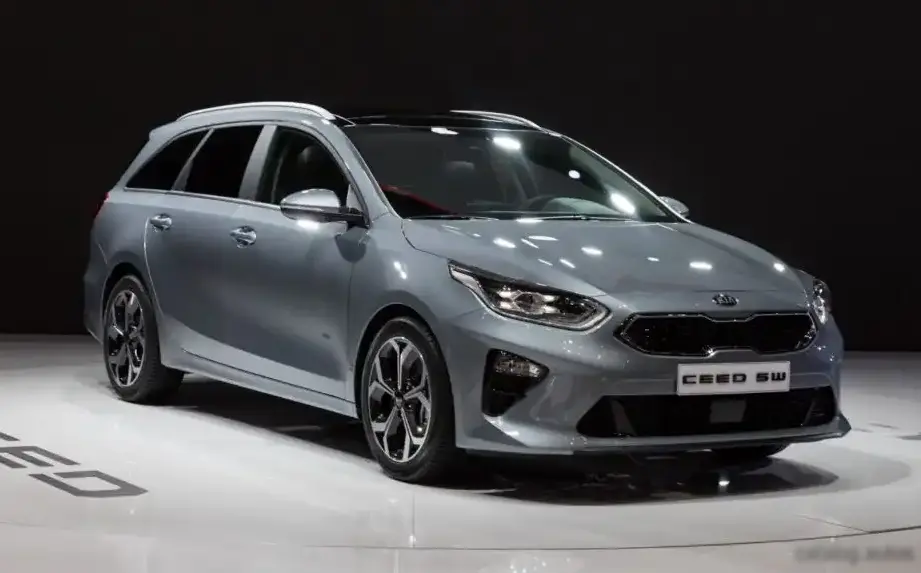
The Kia Ceed III Sportswagon 1.5 T-GDI, producing 160 horsepower, was a variant of the third-generation Ceed (JD) Sportswagon, manufactured between March and September 2021. Positioned as a mid-range offering within the Ceed lineup, it aimed to balance fuel efficiency with respectable performance for the European market. This model represented Kia’s continued effort to offer a practical and well-equipped compact estate car, competing with established rivals like the Volkswagen Golf Estate and Skoda Octavia Combi. The Sportswagon body style, a station wagon or estate, provided increased cargo capacity compared to the standard hatchback, appealing to families and those requiring more versatile load-carrying capabilities.
Technical Specifications
| Brand | Kia |
| Model | Ceed |
| Generation | Ceed III Sportswagon |
| Type (Engine) | 1.5 T-GDI (160 Hp) |
| Start of production | March, 2021 |
| End of production | September, 2021 |
| Powertrain Architecture | Internal Combustion engine |
| Body type | Station wagon (estate) |
| Seats | 5 |
| Doors | 5 |
| Combined fuel consumption (WLTP) | 5.5-6.3 l/100 km (42.8 – 37.3 US mpg, 51.4 – 44.8 UK mpg, 18.2 – 15.9 km/l) |
| CO2 emissions (WLTP) | 125-142 g/km |
| Fuel consumption (economy) – urban (NEDC, WLTP equivalent) | 6.8-7.1 l/100 km (34.6 – 33.1 US mpg, 41.5 – 39.8 UK mpg, 14.7 – 14.1 km/l) |
| Fuel consumption (economy) – extra urban (NEDC, WLTP equivalent) | 4.5-5.1 l/100 km (52.3 – 46.1 US mpg, 62.8 – 55.4 UK mpg, 22.2 – 19.6 km/l) |
| Fuel consumption (economy) – combined (NEDC, WLTP equivalent) | 5.3-5.8 l/100 km (44.4 – 40.6 US mpg, 53.3 – 48.7 UK mpg, 18.9 – 17.2 km/l) |
| CO2 emissions (NEDC, WLTP equivalent) | 121-132 g/km |
| Fuel Type | Petrol (Gasoline) |
| Acceleration 0 – 100 km/h | 8.6 sec |
| Acceleration 0 – 62 mph | 8.6 sec |
| Acceleration 0 – 60 mph | 8.2 sec |
| Maximum speed | 210 km/h (130.49 mph) |
| Emission standard | Euro 6d |
| Weight-to-power ratio | 8.1 kg/Hp, 122.9 Hp/tonne |
| Weight-to-torque ratio | 5.1 kg/Nm, 194.3 Nm/tonne |
| Power | 160 Hp @ 5500 rpm |
| Power per litre | 108 Hp/l |
| Torque | 253 Nm @ 1500-3500 rpm (186.6 lb.-ft. @ 1500-3500 rpm) |
| Engine layout | Front, Transverse |
| Engine Model/Code | Smartstream / G4LH |
| Engine displacement | 1482 cm3 (90.44 cu. in.) |
| Number of cylinders | 4 |
| Engine configuration | Inline |
| Cylinder Bore | 71.6 mm (2.82 in.) |
| Piston Stroke | 92 mm (3.62 in.) |
| Compression ratio | 10.5:1 |
| Number of valves per cylinder | 4 |
| Fuel injection system | Direct injection |
| Engine aspiration | Turbocharger, Intercooler |
| Valvetrain | DOHC |
| Engine oil capacity | 4.2 l (4.44 US qt | 3.7 UK qt) |
| Coolant | 6.1 l (6.45 US qt | 5.37 UK qt) |
| Kerb Weight | 1302-1418 kg (2870.42 – 3126.15 lbs.) |
| Max. weight | 1850 kg (4078.55 lbs.) |
| Max load | 432-548 kg (952.4 – 1208.13 lbs.) |
| Trunk (boot) space – minimum | 625 l (22.07 cu. ft.) |
| Trunk (boot) space – maximum | 1694 l (59.82 cu. ft.) |
| Fuel tank capacity | 50 l (13.21 US gal | 11 UK gal) |
| Max. roof load | 80 kg (176.37 lbs.) |
| Permitted trailer load with brakes (12%) | 1410 kg (3108.52 lbs.) |
| Permitted trailer load without brakes | 600 kg (1322.77 lbs.) |
| Permitted towbar download | 75 kg (165.35 lbs.) |
| Length | 4600 mm (181.1 in.) |
| Width | 1800 mm (70.87 in.) |
| Width including mirrors | 2055 mm (80.91 in.) |
| Height | 1465 mm (57.68 in.) |
| Wheelbase | 2650 mm (104.33 in.) |
| Front track | 1559-1565 mm (61.38 – 61.61 in.) |
| Rear (Back) track | 1567-1573 mm (61.69 – 61.93 in.) |
| Front overhang | 880 mm (34.65 in.) |
| Rear overhang | 1070 mm (42.13 in.) |
| Minimum turning circle (turning diameter) | 10.6 m (34.78 ft.) |
| Drivetrain Architecture | The Internal combustion engine (ICE) drives the front wheels of the vehicle. |
| Drive wheel | Front wheel drive |
| Number of gears and type of gearbox | 6 gears, manual transmission |
| Front suspension | Independent, type McPherson with coil spring and anti-roll bar |
| Rear suspension | Independent multi-link spring suspension with stabilizer |
| Front brakes | Ventilated discs, 305×25 mm |
| Rear brakes | Disc, 272×10 mm |
| Assisting systems | ABS (Anti-lock braking system) |
| Steering type | Steering rack and pinion |
| Power steering | Electric Steering |
| Tires size | 205/55 R16; 225/45 R17; 225/40 R18 |
| Wheel rims size | 6.5J x 16; 7J x 17; 7.5J x 18 |
INTRODUCTION
The Kia Ceed III Sportswagon 1.5 T-GDI (160 Hp) was a key variant within the third generation of Kia’s popular Ceed model range. Introduced in 2021 as part of a mid-cycle refresh (facelift) of the JD platform, it offered a compelling blend of practicality, efficiency, and modern features. The Sportswagon body style, built on the 1HX0/JD platform, expanded the Ceed’s appeal to buyers needing more cargo space than the standard five-door hatchback could provide. This variant specifically targeted buyers seeking a balance between performance and fuel economy, making it a popular choice in the competitive European compact estate market.
Powertrain & Engine Architecture
At the heart of the Ceed Sportswagon 1.5 T-GDI lies Kia’s Smartstream G4LH engine. This 1.5-liter, inline-four cylinder gasoline engine utilizes direct injection and a single scroll turbocharger with intercooling to deliver 160 horsepower at 5500 rpm and 253 Nm (186.6 lb.-ft.) of torque between 1500 and 3500 rpm. The engine features a dual-port fuel injection system and a relatively high compression ratio of 10.5:1, contributing to its efficiency. The engine is transversely mounted in the front of the vehicle. The 6-speed manual transmission was standard, providing a balance between fuel economy and driver engagement. The transmission’s gear ratios were tuned to maximize the engine’s torque output, providing adequate acceleration in everyday driving situations.
Driving Characteristics
The 1.5 T-GDI engine, paired with the 6-speed manual transmission, offered a reasonably responsive driving experience. Acceleration from 0 to 100 km/h (0-62 mph) took approximately 8.6 seconds. While not a performance-oriented variant, the engine provided sufficient power for overtaking and highway cruising. The turbocharger provided a noticeable boost in power at lower engine speeds, minimizing turbo lag. Compared to higher-output Ceed variants, such as those with larger engines, the 1.5 T-GDI prioritized fuel efficiency over outright performance. The manual transmission allowed for greater driver control, but the gear ratios were optimized for economy rather than sporty driving.
Equipment & Trim Levels
The 1.5 T-GDI Sportswagon typically came equipped with a generous level of standard features. These included air conditioning, a touchscreen infotainment system with Apple CarPlay and Android Auto compatibility, Bluetooth connectivity, and a suite of safety features such as lane keeping assist, forward collision avoidance assist, and automatic emergency braking. Higher trim levels offered additional features such as a larger touchscreen display, navigation system, heated seats, a panoramic sunroof, and leather upholstery. Interior upholstery was typically cloth on base models, with leather options available on higher trims. The dashboard layout was modern and functional, with a focus on ease of use.
Chassis & Braking
The Ceed Sportswagon 1.5 T-GDI utilized a McPherson strut front suspension and a multi-link rear suspension, providing a comfortable and controlled ride. The suspension was tuned to balance ride comfort with handling stability. Front brakes were ventilated discs measuring 305x25mm, while rear brakes were solid discs measuring 272x10mm. The braking system was equipped with ABS (Anti-lock Braking System) and Electronic Stability Control (ESC) as standard. The steering was electrically assisted, providing light and precise steering feel.
Market Reception & Comparison
The Kia Ceed III Sportswagon 1.5 T-GDI was generally well-received by automotive critics. It was praised for its practicality, fuel efficiency, and value for money. Compared to other trims in the Ceed lineup, the 1.5 T-GDI offered a good balance between performance and economy. It was often seen as a more sensible choice than the higher-output variants, particularly for drivers who prioritized fuel efficiency and everyday usability. Fuel economy figures ranged from 5.5 to 6.3 l/100 km (42.8 – 37.3 US mpg), making it a competitive option in its class.
Legacy
The Kia Ceed III Sportswagon 1.5 T-GDI has proven to be a reliable and durable vehicle. The Smartstream engine has a good reputation for longevity, and the 6-speed manual transmission is known for its robustness. On the used car market, these models continue to be popular choices due to their practicality, fuel efficiency, and affordability. While not a particularly rare or collectible vehicle, the 1.5 T-GDI Sportswagon represents a well-rounded and dependable option for buyers seeking a compact estate car.