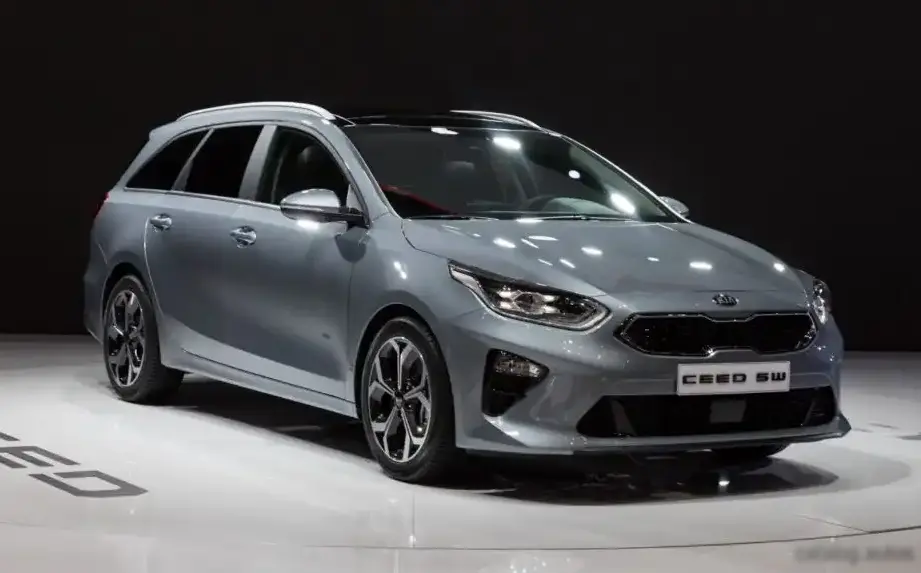
The Kia Ceed III Sportswagon 1.6 CRDi (136 hp) was a popular variant of the third-generation Ceed (JD) Sportswagon, produced from June 2018 to September 2021. Positioned as a mid-range offering within the Ceed lineup, it combined the practicality of a station wagon body style with a fuel-efficient diesel engine. This model aimed to appeal to buyers seeking a versatile and economical vehicle for family use or light commercial purposes, primarily targeting the European market where station wagons maintain significant popularity. The Ceed III Sportswagon, in general, represented Kia’s continued efforts to improve quality, design, and technology in the compact segment.
Technical Specifications
| Brand | Kia |
| Model | Cee’d |
| Generation | Ceed III Sportswagon |
| Type (Engine) | 1.6 CRDi (136 Hp) |
| Start of production | June, 2018 |
| End of production | September, 2021 |
| Powertrain Architecture | Internal Combustion engine |
| Body type | Station wagon (estate) |
| Seats | 5 |
| Doors | 5 |
| Fuel consumption (urban) | 4.5-4.7 l/100 km (62.8 – 60.1 UK mpg, 52.3 – 50 US mpg, 22.2 – 21.3 km/l) |
| Fuel consumption (extra urban) | 3.7-4 l/100 km (76.3 – 70.6 UK mpg, 63.6 – 58.8 US mpg, 27 – 25 km/l) |
| Fuel consumption (combined) | 3.9-4.3 l/100 km (72.4 – 65.7 UK mpg, 60.3 – 54.7 US mpg, 25.6 – 23.3 km/l) |
| CO2 emissions | 104-111 g/km |
| Fuel Type | Diesel |
| Acceleration 0 – 100 km/h | 11.1 sec |
| Acceleration 0 – 62 mph | 11.1 sec |
| Acceleration 0 – 60 mph | 10.5 sec |
| Maximum speed | 192 km/h (119.3 mph) |
| Emission standard | Euro 6d TEMP |
| Weight-to-power ratio | 9.9 kg/Hp, 100.7 Hp/tonne |
| Weight-to-torque ratio | 4.8 kg/Nm, 207.4 Nm/tonne |
| Power | 136 Hp @ 4000 rpm |
| Power per litre | 85.1 Hp/l |
| Torque | 280 Nm @ 1500-3000 rpm (206.52 lb.-ft. @ 1500-3000 rpm) |
| Engine layout | Front, Transverse |
| Engine Model/Code | D4FE |
| Engine displacement | 1598 cm3 (97.52 cu. in.) |
| Number of cylinders | 4 |
| Engine configuration | Inline |
| Cylinder Bore | 77 mm (3.03 in.) |
| Piston Stroke | 85.8 mm (3.38 in.) |
| Compression ratio | 15.9:1 |
| Number of valves per cylinder | 4 |
| Fuel injection system | Diesel Commonrail |
| Engine aspiration | Turbocharger, Intercooler |
| Valvetrain | DOHC |
| Engine oil capacity | 4.4 l (4.65 US qt | 3.87 UK qt) |
| Coolant capacity | 7.7 l (8.14 US qt | 6.78 UK qt) |
| Kerb Weight | 1350 kg (2976.24 lbs.) |
| Max. weight | 1481 kg (3265.05 lbs.) |
| Max load | 131 kg (288.81 lbs.) |
| Trunk (boot) space – minimum | 625 l (22.07 cu. ft.) |
| Trunk (boot) space – maximum | 1694 l (59.82 cu. ft.) |
| Fuel tank capacity | 50 l (13.21 US gal | 11 UK gal) |
| Max. roof load | 80 kg (176.37 lbs.) |
| Permitted trailer load with brakes (12%) | 1500 kg (3306.93 lbs.) |
| Permitted trailer load without brakes | 650 kg (1433 lbs.) |
| Permitted towbar download | 75 kg (165.35 lbs.) |
| Length | 4600 mm (181.1 in.) |
| Width | 1800 mm (70.87 in.) |
| Width including mirrors | 2055 mm (80.91 in.) |
| Height | 1465 mm (57.68 in.) |
| Wheelbase | 2650 mm (104.33 in.) |
| Front track | 1559-1573 mm (61.38 – 61.93 in.) |
| Rear track | 1567-1581 mm (61.69 – 62.24 in.) |
| Front overhang | 880 mm (34.65 in.) |
| Rear overhang | 1070 mm (42.13 in.) |
| Minimum turning circle | 10.6 m (34.78 ft.) |
| Drivetrain Architecture | Front wheel drive |
| Number of gears | 6 |
| Type of gearbox | Manual transmission |
| Front suspension | Independent, type McPherson with coil spring and anti-roll bar |
| Rear suspension | Independent multi-link spring suspension with stabilizer |
| Front brakes | Ventilated discs, 280×23 mm |
| Rear brakes | Disc, 272×10 mm |
| Assisting systems | ABS (Anti-lock braking system) |
| Steering type | Steering rack and pinion |
| Power steering | Electric Steering |
| Tires size | 195/65 R15; 205/55 R16; 225/45 R17; 225/40 R18 |
| Wheel rims size | 6J x 15; 6.5J x 16; 7J x 17; 7.5J x 18 |
Powertrain & Engine Architecture
The Kia Ceed III Sportswagon 1.6 CRDi utilized the D4FE engine, a 1.6-liter inline-four cylinder diesel engine. This engine was a mainstay in the Hyundai-Kia group’s diesel offerings. It featured a common-rail direct injection system, delivering fuel at extremely high pressure for optimized combustion. The D4FE engine employed a turbocharger with an intercooler to boost power and torque, while also improving efficiency. The engine’s valvetrain consisted of a Double Overhead Camshaft (DOHC) configuration with four valves per cylinder, enhancing breathing and overall performance. The 6-speed manual transmission was standard, providing a balance between fuel economy and driver control. The engine produced 136 horsepower at 4,000 rpm and 280 Nm (206.52 lb-ft) of torque between 1,500 and 3,000 rpm, offering a broad torque band suitable for everyday driving and hauling loads.
Driving Characteristics
The 1.6 CRDi engine, paired with the 6-speed manual transmission, provided adequate performance for the Ceed Sportswagon. Acceleration from 0 to 60 mph took approximately 10.5 seconds, and the top speed was around 119.3 mph. While not a particularly sporty setup, the engine’s strong low-end torque made it well-suited for overtaking and navigating hilly terrain. The manual transmission allowed for precise gear selection, and the gear ratios were tuned for fuel efficiency. Compared to higher-output versions of the Ceed, such as those with gasoline engines, the 1.6 CRDi prioritized fuel economy and practicality over outright speed. The driving experience was generally comfortable and refined, with a focus on minimizing noise and vibration.
Equipment & Trim Levels
The 1.6 CRDi Sportswagon typically came with a reasonable level of standard equipment. This included air conditioning, a touchscreen infotainment system with Apple CarPlay and Android Auto compatibility, Bluetooth connectivity, and a suite of safety features such as ABS, ESC (Electronic Stability Control), and multiple airbags. Higher trim levels offered additional features like automatic climate control, a larger touchscreen display, a reversing camera, parking sensors, and upgraded interior materials. Interior upholstery was typically cloth, with options for leather seats on higher trims. Exterior features included alloy wheels, body-colored door handles and mirrors, and optional roof rails.
Chassis & Braking
The Ceed III Sportswagon featured a McPherson strut front suspension and a multi-link rear suspension, providing a comfortable ride and good handling characteristics. The suspension was tuned to balance ride comfort with stability, making it suitable for a variety of road conditions. The braking system consisted of ventilated discs on the front wheels and solid discs on the rear. ABS (Anti-lock Braking System) was standard, enhancing braking performance and safety. The steering was electrically assisted, providing light and precise steering feel.
Market Reception & Comparison
The Kia Ceed III Sportswagon 1.6 CRDi was generally well-received by automotive critics. It was praised for its fuel efficiency, practicality, and comfortable ride. However, some reviewers noted that the engine could feel underpowered when fully loaded or driving uphill. Compared to other diesel-powered station wagons in its class, the Ceed offered a competitive combination of features, price, and fuel economy. Its reliability was also considered to be good, backed by Kia’s industry-leading warranty. The 1.6 CRDi offered a more economical alternative to the gasoline-powered Ceed variants, appealing to drivers who prioritized fuel savings.
Legacy
The D4FE engine, while not known for being exceptionally complex, has proven to be reasonably reliable over the long term, provided it receives regular maintenance. Common issues include diesel particulate filter (DPF) clogging, particularly on vehicles used primarily for short trips. The Ceed III Sportswagon 1.6 CRDi remains a popular choice in the used car market, offering a practical and affordable option for buyers seeking a fuel-efficient station wagon. Its combination of space, economy, and reliability continues to make it a compelling proposition.