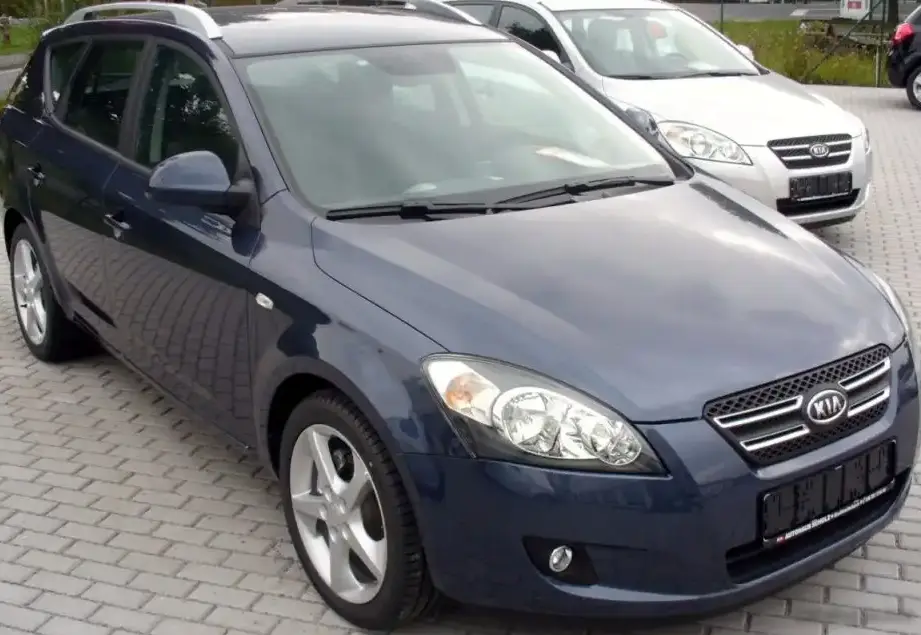
The Kia Cee’d SW I 1.6 CVVT, producing 122 horsepower, was a station wagon variant offered by Kia between 2007 and 2009. It represented Kia’s entry into the European compact estate market, built upon the first-generation Cee’d platform (ED). This model aimed to provide a practical and affordable option for families, offering increased cargo space compared to the hatchback version while maintaining a relatively economical driving experience. The Cee’d SW, in general, was Kia’s attempt to establish a stronger foothold in a segment dominated by established European manufacturers. This particular 1.6L engine and transmission combination occupied a mid-range position within the Cee’d SW lineup, offering a balance between fuel efficiency and acceptable performance.
Technical Specifications
| Brand | Kia |
| Model | Cee’d |
| Generation | Cee’d SW I |
| Type (Engine) | 1.6 CVVT (122 Hp) |
| Start of production | 2007 |
| End of production | 2009 |
| Powertrain Architecture | Internal Combustion engine |
| Body type | Station wagon (estate) |
| Seats | 5 |
| Doors | 5 |
| Fuel consumption (economy) – urban (NEDC) | 8.1 l/100 km (29 US mpg, 34.9 UK mpg, 12.3 km/l) |
| Fuel consumption (economy) – extra urban (NEDC) | 5.6 l/100 km (42 US mpg, 50.4 UK mpg, 17.9 km/l) |
| Fuel consumption (economy) – combined (NEDC) | 6.5 l/100 km (36.2 US mpg, 43.5 UK mpg, 15.4 km/l) |
| CO2 emissions (NEDC) | 154 g/km |
| Fuel Type | Petrol (Gasoline) |
| Acceleration 0 – 100 km/h | 11.1 sec |
| Acceleration 0 – 62 mph | 11.1 sec |
| Acceleration 0 – 60 mph | 10.5 sec |
| Maximum speed | 192 km/h (119.3 mph) |
| Emission standard | Euro 4 |
| Weight-to-power ratio | 10.8 kg/Hp, 92.6 Hp/tonne |
| Weight-to-torque ratio | 8.6 kg/Nm, 116.9 Nm/tonne |
| Power | 122 Hp @ 6200 rpm |
| Power per litre | 76.7 Hp/l |
| Torque | 154 Nm @ 5200 rpm (113.58 lb.-ft. @ 5200 rpm) |
| Engine layout | Front, Transverse |
| Engine Model/Code | G4FC |
| Engine displacement | 1591 cm3 (97.09 cu. in.) |
| Number of cylinders | 4 |
| Engine configuration | Inline |
| Cylinder Bore | 77 mm (3.03 in.) |
| Piston Stroke | 85.44 mm (3.36 in.) |
| Compression ratio | 10.5:1 |
| Number of valves per cylinder | 4 |
| Fuel injection system | Multi-port manifold injection |
| Engine aspiration | Naturally aspirated engine |
| Valvetrain | DOHC CVVT |
| Engine oil capacity | 3.3 l (3.49 US qt, 2.9 UK qt) |
| Coolant | 5.5 l (5.81 US qt, 4.84 UK qt) |
| Kerb Weight | 1317-1399 kg (2903.49 – 3084.27 lbs.) |
| Max. weight | 1820 kg (4012.41 lbs.) |
| Max load | 421-503 kg (928.15 – 1108.93 lbs.) |
| Trunk (boot) space – minimum | 534 l (18.86 cu. ft.) |
| Trunk (boot) space – maximum | 1664 l (58.76 cu. ft.) |
| Fuel tank capacity | 53 l (14 US gal, 11.66 UK gal) |
| Max. roof load | 80 kg (176.37 lbs.) |
| Permitted trailer load with brakes (12%) | 1200 kg (2645.55 lbs.) |
| Permitted trailer load without brakes | 550 kg (1212.54 lbs.) |
| Permitted towbar download | 55 kg (121.25 lbs.) |
| Length | 4470 mm (175.98 in.) |
| Width | 1790 mm (70.47 in.) |
| Height | 1490 mm (58.66 in.) |
| Wheelbase | 2650 mm (104.33 in.) |
| Front track | 1546 mm (60.87 in.) |
| Rear (Back) track | 1544 mm (60.79 in.) |
| Front overhang | 865 mm (34.06 in.) |
| Rear overhang | 955 mm (37.6 in.) |
| Minimum turning circle (turning diameter) | 10.3-10.8 m (33.79 – 35.43 ft.) |
| Drivetrain Architecture | The Internal combustion engine (ICE) drives the front wheels of the vehicle. |
| Drive wheel | Front wheel drive |
| Number of gears and type of gearbox | 5 gears, manual transmission |
| Front suspension | Independent type McPherson |
| Rear suspension | Independent multi-link suspension, Transverse stabilizer |
| Front brakes | Ventilated discs, 280 mm |
| Rear brakes | Disc, 262 mm |
| Assisting systems | ABS (Anti-lock braking system) |
| Steering type | Steering rack and pinion |
| Power steering | Electric Steering |
| Tires size | 185/65 R15; 195/65 R15; 205/55 R16; 225/45 R17 |
| Wheel rims size | 5.5J x 15; 6J x 16; 7J x 17 |
INTRODUCTION
The Kia Cee’d SW I 1.6 CVVT was produced from 2007 to 2009 as part of the first generation (ED) Cee’d family. Kia introduced the Cee’d specifically for the European market, aiming to offer a compelling alternative to established competitors like the Ford Focus, Volkswagen Golf, and Opel/Vauxhall Astra. The SW (Station Wagon) variant expanded the Cee’d’s appeal by providing increased practicality and cargo capacity. The 1.6 CVVT engine, paired with a five-speed manual transmission, was positioned as a mainstream offering, balancing affordability with reasonable performance and fuel economy. It was designed to appeal to buyers prioritizing everyday usability over outright speed.
Powertrain & Engine Architecture
The heart of the Cee’d SW 1.6 CVVT is the G4FC engine, a 1.6-liter inline-four cylinder gasoline engine. This engine utilizes multi-point fuel injection and a double overhead camshaft (DOHC) configuration with continuously variable valve timing (CVVT) on both intake and exhaust valves. The CVVT system optimizes valve timing based on engine speed and load, improving both performance and fuel efficiency. The engine produces 122 horsepower at 6200 rpm and 154 Nm (113.58 lb-ft) of torque at 5200 rpm. The five-speed manual transmission was the standard gearbox for this variant, offering a relatively conventional gear ratio spread. The transmission’s ratios were tuned for a balance of acceleration and fuel economy, rather than sporty performance. The engine’s design prioritized reliability and ease of maintenance, reflecting Kia’s broader strategy of building a reputation for quality.
Driving Characteristics
The 1.6L engine in the Cee’d SW, while adequate for everyday driving, wasn’t known for its blistering acceleration. The 0-60 mph time of around 10.5 seconds reflects this. The power delivery is relatively linear, with usable torque available from mid-range revs. Compared to higher-output versions of the Cee’d, or those equipped with a diesel engine, the 1.6 CVVT felt noticeably less responsive. The five-speed manual transmission, while precise, required frequent shifting to maintain momentum, especially when fully loaded or tackling inclines. The suspension setup provided a comfortable ride, prioritizing smoothness over sharp handling. Steering feel was light and predictable, making it easy to maneuver in urban environments. Overall, the driving experience was geared towards practicality and comfort rather than enthusiast-level performance.
Equipment & Trim Levels
The Cee’d SW 1.6 CVVT typically came with a reasonable level of standard equipment. Base models included air conditioning, power steering, electric front windows, and a basic audio system. Safety features such as ABS (Anti-lock Braking System) and front airbags were also standard. Higher trim levels, such as the LS and EX, added features like alloy wheels, rear electric windows, a more advanced audio system with CD player, and remote central locking. Optional extras included a sunroof, parking sensors, and upgraded upholstery. Interior materials were generally durable and functional, though not particularly luxurious. The dashboard layout was straightforward and user-friendly, with logically placed controls.
Chassis & Braking
The Cee’d SW utilized a front-wheel-drive layout with an independent McPherson strut suspension at the front and an independent multi-link suspension at the rear. The rear suspension incorporated a transverse stabilizer bar to reduce body roll during cornering. Braking duties were handled by ventilated discs at the front and solid discs at the rear. The braking system provided adequate stopping power for everyday driving, with ABS helping to maintain control during emergency braking situations. The chassis was designed to provide a comfortable ride and reasonable handling characteristics, prioritizing stability and predictability over sporty dynamics. The suspension tuning was geared towards absorbing bumps and imperfections in the road surface.
Market Reception & Comparison
The Kia Cee’d SW 1.6 CVVT was generally well-received by automotive critics as a practical and affordable family car. It was praised for its spacious interior, generous cargo capacity, and competitive price point. However, some reviewers noted that the 1.6-liter engine lacked the refinement and performance of some of its rivals. Compared to the diesel-powered Cee’d SW models, the 1.6 CVVT offered lower fuel economy but a smoother and quieter driving experience. Against competitors like the Ford Focus Estate and Volkswagen Golf Estate, the Cee’d SW offered a compelling value proposition, often undercutting them on price while providing a similar level of practicality. Reliability was also a strong point, with Kia steadily improving its reputation for build quality.
Legacy
The Kia Cee’d SW 1.6 CVVT has proven to be a relatively reliable and durable vehicle in the used car market. The G4FC engine is known for its longevity, and routine maintenance is generally straightforward and affordable. While not a particularly exciting car to drive, it provides a practical and economical transportation solution for families. Today, these vehicles can be found at very affordable prices, making them an attractive option for budget-conscious buyers. The Cee’d SW helped establish Kia as a credible player in the European compact estate market, paving the way for subsequent generations of Cee’d models.