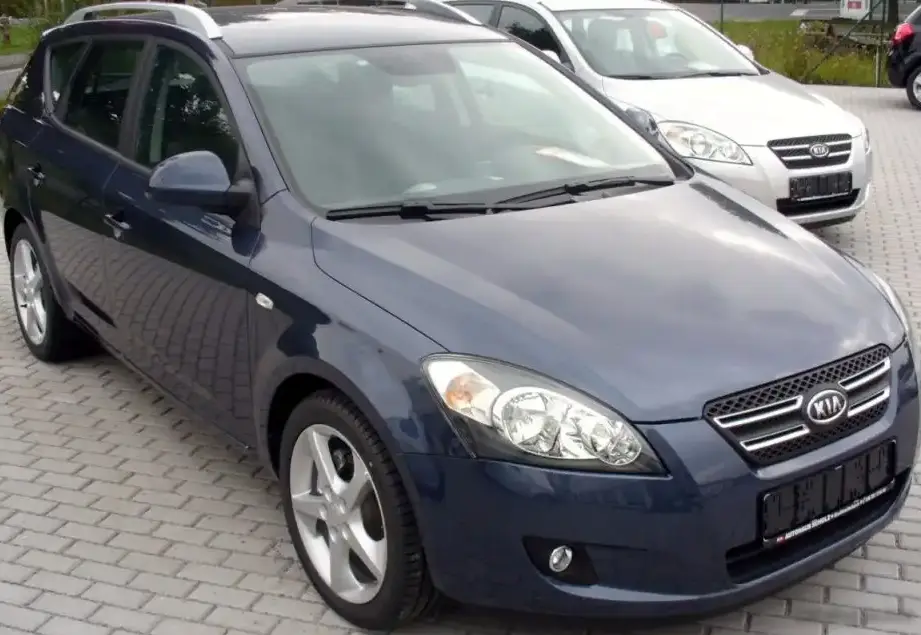
The Kia Cee’d SW I 2.0 CRDi (140 hp) was a station wagon variant produced between 2007 and 2009, representing a key offering in Kia’s expanding European lineup. Built on the ED platform (internally designated as the Cee’d), the SW – standing for Station Wagon – aimed to provide practicality and fuel efficiency within the compact family car segment. This particular 2.0 CRDi engine and transmission combination occupied a mid-range position within the Cee’d SW lineup, offering a balance between performance and economy, appealing to buyers needing both space and reasonable running costs. It was Kia’s attempt to establish a foothold in a market traditionally dominated by European manufacturers.
Technical Specifications
| Brand | Kia |
| Model | Cee’d |
| Generation | Cee’d SW I |
| Type (Engine) | 2.0 CRDi (140 Hp) |
| Start of production | 2007 |
| End of production | 2009 |
| Powertrain Architecture | Internal Combustion engine |
| Body type | Station wagon (estate) |
| Seats | 5 |
| Doors | 5 |
| Fuel consumption (economy) – urban (NEDC) | 7.7 l/100 km (30.5 US mpg, 36.7 UK mpg, 13 km/l) |
| Fuel consumption (economy) – extra urban (NEDC) | 4.7 l/100 km (50 US mpg, 60.1 UK mpg, 21.3 km/l) |
| Fuel consumption (economy) – combined (NEDC) | 5.8 l/100 km (40.6 US mpg, 48.7 UK mpg, 17.2 km/l) |
| CO2 emissions (NEDC) | 154 g/km |
| Fuel Type | Diesel |
| Acceleration 0 – 100 km/h | 10.5 sec |
| Acceleration 0 – 62 mph | 10.5 sec |
| Acceleration 0 – 60 mph | 10 sec |
| Maximum speed | 205 km/h (127.38 mph) |
| Emission standard | Euro 4 |
| Weight-to-power ratio | 10.8 kg/Hp, 92.5 Hp/tonne |
| Weight-to-torque ratio | 5 kg/Nm, 201.6 Nm/tonne |
| Power | 140 Hp @ 3800 rpm |
| Power per litre | 70.3 Hp/l |
| Torque | 305 Nm @ 1800-2500 rpm (224.96 lb.-ft. @ 1800-2500 rpm) |
| Engine layout | Front, Transverse |
| Engine Model/Code | D4EA |
| Engine displacement | 1991 cm3 (121.5 cu. in.) |
| Number of cylinders | 4 |
| Engine configuration | Inline |
| Cylinder Bore | 83 mm (3.27 in.) |
| Piston Stroke | 92 mm (3.62 in.) |
| Compression ratio | 17.3:1 |
| Number of valves per cylinder | 4 |
| Fuel injection system | Diesel Commonrail |
| Engine aspiration | Turbocharger, Intercooler |
| Valvetrain | SOHC |
| Engine oil capacity | 5.9 l (6.23 US qt | 5.19 UK qt) |
| Coolant | 7.3 l (7.71 US qt | 6.42 UK qt) |
| Kerb Weight | 1513-1572 kg (3335.59 – 3465.67 lbs.) |
| Max. weight | 1970 kg (4343.11 lbs.) |
| Max load | 398-457 kg (877.44 – 1007.51 lbs.) |
| Trunk (boot) space – minimum | 534 l (18.86 cu. ft.) |
| Trunk (boot) space – maximum | 1664 l (58.76 cu. ft.) |
| Fuel tank capacity | 53 l (14 US gal | 11.66 UK gal) |
| Max. roof load | 80 kg (176.37 lbs.) |
| Permitted trailer load with brakes (12%) | 1500 kg (3306.93 lbs.) |
| Permitted trailer load without brakes | 550 kg (1212.54 lbs.) |
| Permitted towbar download | 75 kg (165.35 lbs.) |
| Length | 4470 mm (175.98 in.) |
| Width | 1790 mm (70.47 in.) |
| Height | 1490 mm (58.66 in.) |
| Wheelbase | 2650 mm (104.33 in.) |
| Front track | 1546 mm (60.87 in.) |
| Rear (Back) track | 1544 mm (60.79 in.) |
| Front overhang | 865 mm (34.06 in.) |
| Rear overhang | 955 mm (37.6 in.) |
| Minimum turning circle (turning diameter) | 10.3-10.8 m (33.79 – 35.43 ft.) |
| Drivetrain Architecture | The Internal combustion engine (ICE) drives the front wheels of the vehicle. |
| Drive wheel | Front wheel drive |
| Number of gears and type of gearbox | 6 gears, manual transmission |
| Front suspension | Independent type McPherson |
| Rear suspension | Independent multi-link suspension, Transverse stabilizer |
| Front brakes | Ventilated discs, 280 mm |
| Rear brakes | Disc, 262 mm |
| Assisting systems | ABS (Anti-lock braking system) |
| Steering type | Steering rack and pinion |
| Power steering | Electric Steering |
| Tires size | 185/65 R15; 195/65 R15; 205/55 R16; 225/45 R17 |
| Wheel rims size | 5.5J x 15; 6J x 16; 7J x 17 |
Powertrain & Engine Architecture
The heart of this Cee’d SW variant is the Kia D4EA 2.0-liter inline-four cylinder diesel engine. This engine, a product of Kia’s own development, utilizes a second-generation common-rail direct injection system, delivering fuel at extremely high pressure for optimized combustion. The D4EA features a single overhead camshaft (SOHC) valvetrain operating four valves per cylinder. A turbocharger with an intercooler is employed to boost power and torque, mitigating turbo lag and improving engine responsiveness. The engine’s 17.3:1 compression ratio is typical for a diesel engine, contributing to its thermal efficiency. The engine was paired with a six-speed manual transmission, delivering power to the front wheels. While an automatic transmission was offered on other Cee’d models, the 2.0 CRDi 140 hp was exclusively available with the manual gearbox in the SW body style.
Driving Characteristics
The 140 hp 2.0 CRDi engine provided a respectable level of performance for the Cee’d SW. Acceleration from 0 to 60 mph took approximately 10 seconds, and it reached a top speed of 127 mph. The engine’s 305 Nm (225 lb-ft) of torque, available from 1800-2500 rpm, provided good pulling power for everyday driving and when carrying a load. The six-speed manual transmission allowed drivers to keep the engine in its optimal power band. Compared to the lower-powered 1.6 CRDi variants, the 2.0 CRDi offered noticeably more punch, especially when overtaking or climbing hills. However, it didn’t possess the outright performance of the petrol-powered models. The gear ratios were tuned for fuel efficiency, meaning the engine could feel slightly strained at higher speeds.
Equipment & Trim Levels
The 2.0 CRDi SW typically came equipped with a reasonable level of standard features. These included air conditioning, electric front windows, a radio/CD player, and central locking. Safety features such as ABS, front airbags, and seatbelt pretensioners were also standard. Higher trim levels, such as the ‘3’ or ‘4’ variants, added features like alloy wheels, rear parking sensors, climate control, and upgraded interior trim. Interior upholstery was typically cloth, with options for leather available on higher-spec models. The dashboard layout was functional and straightforward, prioritizing usability over stylistic flair.
Chassis & Braking
The Cee’d SW utilized a McPherson strut front suspension and a multi-link rear suspension, providing a comfortable and controlled ride. The suspension was tuned to balance ride comfort with handling stability. Braking duties were handled by ventilated discs at the front and solid discs at the rear. ABS (Anti-lock Braking System) was standard, enhancing braking performance and safety. The steering was rack and pinion with electric power assistance, offering a light and precise feel.
Market Reception & Comparison
The Kia Cee’d SW 2.0 CRDi was generally well-received by automotive critics. It was praised for its spacious interior, practical load-carrying capacity, and fuel efficiency. The 2.0 CRDi engine was considered a good compromise between performance and economy. However, some reviewers noted that the interior materials weren’t as refined as those found in some of its European rivals. Compared to the 1.6 CRDi variants, the 2.0 CRDi offered significantly better performance, but at a slightly higher price point. Fuel economy was competitive, averaging around 40.6 US mpg in combined driving.
Legacy
The Kia Cee’d SW I 2.0 CRDi has proven to be a relatively reliable vehicle in the used car market. The D4EA engine is known for its durability, provided it has been properly maintained. Common issues include wear and tear on suspension components and potential problems with the diesel particulate filter (DPF) if the vehicle has primarily been used for short journeys. Today, these vehicles represent an affordable and practical option for buyers seeking a spacious and fuel-efficient station wagon. The Cee’d SW helped Kia establish a stronger presence in the European market and laid the foundation for its subsequent success.