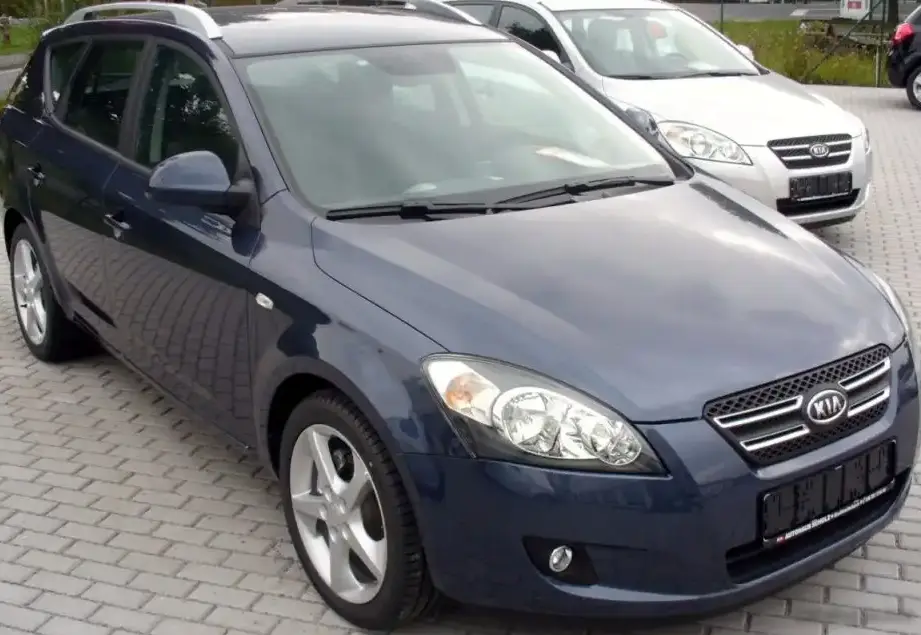
The Kia Cee’d SW I 2.0 CVVT (143 Hp) Automatic, produced between 2007 and 2009, represents a significant step for Kia in the European market. This variant of the first-generation Cee’d station wagon (estate) aimed to provide a practical and reasonably well-equipped family vehicle with the convenience of an automatic transmission. Positioned as a mid-range offering within the Cee’d SW lineup, it slotted above the base 1.4L models and below the more performance-oriented trims. The Cee’d, in general, was Kia’s first car designed specifically for the European market, and the SW (Station Wagon) body style added enhanced practicality to the package. It was built on the Hyundai-Kia EDIS platform, shared with the Hyundai i30.
Technical Specifications
| Brand | Kia |
| Model | Cee’d |
| Generation | Cee’d SW I |
| Type (Engine) | 2.0 CVVT (143 Hp) Automatic |
| Start of production | 2007 |
| End of production | 2009 |
| Powertrain Architecture | Internal Combustion engine |
| Body type | Station wagon (estate) |
| Seats | 5 |
| Doors | 5 |
| Fuel consumption (urban) | 10.2 l/100 km (23.1 US mpg, 27.7 UK mpg, 9.8 km/l) |
| Fuel consumption (extra urban) | 6.2 l/100 km (37.9 US mpg, 45.6 UK mpg, 16.1 km/l) |
| Fuel consumption (combined) | 7.7 l/100 km (30.5 US mpg, 36.7 UK mpg, 13 km/l) |
| CO2 emissions | 183 g/km |
| Fuel Type | Petrol (Gasoline) |
| Acceleration 0 – 100 km/h | 10.7 sec |
| Acceleration 0 – 62 mph | 10.7 sec |
| Acceleration 0 – 60 mph | 10.2 sec |
| Maximum speed | 195 km/h (121.17 mph) |
| Emission standard | Euro 4 |
| Weight-to-power ratio | 9.9 kg/Hp, 101.5 Hp/tonne |
| Weight-to-torque ratio | 7.6 kg/Nm, 132 Nm/tonne |
| Power | 143 Hp @ 6000 rpm |
| Power per litre | 72.4 Hp/l |
| Torque | 186 Nm @ 4600 rpm (137.19 lb.-ft. @ 4600 rpm) |
| Engine layout | Front, Transverse |
| Engine Model/Code | G4GC |
| Engine displacement | 1975 cm3 (120.52 cu. in.) |
| Number of cylinders | 4 |
| Engine configuration | Inline |
| Cylinder Bore | 82 mm (3.23 in.) |
| Piston Stroke | 93.5 mm (3.68 in.) |
| Compression ratio | 10.1:1 |
| Number of valves per cylinder | 4 |
| Fuel injection system | Multi-port manifold injection |
| Engine aspiration | Naturally aspirated engine |
| Valvetrain | DOHC CVVT |
| Engine oil capacity | 4 l (4.23 US qt | 3.52 UK qt) |
| Coolant capacity | 6.3 l (6.66 US qt | 5.54 UK qt) |
| Kerb Weight | 1409-1470 kg (3106.31 – 3240.8 lbs.) |
| Max. weight | 1900 kg (4188.78 lbs.) |
| Max load | 430-491 kg (947.99 – 1082.47 lbs.) |
| Trunk (boot) space – minimum | 534 l (18.86 cu. ft.) |
| Trunk (boot) space – maximum | 1664 l (58.76 cu. ft.) |
| Fuel tank capacity | 53 l (14 US gal | 11.66 UK gal) |
| Max. roof load | 80 kg (176.37 lbs.) |
| Permitted trailer load with brakes (12%) | 1500 kg (3306.93 lbs.) |
| Permitted trailer load without brakes | 550 kg (1212.54 lbs.) |
| Permitted towbar download | 75 kg (165.35 lbs.) |
| Length | 4470 mm (175.98 in.) |
| Width | 1790 mm (70.47 in.) |
| Height | 1490 mm (58.66 in.) |
| Wheelbase | 2650 mm (104.33 in.) |
| Front track | 1546 mm (60.87 in.) |
| Rear track | 1544 mm (60.79 in.) |
| Front overhang | 865 mm (34.06 in.) |
| Rear overhang | 955 mm (37.6 in.) |
| Minimum turning circle | 10.3-10.8 m (33.79 – 35.43 ft.) |
| Drivetrain | Front wheel drive |
| Number of gears | 4 |
| Gearbox type | automatic transmission |
| Front suspension | Independent type McPherson |
| Rear suspension | Independent multi-link suspension, Transverse stabilizer |
| Front brakes | Ventilated discs, 280 mm |
| Rear brakes | Disc, 262 mm |
| Assisting systems | ABS (Anti-lock braking system) |
| Steering type | Steering rack and pinion |
| Power steering | Electric Steering |
| Tires size | 185/65 R15; 195/65 R15; 205/55 R16; 225/45 R17 |
| Wheel rims size | 5.5J x 15; 6J x 16; 7J x 17 |
Powertrain & Engine Architecture
The heart of the Cee’d SW 2.0 CVVT Automatic is the G4GC engine, a 1.975-liter inline-four cylinder gasoline engine. This engine utilizes a multi-point fuel injection system and a double overhead camshaft (DOHC) configuration with continuously variable valve timing (CVVT) on both intake and exhaust valves. The CVVT system optimizes engine performance and fuel efficiency by adjusting valve timing based on engine speed and load. The engine produces 143 horsepower at 6000 rpm and 186 Nm (137.19 lb-ft) of torque at 4600 rpm. Paired with this engine is a four-speed automatic transmission, designed to provide smooth and convenient shifting. While not the most modern transmission by today’s standards, it was a common choice for this class of vehicle at the time. The engine is transversely mounted, driving the front wheels.
Driving Characteristics
The 2.0L engine and four-speed automatic combination in the Cee’d SW offered a comfortable, if not particularly sporty, driving experience. Acceleration from 0-60 mph took around 10.2 seconds, and top speed was rated at 195 km/h (121.17 mph). The automatic transmission, while providing convenience, did result in some power loss compared to the available manual transmission options. Gear ratios were tuned for fuel economy and smooth cruising rather than aggressive acceleration. Compared to the base 1.4L engine, the 2.0L provided noticeably more power, making it better suited for highway driving and carrying a full load of passengers and cargo. However, it lacked the responsiveness of the higher-performance trims.
Equipment & Trim Levels
The 2.0 CVVT Automatic trim typically included features such as air conditioning, power windows, central locking, and an integrated audio system. Higher trim levels offered options like alloy wheels, a sunroof, and upgraded interior upholstery. Safety features included ABS brakes and front airbags. The interior generally featured a functional, if somewhat basic, design with durable materials. The station wagon body style provided a generous 534 liters (18.86 cu. ft.) of cargo space with the rear seats up, expanding to 1664 liters (58.76 cu. ft.) with the seats folded down.
Chassis & Braking
The Cee’d SW I utilized an independent McPherson strut suspension in the front and an independent multi-link suspension in the rear, providing a comfortable ride and decent handling. A transverse stabilizer bar was included to reduce body roll. Braking duties were handled by ventilated discs in the front and solid discs in the rear. ABS (Anti-lock Braking System) was standard, enhancing braking performance and safety. The steering was rack and pinion with electric power assistance.
Market Reception & Comparison
The Kia Cee’d SW 2.0 CVVT Automatic was generally well-received by automotive critics as a practical and affordable family vehicle. The automatic transmission was praised for its smoothness, but some reviewers noted that it could feel somewhat sluggish during quick acceleration. Fuel economy was considered average for its class. Compared to rivals like the Ford Focus Estate and Volkswagen Golf Estate, the Cee’d SW offered a competitive price point and a generous warranty, but lacked the brand prestige and refinement of some European competitors. The 1.6L diesel variants were often favored in Europe for their superior fuel economy, while the 2.0L petrol was more popular with buyers prioritizing smooth power delivery and a more traditional driving experience.
Legacy
The Kia Cee’d SW I 2.0 CVVT Automatic, while not a particularly rare or collectible vehicle, has proven to be relatively reliable in the long term. The G4GC engine is known for its durability, and the four-speed automatic transmission, while simple, is generally robust. In the used car market, these models represent an affordable and practical option for buyers seeking a spacious and dependable station wagon. Common issues reported by owners include wear and tear on suspension components and occasional problems with the electric power steering. Overall, the Cee’d SW 2.0 CVVT Automatic remains a viable choice for those seeking a budget-friendly and functional family vehicle.