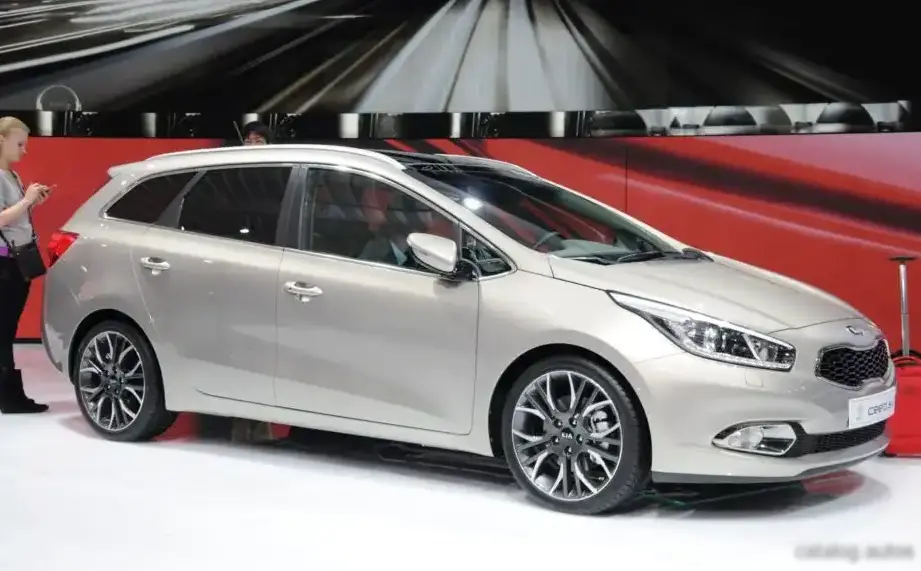
The Kia Cee’d SW II 1.4 16V CVVT, producing 100 horsepower, was a station wagon variant offered by Kia between April 2012 and June 2015. Positioned as an entry-level offering within the second generation Cee’d (JD) lineup – built on the 1HX0 platform – it aimed to provide a practical and fuel-efficient option for families and individuals needing versatile cargo space. This model represented Kia’s continued efforts to establish itself as a mainstream automotive brand in the European market, offering a compelling alternative to established competitors. The SW designation denotes the station wagon body style, differentiating it from the five-door hatchback version.
Technical Specifications
| Brand | Kia |
| Model | Cee’d |
| Generation | Cee’d SW II |
| Type (Engine) | 1.4 16V CVVT (100 Hp) |
| Start of production | April, 2012 |
| End of production | June, 2015 |
| Powertrain Architecture | Internal Combustion engine |
| Body type | Station wagon (estate) |
| Seats | 5 |
| Doors | 5 |
| Fuel consumption (urban) | 8.8 l/100 km (26.7 US mpg) |
| Fuel consumption (extra urban) | 5.3 l/100 km (44.4 US mpg) |
| Fuel consumption (combined) | 6.6 l/100 km (35.6 US mpg) |
| Fuel Type | Petrol (Gasoline) |
| Acceleration 0 – 100 km/h | 13.5 sec |
| Acceleration 0 – 62 mph | 13.5 sec |
| Acceleration 0 – 60 mph | 12.8 sec |
| Maximum speed | 180 km/h (111.85 mph) |
| Emission standard | Euro 5 |
| Weight-to-power ratio | 13.1 kg/Hp |
| Weight-to-torque ratio | 9.5 kg/Nm |
| Power | 100 Hp |
| Torque | 137 Nm @ 4200 rpm (101.05 lb.-ft. @ 4200 rpm) |
| Engine layout | Front, Transverse |
| Engine Model/Code | G4FA |
| Engine displacement | 1396 cm3 (85.19 cu. in.) |
| Number of cylinders | 4 |
| Engine configuration | Inline |
| Number of valves per cylinder | 4 |
| Fuel injection system | Multi-port manifold injection |
| Engine aspiration | Naturally aspirated engine |
| Valvetrain | DOHC |
| Engine oil capacity | 3.6 l (3.8 US qt | 3.17 UK qt) |
| Coolant capacity | 5.8 l (6.13 US qt | 5.1 UK qt) |
| Kerb Weight | 1308 kg (2883.65 lbs.) |
| Max. weight | 1820 kg (4012.41 lbs.) |
| Max load | 512 kg (1128.77 lbs.) |
| Trunk (boot) space – minimum | 528 l (18.65 cu. ft.) |
| Trunk (boot) space – maximum | 1642 l (57.99 cu. ft.) |
| Fuel tank capacity | 53 l (14 US gal | 11.66 UK gal) |
| Length | 4505 mm (177.36 in.) |
| Width | 1780 mm (70.08 in.) |
| Height | 1485 mm (58.46 in.) |
| Wheelbase | 2650 mm (104.33 in.) |
| Minimum turning circle | 10.6 m (34.78 ft.) |
| Drive wheel | Front wheel drive |
| Number of gears | 6 gears, manual transmission |
Powertrain & Engine Architecture
The Cee’d SW II 1.4 16V CVVT utilized the Kia G4FA engine, a 1.4-liter inline-four cylinder gasoline engine. This engine featured a cast iron block and an aluminum cylinder head, incorporating Kia’s Continuously Variable Valve Timing (CVVT) technology on both the intake and exhaust camshafts. CVVT optimizes valve timing based on engine speed and load, improving fuel efficiency and torque output across the rev range. Fuel delivery was managed by a multi-point fuel injection system. The engine produced 100 horsepower at approximately 6,000 rpm and 137 Nm (101 lb-ft) of torque at 4,200 rpm. The engine was paired with a six-speed manual transmission, delivering power to the front wheels. This transmission was chosen for its balance of fuel efficiency and driver engagement.
Driving Characteristics
The 1.4-liter engine, coupled with the station wagon body style, resulted in a vehicle focused on practicality and fuel economy rather than outright performance. Acceleration from 0-60 mph took around 12.8 seconds, and top speed was limited to 111.85 mph. The six-speed manual transmission helped to keep the engine within its optimal power band, but required frequent downshifts for overtaking maneuvers or climbing hills. Compared to the more powerful 1.6-liter gasoline or 1.6-liter diesel variants, the 1.4 offered a more relaxed driving experience, prioritizing comfort and efficiency over spirited performance. The gear ratios were tuned for maximizing fuel economy, resulting in a slightly less responsive feel than higher-performance trims.
Equipment & Trim Levels
The 1.4 16V CVVT trim typically served as the entry point to the Cee’d SW II range. Standard equipment generally included air conditioning, electric front windows, a radio with USB connectivity, and basic safety features like ABS, ESP (Electronic Stability Program), and multiple airbags. Higher trim levels, such as the ‘2’ or ‘3’ trims, added features like alloy wheels, a more advanced audio system, cruise control, rear parking sensors, and automatic climate control. Interior upholstery was typically cloth, with a functional and durable design. Optional extras included a panoramic sunroof, leather upholstery, and a navigation system.
Chassis & Braking
The Cee’d SW II utilized a MacPherson strut front suspension and a coupled torsion beam rear suspension. This setup provided a comfortable ride quality suitable for everyday driving. The front brakes were ventilated discs, while the rear brakes were typically drum brakes on the base 1.4 model, although some variants received rear discs. The steering was a rack and pinion system, offering reasonable precision and feedback. Stabilizer bars were fitted to both the front and rear axles to reduce body roll during cornering. The suspension tuning prioritized comfort and stability over sporty handling.
Market Reception & Comparison
The Kia Cee’d SW II 1.4 16V CVVT was generally well-received as a practical and affordable family car. Critics praised its spacious interior, generous cargo capacity, and competitive fuel economy. However, the engine was often criticized for being underpowered, particularly when the vehicle was fully loaded. Compared to the 1.6-liter gasoline and diesel options, the 1.4 offered lower running costs but sacrificed performance. The 1.6-liter diesel, in particular, provided significantly more torque and better fuel economy, making it a popular choice for those covering long distances. Reliability was generally good, with few reported issues specific to the 1.4-liter engine and transmission combination.
Legacy
The Kia Cee’d SW II 1.4 16V CVVT remains a relatively common sight on the used car market. The G4FA engine has proven to be reasonably durable, although regular maintenance is crucial for long-term reliability. Common issues, if any, typically relate to wear and tear on components like the timing belt and water pump. The 1.4-liter variant continues to appeal to buyers seeking an affordable and practical station wagon, particularly those prioritizing fuel efficiency and low running costs. While not a performance standout, it represents a solid and dependable option within its segment, contributing to Kia’s growing reputation for value and reliability.