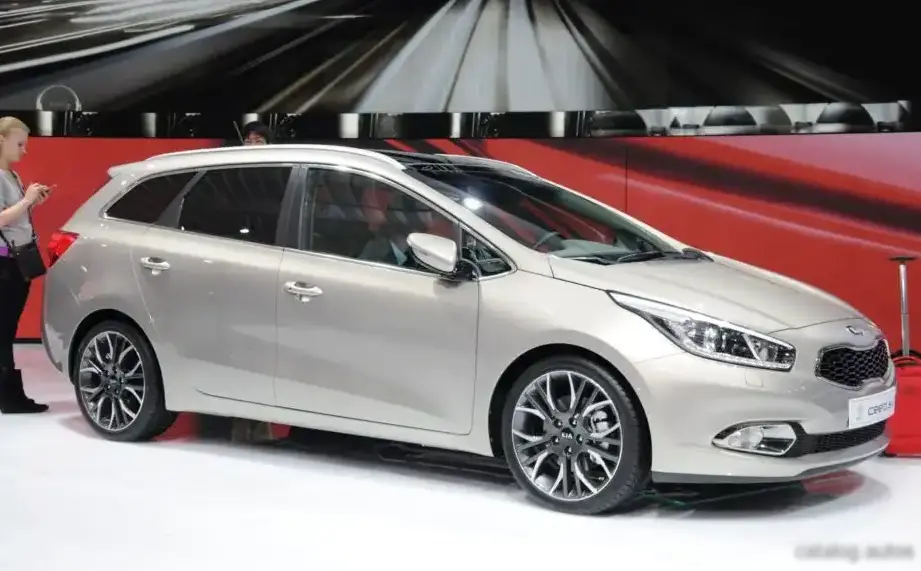
The Kia Cee’d SW II 1.4D 16V CRDi (90 hp) was a European-market station wagon produced between April 2012 and October 2013. It represented an entry-level diesel option within the second generation of the Cee’d SW (station wagon) model line, which itself was based on the 1HX0/A3 platform shared with the Hyundai i30. Positioned as a fuel-efficient and practical family vehicle, this variant aimed to provide affordable diesel power and increased cargo capacity compared to the hatchback version. The Cee’d line was Kia’s attempt to establish a stronger foothold in the competitive European compact segment, offering a value-oriented alternative to established brands.
Technical Specifications
| Brand | Kia |
| Model | Cee’d |
| Generation | Cee’d SW II |
| Type (Engine) | 1.4D 16V CRDi (90 Hp) |
| Start of production | April, 2012 |
| End of production | October, 2013 |
| Powertrain Architecture | Internal Combustion engine |
| Body type | Station wagon (estate) |
| Seats | 5 |
| Doors | 5 |
| Fuel consumption (urban) | 5.5 l/100 km (42.8 US mpg, 51.4 UK mpg, 18.2 km/l) |
| Fuel consumption (extra urban) | 3.9 l/100 km (60.3 US mpg, 72.4 UK mpg, 25.6 km/l) |
| Fuel consumption (combined) | 4.5 l/100 km (52.3 US mpg, 62.8 UK mpg, 22.2 km/l) |
| Fuel Type | Diesel |
| Acceleration 0 – 100 km/h | 13.9 sec |
| Acceleration 0 – 62 mph | 13.9 sec |
| Acceleration 0 – 60 mph | 13.2 sec |
| Maximum speed | 170 km/h (105.63 mph) |
| Emission standard | Euro 5 |
| Weight-to-power ratio | 15.7 kg/Hp, 63.8 Hp/tonne |
| Weight-to-torque ratio | 6.4 kg/Nm, 155.9 Nm/tonne |
| Power | 90 Hp |
| Power per litre | 64.5 Hp/l |
| Torque | 220 Nm @ 1500 rpm (162.26 lb.-ft. @ 1500 rpm) |
| Engine layout | Front, Transverse |
| Engine Model/Code | D4FC |
| Engine displacement | 1396 cm3 (85.19 cu. in.) |
| Number of cylinders | 4 |
| Engine configuration | Inline |
| Number of valves per cylinder | 4 |
| Fuel injection system | Diesel Commonrail |
| Engine aspiration | Turbocharger, Intercooler |
| Valvetrain | DOHC |
| Engine oil capacity | 5.3 l (5.6 US qt | 4.66 UK qt) |
| Coolant capacity | 6.9 l (7.29 US qt | 6.07 UK qt) |
| Kerb Weight | 1411 kg (3110.72 lbs.) |
| Max. weight | 1910 kg (4210.83 lbs.) |
| Max load | 499 kg (1100.11 lbs.) |
| Trunk (boot) space – minimum | 528 l (18.65 cu. ft.) |
| Trunk (boot) space – maximum | 1642 l (57.99 cu. ft.) |
| Fuel tank capacity | 53 l (14 US gal | 11.66 UK gal) |
| Length | 4505 mm (177.36 in.) |
| Width | 1780 mm (70.08 in.) |
| Height | 1485 mm (58.46 in.) |
| Wheelbase | 2650 mm (104.33 in.) |
| Minimum turning circle | 10.6 m (34.78 ft.) |
| Drivetrain Architecture | The Internal combustion engine (ICE) drives the front wheels of the vehicle. |
| Drive wheel | Front wheel drive |
| Number of gears | 6 gears, manual transmission |
| Assisting systems | ABS (Anti-lock braking system) |
| Steering type | Steering rack and pinion |
| Tires size | 195/65 R15; 205/55 R16; 225/45 R17 |
| Wheel rims size | 15; 16; 17 |
Powertrain & Engine Architecture
The Cee’d SW II 1.4D 16V CRDi utilized the Kia D4FC engine, a 1.4-liter inline-four cylinder diesel engine. This engine was part of Kia’s broader family of small-displacement diesel engines designed for fuel efficiency. The ‘CRDi’ designation stands for Common Rail Direct Injection, a technology that delivers fuel directly into the combustion chamber at very high pressure, improving combustion efficiency and reducing emissions. The D4FC engine featured a turbocharger with an intercooler to boost power output. The engine employed a Double Overhead Camshaft (DOHC) valvetrain with four valves per cylinder, optimizing airflow for improved performance. The 90 horsepower output was achieved through careful calibration of the engine management system and the common rail injection system. This specific variant was exclusively offered with a six-speed manual transmission, prioritizing fuel economy over outright performance.
Driving Characteristics
The 1.4D 16V CRDi with the six-speed manual transmission offered a practical, if not particularly exciting, driving experience. With 90 hp and 220 Nm (162 lb-ft) of torque, acceleration was modest, taking approximately 13.9 seconds to reach 62 mph (100 km/h). The engine’s torque peak at 1500 rpm provided adequate pulling power for everyday driving and highway cruising, but overtaking maneuvers required careful planning. The six-speed gearbox was well-matched to the engine’s characteristics, allowing drivers to keep the engine in its optimal power band. Compared to the more powerful 1.6L gasoline or higher-output diesel variants, this version prioritized fuel economy and lower running costs. The steering was light and precise, making it easy to maneuver in urban environments, but lacked the feedback desired by more enthusiastic drivers.
Equipment & Trim Levels
The 1.4D 16V CRDi typically represented the entry-level diesel trim in the Cee’d SW II range. Standard equipment generally included air conditioning, electric front windows, a basic audio system with USB connectivity, and ABS brakes. Safety features such as front and side airbags were also standard. Higher trim levels, such as the ‘2’ or ‘3’ trims, added features like alloy wheels, rear parking sensors, cruise control, and a more sophisticated infotainment system. Interior upholstery was typically cloth, with a functional and durable design. Optional extras included a panoramic sunroof, leather upholstery, and a navigation system.
Chassis & Braking
The Cee’d SW II featured a typical front-wheel-drive chassis configuration with MacPherson strut front suspension and a coupled torsion beam rear suspension. This setup provided a good balance between ride comfort and handling. The 1.4D variant, being one of the lighter engine options, generally utilized smaller diameter brake discs. Front brakes were typically ventilated discs, while rear brakes were often drum brakes, a cost-saving measure for the entry-level trim. Anti-lock Braking System (ABS) was standard across the range. Stabilizer bars were fitted to both the front and rear axles to reduce body roll during cornering.
Market Reception & Comparison
The Kia Cee’d SW II 1.4D 16V CRDi was generally well-received by automotive critics as a practical and fuel-efficient family car. It was praised for its spacious interior, generous cargo capacity, and competitive pricing. However, some reviewers noted that the engine lacked refinement and could be noisy under acceleration. Compared to rivals like the Volkswagen Golf Estate, Ford Focus Estate, and Peugeot 308 SW, the Cee’d SW offered a compelling value proposition, often undercutting its competitors on price while offering a similar level of equipment. Fuel economy was a key strength, consistently achieving combined figures around 52.3 US mpg. Reliability was also considered good, although not exceptional.
Legacy
The Kia Cee’d SW II 1.4D 16V CRDi has proven to be a relatively reliable and durable vehicle in the used car market. The D4FC engine, while not known for blistering performance, is generally considered robust and capable of high mileage with proper maintenance. Common issues include diesel particulate filter (DPF) clogging, particularly on vehicles primarily used for short journeys, and wear and tear on suspension components. Today, these vehicles represent an affordable option for buyers seeking a practical and fuel-efficient station wagon. The Cee’d SW II helped to establish Kia as a credible player in the European compact car segment, paving the way for the brand’s continued success.