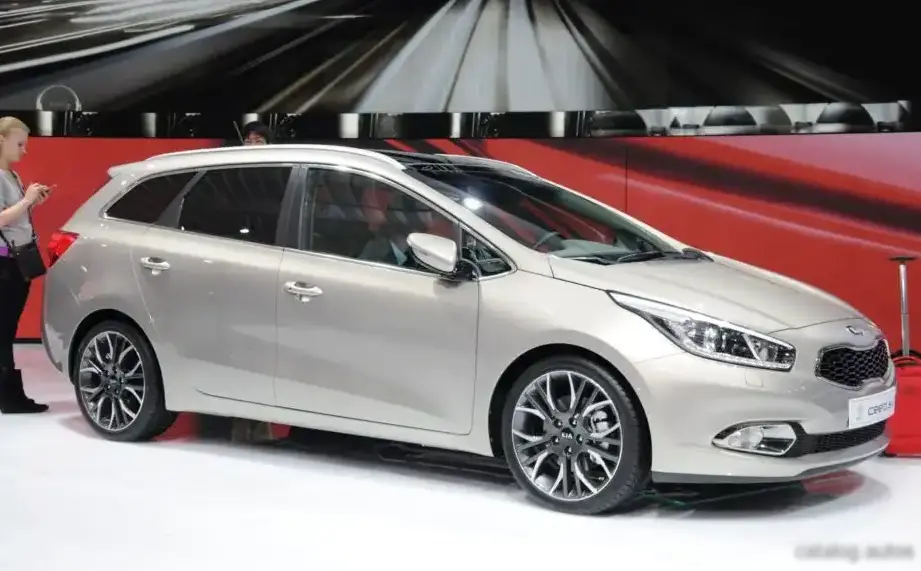
The Kia Cee’d SW II 1.6 GDi, produced from April 2012 to August 2015, represents a significant step forward for Kia in the European compact estate market. Part of the second generation Cee’d (JD) family, built on the 1HX0 platform, the SW (Station Wagon) body style offered increased practicality compared to the five-door hatchback. This particular variant, equipped with the 1.6-liter GDi engine producing 135 horsepower, was positioned as a mid-range offering, balancing fuel efficiency with reasonable performance. It aimed to appeal to families and individuals needing a versatile vehicle without the higher costs associated with more powerful engine options.
Technical Specifications
| Brand | Kia |
| Model | Cee’d |
| Generation | Cee’d SW II |
| Type (Engine) | 1.6 16V GDi (135 Hp) |
| Start of production | April, 2012 |
| End of production | August, 2015 |
| Powertrain Architecture | Internal Combustion engine |
| Body type | Station wagon (estate) |
| Seats | 5 |
| Doors | 5 |
| Fuel consumption (urban) | 8.6 l/100 km (27.4 US mpg) |
| Fuel consumption (extra urban) | 5.2 l/100 km (45.2 US mpg) |
| Fuel consumption (combined) | 6.5 l/100 km (36.2 US mpg) |
| Fuel Type | Petrol (Gasoline) |
| Acceleration 0 – 100 km/h | 10.2 sec |
| Acceleration 0 – 62 mph | 10.2 sec |
| Acceleration 0 – 60 mph | 9.7 sec |
| Maximum speed | 192 km/h (119.3 mph) |
| Emission standard | Euro 5 |
| Weight-to-power ratio | 9.7 kg/Hp |
| Weight-to-torque ratio | 8 kg/Nm |
| Power | 135 Hp |
| Torque | 164 Nm @ 4850 rpm (120.96 lb.-ft. @ 4850 rpm) |
| Engine layout | Front, Transverse |
| Engine Model/Code | G4FD |
| Engine displacement | 1591 cm3 (97.09 cu. in.) |
| Number of cylinders | 4 |
| Engine configuration | Inline |
| Number of valves per cylinder | 4 |
| Fuel injection system | Direct injection |
| Engine aspiration | Naturally aspirated engine |
| Valvetrain | DOHC |
| Engine oil capacity | 3.6 l (3.8 US qt | 3.17 UK qt) |
| Coolant capacity | 5.8 l (6.13 US qt | 5.1 UK qt) |
| Kerb Weight | 1316 kg (2901.28 lbs.) |
| Max. weight | 1820 kg (4012.41 lbs.) |
| Max load | 504 kg (1111.13 lbs.) |
| Trunk (boot) space – minimum | 528 l (18.65 cu. ft.) |
| Trunk (boot) space – maximum | 1642 l (57.99 cu. ft.) |
| Fuel tank capacity | 53 l (14 US gal | 11.66 UK gal) |
| Length | 4505 mm (177.36 in.) |
| Width | 1780 mm (70.08 in.) |
| Height | 1485 mm (58.46 in.) |
| Wheelbase | 2650 mm (104.33 in.) |
| Minimum turning circle | 10.6 m (34.78 ft.) |
| Drivetrain Architecture | Front wheel drive |
| Number of gears | 6 gears, manual transmission |
Powertrain & Engine Architecture
The heart of the Cee’d SW II 1.6 GDi is the G4FD engine, a 1.6-liter inline-four cylinder gasoline engine. This engine utilizes direct fuel injection (GDi – Gasoline Direct Injection) which improves combustion efficiency and power output compared to traditional port fuel injection systems. The G4FD features a double overhead camshaft (DOHC) valvetrain, optimizing airflow into and out of the cylinders. The engine produces 135 horsepower and 164 Nm (120.96 lb-ft) of torque at 4850 rpm. The engine is transversely mounted, driving the front wheels. The six-speed manual transmission was the standard offering for this trim, providing a balance between fuel economy and driver engagement. The transmission’s gear ratios were tuned for everyday usability, prioritizing smooth acceleration and comfortable cruising rather than outright performance.
Driving Characteristics
The 1.6 GDi engine, paired with the six-speed manual transmission, delivers adequate performance for typical daily driving. Acceleration from 0 to 60 mph takes approximately 9.7 seconds, and the car has a top speed of 119.3 mph. While not a particularly sporty setup, the engine provides sufficient power for overtaking maneuvers and maintaining highway speeds. The manual transmission allows for greater driver control, but the relatively low torque output means that frequent downshifts are often necessary, especially when carrying a full load or tackling hilly terrain. Compared to the more powerful 1.6 T-GDi turbo engine option, the 1.6 GDi feels less responsive, but it offers better fuel economy and potentially lower maintenance costs.
Equipment & Trim Levels
The Cee’d SW II 1.6 GDi typically came equipped with a reasonable level of standard features. These included air conditioning, electric front and rear windows, a radio/CD player with USB connectivity, and ABS brakes with Electronic Stability Control (ESC). Higher trim levels, such as the ‘2’ or ‘3’ trims, added features like alloy wheels, a touchscreen infotainment system, rear parking sensors, and cruise control. Interior upholstery was typically cloth, with options for upgraded materials on higher trims. The dashboard layout was functional and straightforward, prioritizing usability over stylistic flair.
Chassis & Braking
The Cee’d SW II utilizes a MacPherson strut front suspension and a coupled torsion beam rear suspension. This setup provides a comfortable ride quality, although it’s not as sophisticated as independent rear suspension found on some competitors. Braking duties are handled by disc brakes on the front wheels and drum brakes on the rear wheels. The braking system is assisted by ABS and ESC, enhancing safety and stability. Stabilizer bars are fitted to both the front and rear axles to reduce body roll during cornering.
Market Reception & Comparison
The Kia Cee’d SW II 1.6 GDi was generally well-received by automotive critics as a practical and affordable estate car. Its fuel economy of around 36.2 US mpg combined was a strong selling point, and its spacious interior and large cargo area made it a suitable choice for families. Compared to rivals like the Ford Focus Estate and Volkswagen Golf Estate, the Cee’d offered a competitive price point and a generous warranty. However, some critics noted that the interior materials were not as premium as those found in some competitors, and the driving experience was not as engaging. The 1.6 GDi engine was considered reliable, but regular maintenance, including oil changes and timing belt replacements, was essential to ensure long-term durability.
Legacy
The Kia Cee’d SW II 1.6 GDi has proven to be a relatively reliable vehicle in the used car market. The G4FD engine is known for its durability, provided it has been properly maintained. Common issues are relatively minor, often relating to wear and tear on suspension components or electrical glitches. The availability of affordable spare parts and a strong dealer network contribute to the Cee’d’s continued popularity as a used car. Today, these vehicles represent a good value proposition for buyers seeking a practical, fuel-efficient, and affordable estate car.