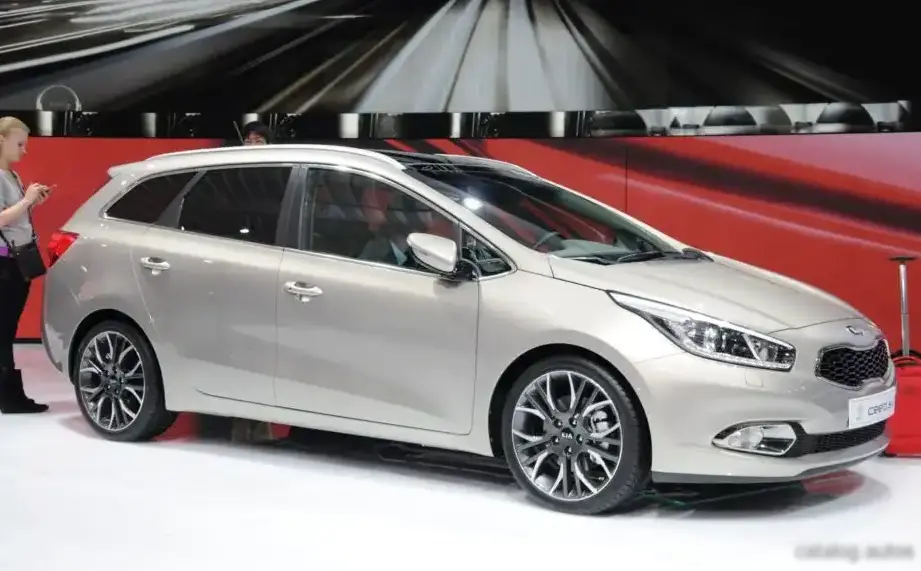
The Kia Cee’d SW II 1.6 GDi (135 Hp) DCT, produced from 2012 to 2015, represents a significant offering in the compact estate (station wagon) segment. Part of the second generation of the Cee’d (JD) model, specifically the SW body style, this variant aimed to provide a balance of fuel efficiency, practicality, and modern technology for European consumers. Positioned as a mid-range option within the Cee’d SW II lineup, it slotted between the lower-powered 1.4L engine options and the more performance-oriented 1.6L Turbo variants. The Cee’d SW II was Kia’s attempt to establish a stronger foothold in the European market, offering a compelling alternative to established rivals like the Ford Focus Estate and Volkswagen Golf Variant.
Technical Specifications
| Brand | Kia |
| Model | Cee’d |
| Generation | Cee’d SW II |
| Type (Engine) | 1.6 GDi (135 Hp) DCT |
| Start of production | 2012 |
| End of production | 2015 |
| Powertrain Architecture | Internal Combustion engine |
| Body type | Station wagon (estate) |
| Seats | 5 |
| Doors | 5 |
| Fuel consumption (economy) – urban (NEDC) | 8.5 l/100 km (27.7 US mpg, 33.2 UK mpg, 11.8 km/l) |
| Fuel consumption (economy) – extra urban (NEDC) | 5.3 l/100 km (44.4 US mpg, 53.3 UK mpg, 18.9 km/l) |
| Fuel consumption (economy) – combined (NEDC) | 6.4 l/100 km (36.8 US mpg, 44.1 UK mpg, 15.6 km/l) |
| CO2 emissions (NEDC) | 144 g/km |
| Fuel Type | Petrol (Gasoline) |
| Acceleration 0 – 100 km/h | 11.1 sec |
| Acceleration 0 – 62 mph | 11.1 sec |
| Acceleration 0 – 60 mph | 10.5 sec |
| Maximum speed | 192 km/h (119.3 mph) |
| Emission standard | Euro 5 |
| Weight-to-power ratio | 9.4 kg/Hp, 106 Hp/tonne |
| Weight-to-torque ratio | 7.7 kg/Nm, 129.6 Nm/tonne |
| Power | 135 Hp @ 6300 rpm |
| Power per litre | 84.9 Hp/l |
| Torque | 165 Nm @ 4850 rpm (121.7 lb.-ft. @ 4850 rpm) |
| Engine layout | Front, Transverse |
| Engine Model/Code | Gamma II / G4FD |
| Engine displacement | 1591 cm3 (97.09 cu. in.) |
| Number of cylinders | 4 |
| Engine configuration | Inline |
| Cylinder Bore | 77 mm (3.03 in.) |
| Piston Stroke | 85.44 mm (3.36 in.) |
| Compression ratio | 11:1 |
| Number of valves per cylinder | 4 |
| Fuel injection system | Direct injection |
| Engine aspiration | Naturally aspirated engine |
| Valvetrain | DOHC, VVT |
| Engine oil capacity | 3.6 l (3.8 US qt | 3.17 UK qt) |
| Coolant | 5.7 l (6.02 US qt | 5.02 UK qt) |
| Kerb Weight | 1273-1397 kg (2806.48 – 3079.86 lbs.) |
| Max. weight | 1850 kg (4078.55 lbs.) |
| Max load | 453-577 kg (998.69 – 1272.07 lbs.) |
| Trunk (boot) space – minimum | 528 l (18.65 cu. ft.) |
| Trunk (boot) space – maximum | 1642 l (57.99 cu. ft.) |
| Fuel tank capacity | 53 l (14 US gal | 11.66 UK gal) |
| Max. roof load | 80 kg (176.37 lbs.) |
| Permitted trailer load with brakes (12%) | 1300 kg (2866.01 lbs.) |
| Permitted trailer load without brakes | 600 kg (1322.77 lbs.) |
| Permitted towbar download | 60 kg (132.28 lbs.) |
| Length | 4505 mm (177.36 in.) |
| Width | 1780 mm (70.08 in.) |
| Width including mirrors | 2045 mm (80.51 in.) |
| Height | 1485 mm (58.46 in.) |
| Wheelbase | 2650 mm (104.33 in.) |
| Front track | 1549-1555 mm (60.98 – 61.22 in.) |
| Rear (Back) track | 1557-1563 mm (61.3 – 61.54 in.) |
| Front overhang | 900 mm (35.43 in.) |
| Rear overhang | 955 mm (37.6 in.) |
| Ride height (ground clearance) | 140 mm (5.51 in.) |
| Minimum turning circle (turning diameter) | 10.34 m (33.92 ft.) |
| Drivetrain Architecture | The Internal combustion engine (ICE) drives the front wheels of the vehicle. |
| Drive wheel | Front wheel drive |
| Number of gears and type of gearbox | 6 gears, automatic transmission DCT |
| Front suspension | Independent, type McPherson with coil spring and anti-roll bar |
| Rear suspension | Independent multi-link spring suspension with stabilizer |
| Front brakes | Ventilated discs |
| Rear brakes | Disc |
| Assisting systems | ABS (Anti-lock braking system) |
| Steering type | Steering rack and pinion |
| Power steering | Electric Steering |
| Tires size | 205/55 R16; 225/45 R17 |
| Wheel rims size | 6.5J x 16; 7J x 17 |
Powertrain & Engine Architecture
The heart of the Cee’d SW II 1.6 GDi DCT is the Gamma II family of engines, specifically the G4FD code. This 1.6-liter inline-four cylinder engine utilizes direct fuel injection (GDi – Gasoline Direct Injection) to enhance efficiency and power output. The direct injection system allows for more precise fuel delivery, resulting in improved combustion and reduced emissions. The engine features a double overhead camshaft (DOHC) valvetrain with variable valve timing (VVT) on both intake and exhaust camshafts, further optimizing performance across the rev range. Paired with this engine is a six-speed dual-clutch transmission (DCT), offering quicker and smoother gear changes compared to a traditional automatic transmission. The DCT contributes to both improved acceleration and fuel economy. The engine produces 135 horsepower at 6,300 rpm and 165 Nm (121.7 lb-ft) of torque at 4,850 rpm.
Driving Characteristics
The 1.6 GDi DCT powertrain delivers a reasonably responsive driving experience, although it isn’t designed for outright performance. Acceleration from 0-60 mph takes around 10.5 seconds, and the top speed is 119.3 mph. The DCT transmission provides quick shifts, making overtaking maneuvers manageable. However, compared to the more powerful 1.6L Turbo variants, this engine feels less eager, particularly when fully loaded. The gear ratios are tuned for fuel efficiency, meaning the engine can feel slightly strained when climbing hills or accelerating quickly. The steering is light and precise, making it easy to maneuver in urban environments. Overall, the driving experience is comfortable and refined, prioritizing practicality and fuel economy over sporty handling.
Equipment & Trim Levels
The 1.6 GDi DCT trim typically included a good level of standard equipment. Features commonly found in this variant include air conditioning, electric front and rear windows, a USB audio connection, Bluetooth connectivity, and a multi-function steering wheel. Safety features such as ABS, Electronic Stability Control (ESC), and multiple airbags were also standard. Higher trim levels offered additional features like alloy wheels, a touchscreen infotainment system, rear parking sensors, and cruise control. Interior upholstery was typically cloth, with options for upgraded materials available. The dashboard layout was functional and well-designed, with a focus on ergonomics.
Chassis & Braking
The Cee’d SW II utilized a McPherson strut front suspension and a multi-link rear suspension, providing a comfortable ride and decent handling characteristics. The suspension was tuned to prioritize comfort over sporty handling. Braking duties were handled by ventilated discs at the front and solid discs at the rear. ABS (Anti-lock Braking System) was standard, enhancing braking performance and stability. The steering system employed an electric power steering (EPS) system, offering light and precise steering feel.
Market Reception & Comparison
The Kia Cee’d SW II 1.6 GDi DCT was generally well-received by automotive critics. It was praised for its practicality, fuel efficiency, and value for money. However, some reviewers noted that the engine lacked the punch of its turbocharged counterparts. Compared to the 1.6L Turbo models, the 1.6 GDi offered lower running costs but sacrificed performance. Against competitors like the Ford Focus Estate and Volkswagen Golf Variant, the Cee’d SW II offered a compelling alternative, often undercutting them on price while providing a similar level of equipment. Fuel economy figures of around 36.8 US mpg combined were competitive within its class.
Legacy
The Kia Cee’d SW II 1.6 GDi DCT has proven to be a relatively reliable powertrain. The Gamma II engine is known for its durability, and the DCT transmission, while requiring occasional maintenance, has generally held up well over time. In the used car market, this variant represents a good value proposition, offering a practical and fuel-efficient estate car at an affordable price. Common issues reported by owners include occasional DCT software glitches and wear on suspension components. However, these are generally minor and easily addressed. The Cee’d SW II helped to establish Kia as a credible player in the European market, paving the way for the brand’s continued success.