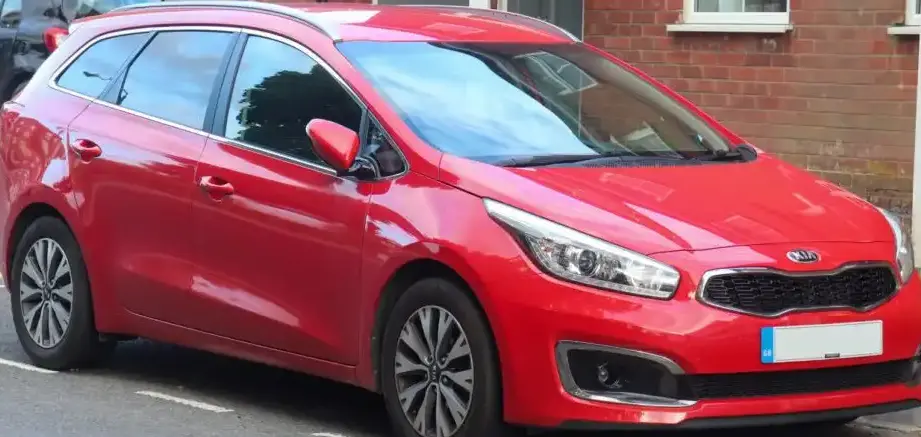
The Kia Cee’d SW II (facelifted in 2015) 1.4 CVVT producing 100 horsepower represents an entry-level offering within the second generation of Kia’s European-focused compact estate car. Introduced in June 2015 and continuing through 2018, this variant aimed to provide affordable practicality and reasonable fuel economy for buyers prioritizing space and efficiency over outright performance. It was positioned as the gateway to the Cee’d SW range, appealing to families and individuals seeking a versatile vehicle for everyday use. The Cee’d SW II itself was built upon the 1HX0/JD platform, shared with the Hyundai i30, and represented a significant step forward for Kia in terms of design, build quality, and European market appeal.
Technical Specifications
| Brand | Kia |
| Model | Cee’d |
| Generation | Cee’d SW II (facelift 2015) |
| Type (Engine) | 1.4 CVVT (100 Hp) |
| Start of production | June, 2015 |
| End of production | 2018 |
| Powertrain Architecture | Internal Combustion engine |
| Body type | Station wagon (estate) |
| Seats | 5 |
| Doors | 5 |
| Fuel consumption (urban) | 7.8 l/100 km (30.2 US mpg, 36.2 UK mpg, 12.8 km/l) |
| Fuel consumption (extra urban) | 4.9 l/100 km (48 US mpg, 57.6 UK mpg, 20.4 km/l) |
| Fuel consumption (combined) | 6.0 l/100 km (39.2 US mpg, 47.1 UK mpg, 16.7 km/l) |
| CO2 emissions | 138 g/km |
| Fuel Type | Petrol (Gasoline) |
| Acceleration 0 – 100 km/h | 13.0 sec |
| Acceleration 0 – 62 mph | 13.0 sec |
| Acceleration 0 – 60 mph | 12.4 sec |
| Maximum speed | 181 km/h (112.47 mph) |
| Emission standard | Euro 6 |
| Weight-to-power ratio | 12 kg/Hp, 83.1 Hp/tonne |
| Weight-to-torque ratio | 9 kg/Nm, 111.3 Nm/tonne |
| Power | 100 Hp @ 6000 rpm |
| Power per litre | 73.1 Hp/l |
| Torque | 134 Nm @ 4000 rpm (98.83 lb.-ft. @ 4000 rpm) |
| Engine layout | Front, Transverse |
| Engine Model/Code | Kappa / G4LC |
| Engine displacement | 1368 cm3 (83.48 cu. in.) |
| Number of cylinders | 4 |
| Engine configuration | Inline |
| Cylinder Bore | 72 mm (2.83 in.) |
| Piston Stroke | 84 mm (3.31 in.) |
| Compression ratio | 10.5:1 |
| Number of valves per cylinder | 4 |
| Fuel injection system | Multi-port manifold injection |
| Engine aspiration | Naturally aspirated engine |
| Valvetrain | CVVT |
| Engine oil capacity | 3.6 l (3.8 US qt | 3.17 UK qt) |
| Coolant | 5.8 l (6.13 US qt | 5.1 UK qt) |
| Kerb Weight | 1204-1349 kg (2654.37 – 2974.04 lbs.) |
| Max. weight | 1820 kg (4012.41 lbs.) |
| Max load | 471-616 kg (1038.38 – 1358.05 lbs.) |
| Trunk (boot) space – minimum | 528 l (18.65 cu. ft.) |
| Trunk (boot) space – maximum | 1642 l (57.99 cu. ft.) |
| Fuel tank capacity | 53 l (14 US gal | 11.66 UK gal) |
| Max. roof load | 80 kg (176.37 lbs.) |
| Permitted trailer load with brakes (12%) | 1200 kg (2645.55 lbs.) |
| Permitted trailer load without brakes | 600 kg (1322.77 lbs.) |
| Permitted towbar download | 60 kg (132.28 lbs.) |
| Length | 4505 mm (177.36 in.) |
| Width | 1780 mm (70.08 in.) |
| Width including mirrors | 2035 mm (80.12 in.) |
| Height | 1485 mm (58.46 in.) |
| Wheelbase | 2650 mm (104.33 in.) |
| Front track | 1555-1563 mm (61.22 – 61.54 in.) |
| Rear (Back) track | 1563-1571 mm (61.54 – 61.85 in.) |
| Front overhang | 900 mm (35.43 in.) |
| Rear overhang | 955 mm (37.6 in.) |
| Minimum turning circle (turning diameter) | 10.6 m (34.78 ft.) |
| Drivetrain Architecture | The Internal combustion engine (ICE) drives the front wheels of the vehicle. |
| Drive wheel | Front wheel drive |
| Number of gears and type of gearbox | 6 gears, manual transmission |
| Front suspension | Independent type McPherson |
| Rear suspension | Independent multi-link suspension |
| Front brakes | Ventilated discs, 280-300 mm |
| Rear brakes | Disc, 262-284 mm |
| Assisting systems | ABS (Anti-lock braking system) |
| Steering type | Steering rack and pinion |
| Tires size | 195/65 R15 91H; 205/55 R16 91H |
| Wheel rims size | 6.0J x 15 ET46; 6.5J x 16 ET50 |
Powertrain & Engine Architecture
The heart of this Cee’d SW variant is the Kia Kappa 1.4-liter inline-four cylinder gasoline engine, internally designated as the G4LC. This engine is a naturally aspirated unit featuring multi-point fuel injection and Kia’s Continuously Variable Valve Timing (CVVT) technology. CVVT optimizes valve timing based on engine speed and load, improving both fuel efficiency and power delivery. The engine produces 100 horsepower at 6000 rpm and 134 Nm (98.83 lb-ft) of torque at 4000 rpm. The engine’s relatively modest output is a result of its focus on fuel economy and emissions compliance. The engine is transversely mounted at the front of the vehicle. The 6-speed manual transmission was standard, offering a fairly conventional gear ratio spread designed for everyday driving rather than sporty performance.
Driving Characteristics
The 1.4 CVVT engine, paired with the manual transmission, delivers adequate but not exhilarating performance. Acceleration from 0 to 60 mph takes around 12.4 seconds, and top speed is limited to 181 km/h (112.47 mph). The engine feels most comfortable in the mid-range, providing sufficient power for overtaking and highway cruising, but requires downshifting for quicker acceleration. Compared to higher-output versions of the Cee’d SW, such as those equipped with the 1.6 GDI engine, this variant feels noticeably slower. However, the trade-off is improved fuel economy and a more relaxed driving experience. The manual gearbox is light and precise, contributing to a pleasant driving feel.
Equipment & Trim Levels
The 1.4 CVVT trim typically served as the entry point to the Cee’d SW range. Standard equipment generally included air conditioning, electric front windows, a basic audio system with USB connectivity, and stability control. Safety features such as ABS, ESC (Electronic Stability Control), and multiple airbags were also standard. Higher trim levels added features like alloy wheels, a touchscreen infotainment system, rear parking sensors, and cruise control. Interior upholstery was typically cloth, with a functional but not luxurious design.
Chassis & Braking
The Cee’d SW II utilizes an independent McPherson strut suspension at the front and an independent multi-link suspension at the rear, providing a comfortable and controlled ride. Front brakes are ventilated discs, while rear brakes are solid discs. The suspension is tuned for comfort rather than outright sportiness, absorbing bumps and imperfections in the road effectively. The steering is light and precise, making it easy to maneuver in urban environments.
Market Reception & Comparison
The 1.4 CVVT Cee’d SW was generally well-received by critics as a practical and affordable estate car. It was praised for its spacious interior, good fuel economy, and comfortable ride. However, some reviewers noted its lack of outright performance compared to rivals. Compared to other engines in the Cee’d SW lineup, the 1.4 CVVT offered the lowest running costs but also the slowest acceleration. The 1.6 GDI engine provided a noticeable performance boost, while the 1.6 CRDi diesel offered superior fuel economy.
Legacy
The Kia Cee’d SW II 1.4 CVVT has proven to be a reliable and durable vehicle. The Kappa engine is generally considered to be robust, and the manual transmission is known for its longevity. On the used car market, these models represent good value for money, offering a practical and economical option for buyers seeking a spacious estate car. While not the most exciting vehicle to drive, its affordability, practicality, and reliability have ensured its continued popularity.