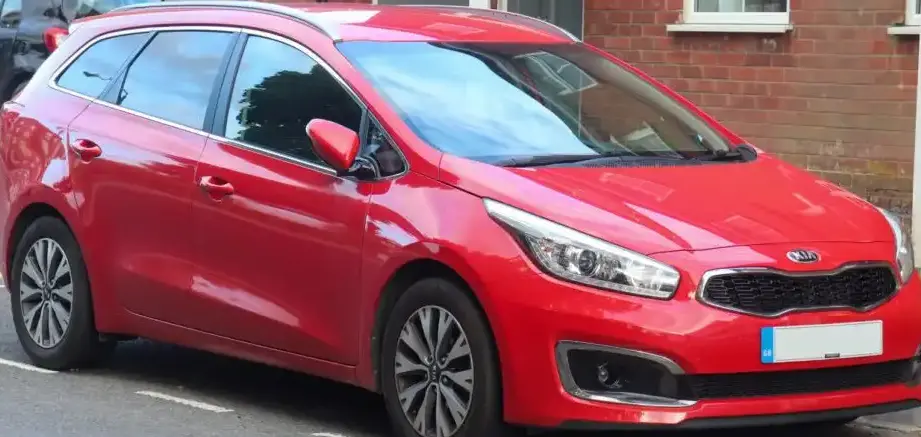
The Kia Cee’d SW II (facelift 2015) 1.6 GDI (135 Hp) ISG represents a significant iteration within the second generation of Kia’s Cee’d model line, specifically the station wagon (SW) body style. Introduced in June 2015 and continuing through 2018, this variant aimed to provide a balance of fuel efficiency, practicality, and reasonable performance for European buyers. It was positioned as a mid-range offering within the Cee’d SW lineup, slotting between the lower-powered 1.4L engine options and the more performance-oriented 1.6L Turbo variants. The “ISG” designation indicates the inclusion of Kia’s Idle Stop & Go system, a fuel-saving technology that automatically shuts off the engine when the vehicle is stationary.
Technical Specifications
| Brand | Kia |
| Model | Cee’d |
| Generation | Cee’d SW II (facelift 2015) |
| Type (Engine) | 1.6 GDI (135 Hp) ISG |
| Start of production | June, 2015 |
| End of production | 2018 |
| Powertrain Architecture | Internal Combustion engine |
| Body type | Station wagon (estate) |
| Seats | 5 |
| Doors | 5 |
| Fuel consumption (urban) | 7.5 l/100 km (31.4 US mpg) |
| Fuel consumption (extra urban) | 5.0 l/100 km (47 US mpg) |
| Fuel consumption (combined) | 6.0 l/100 km (39.2 US mpg) |
| CO2 emissions | 134 g/km |
| Fuel Type | Petrol (Gasoline) |
| Acceleration 0 – 100 km/h | 10.2 sec |
| Acceleration 0 – 62 mph | 10.2 sec |
| Acceleration 0 – 60 mph | 9.7 sec |
| Maximum speed | 192 km/h (119.3 mph) |
| Emission standard | Euro 6 |
| Weight-to-power ratio | 8.9 kg/Hp |
| Weight-to-torque ratio | 7.2 kg/Nm |
| Power | 135 Hp @ 6300 rpm |
| Torque | 165 Nm @ 4850 rpm (121.7 lb.-ft. @ 4850 rpm) |
| Engine layout | Front, Transverse |
| Engine Model/Code | G4FD |
| Engine displacement | 1591 cm3 (97.09 cu. in.) |
| Number of cylinders | 4 |
| Engine configuration | Inline |
| Cylinder Bore | 77 mm (3.03 in.) |
| Piston Stroke | 85.44 mm (3.36 in.) |
| Compression ratio | 11:1 |
| Number of valves per cylinder | 4 |
| Fuel injection system | Direct injection |
| Engine aspiration | Naturally aspirated engine |
| Engine oil capacity | 4 l (4.23 US qt | 3.52 UK qt) |
| Coolant capacity | 5.8 l (6.13 US qt | 5.1 UK qt) |
| Kerb Weight | 1196-1330 kg (2636.73 – 2932.15 lbs.) |
| Max. weight | 1820 kg (4012.41 lbs.) |
| Max load | 490-624 kg (1080.27 – 1375.68 lbs.) |
| Trunk (boot) space – minimum | 528 l (18.65 cu. ft.) |
| Trunk (boot) space – maximum | 1642 l (57.99 cu. ft.) |
| Fuel tank capacity | 53 l (14 US gal | 11.66 UK gal) |
| Max. roof load | 80 kg (176.37 lbs.) |
| Permitted trailer load with brakes (12%) | 1400 kg (3086.47 lbs.) |
| Permitted trailer load without brakes | 600 kg (1322.77 lbs.) |
| Permitted towbar download | 60 kg (132.28 lbs.) |
| Length | 4505 mm (177.36 in.) |
| Width | 1780 mm (70.08 in.) |
| Width including mirrors | 2035 mm (80.12 in.) |
| Height | 1485 mm (58.46 in.) |
| Wheelbase | 2650 mm (104.33 in.) |
| Front track | 1549-1563 mm (60.98 – 61.54 in.) |
| Rear (Back) track | 1557-1571 mm (61.3 – 61.85 in.) |
| Front overhang | 900 mm (35.43 in.) |
| Rear overhang | 955 mm (37.6 in.) |
| Minimum turning circle | 10.6 m (34.78 ft.) |
| Drivetrain Architecture | Front wheel drive |
| Number of gears and type of gearbox | 6 gears, manual transmission |
| Front suspension | Independent type McPherson |
| Rear suspension | Independent multi-link suspension |
| Front brakes | Ventilated discs, 280-300 mm |
| Rear brakes | Disc, 262-284 mm |
| Assisting systems | ABS (Anti-lock braking system) |
| Steering type | Steering rack and pinion |
| Tires size | 195/65 R15 91H; 205/55 R16 91H; 225/45 R17 91V |
| Wheel rims size | 6; 0J x 15 ET46; 6; 5J x 16 ET50; 7; 0J x 17 ET53 |
INTRODUCTION
The Kia Cee’d SW II, particularly the 1.6 GDI (135 Hp) ISG variant, was designed to appeal to European families and individuals seeking a practical and economical vehicle. The Cee’d line, introduced in 2006, was Kia’s first model specifically designed and engineered for the European market. The SW (Station Wagon) body style offered increased cargo capacity compared to the five-door hatchback, making it a popular choice for those needing extra space. The 2015 facelift brought styling updates, improved interior materials, and refinements to the engine lineup, including the G4FD 1.6-liter gasoline direct injection engine.
Powertrain & Engine Architecture
At the heart of this Cee’d SW variant lies the G4FD 1.6-liter inline-four cylinder engine. This engine utilizes Gasoline Direct Injection (GDI) technology, where fuel is injected directly into the combustion chamber, improving efficiency and power output. The G4FD engine produces 135 horsepower at 6300 rpm and 165 Nm (121.7 lb-ft) of torque at 4850 rpm. It features a dual continuously variable valve timing (CVVT) system, optimizing valve timing for both intake and exhaust to enhance performance and fuel economy across the rev range. The engine’s block is constructed from aluminum to reduce weight. The 1.6 GDI was typically paired with a six-speed manual transmission, although an optional six-speed automatic transmission was also available. The ISG (Idle Stop & Go) system automatically shuts off the engine when the vehicle comes to a stop, such as at traffic lights, and restarts it when the driver depresses the clutch or brake pedal, further improving fuel efficiency.
Driving Characteristics
The 1.6 GDI 135 hp engine, when coupled with the six-speed manual transmission, provided adequate performance for everyday driving. Acceleration from 0-60 mph took approximately 9.7 seconds, and the top speed was around 119.3 mph. While not a particularly sporty setup, the engine offered a reasonable amount of power for overtaking and highway cruising. The manual transmission provided precise shifts and allowed drivers to maintain control over the engine’s power delivery. Compared to the more powerful 1.6L Turbo variants, the 1.6 GDI felt less responsive, particularly at lower engine speeds. However, it offered better fuel economy and a smoother, more linear power delivery. The automatic transmission, while convenient, slightly dulled the driving experience and resulted in marginally slower acceleration times.
Equipment & Trim Levels
The 1.6 GDI ISG trim typically included standard features such as air conditioning, electric front and rear windows, a USB audio connection, Bluetooth connectivity, and a multi-function steering wheel. Safety features included ABS, ESC (Electronic Stability Control), and multiple airbags. Higher trim levels offered additional features such as a touchscreen infotainment system, rear parking sensors, cruise control, and alloy wheels. Interior upholstery was typically cloth, with options for upgraded materials on higher trims. The dashboard layout was functional and user-friendly, with a focus on practicality rather than luxury.
Chassis & Braking
The Cee’d SW II utilized a McPherson strut front suspension and a multi-link rear suspension, providing a comfortable and controlled ride. The suspension was tuned to prioritize comfort over outright handling prowess. Braking duties were handled by ventilated discs on the front wheels and solid discs on the rear. ABS (Anti-lock Braking System) was standard, providing enhanced braking performance in emergency situations. The steering was a rack and pinion system, offering reasonable precision and feedback.
Market Reception & Comparison
The Kia Cee’d SW II 1.6 GDI ISG was generally well-received by automotive critics as a practical and affordable family car. It was praised for its spacious interior, comfortable ride, and good fuel economy. However, some critics noted that the engine lacked the punch of its turbocharged counterparts. Compared to rivals such as the Volkswagen Golf Estate and Ford Focus Estate, the Cee’d SW offered a competitive level of equipment and value for money. The 1.6 GDI engine offered a good balance between performance and fuel efficiency, making it a popular choice for drivers who prioritized economy over outright speed.
Legacy
The G4FD 1.6 GDI engine proved to be a relatively reliable unit, although some owners have reported issues with carbon buildup on the intake valves, a common problem with direct injection engines. Regular maintenance, including the use of high-quality fuel and occasional intake valve cleaning, can help mitigate this issue. On the used car market, the Cee’d SW II 1.6 GDI ISG represents a good value proposition, offering a practical and economical vehicle at an affordable price. Its spacious interior, comfortable ride, and reasonable running costs make it a suitable choice for families and individuals seeking a reliable and versatile station wagon.