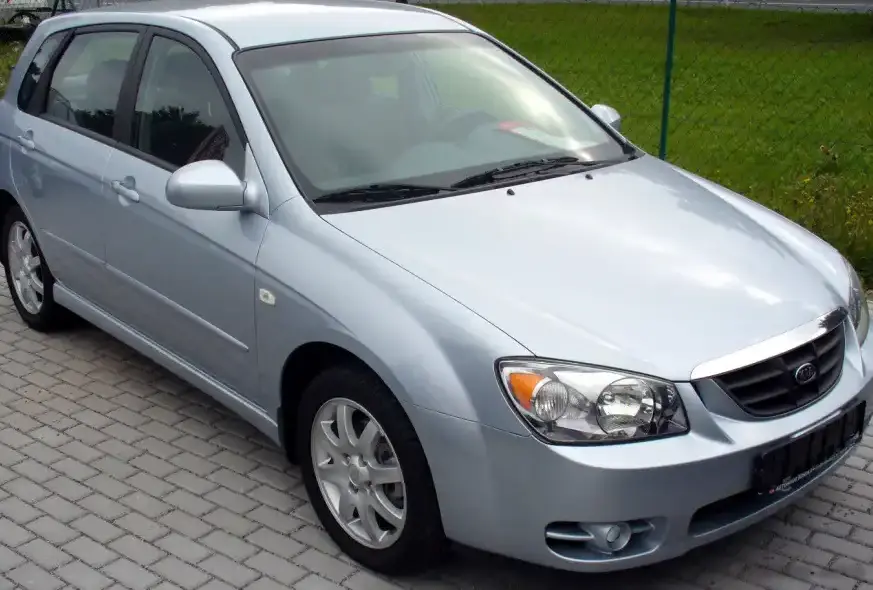
The Kia Cerato I Hatchback 1.5 CRDi, produced from 2005 to 2006, marked Kia’s initial foray into the highly competitive European and Asian compact hatchback segments. Positioned as a fuel-efficient and practical option, this variant leveraged a diesel engine to attract buyers prioritizing economy. It was part of the first-generation Cerato (LD) series, internally designated as the 1HX, and shared its platform with the contemporary Hyundai Elantra. The 1.5 CRDi model aimed to strike a balance between affordability, reasonable performance, and low running costs, making it a popular choice for urban commuters and small families.
Technical Specifications
| Brand | Kia |
| Model | Cerato |
| Generation | Cerato I Hatchback |
| Type (Engine) | 1.5 CRDi (102 Hp) |
| Start of production | 2005 |
| End of production | 2006 |
| Powertrain Architecture | Internal Combustion engine |
| Body type | Hatchback |
| Seats | 5 |
| Doors | 5 |
| Fuel consumption (urban) | 6.3 l/100 km (37.3 US mpg, 44.8 UK mpg, 15.9 km/l) |
| Fuel consumption (extra urban) | 4.1 l/100 km (57.4 US mpg, 68.9 UK mpg, 24.4 km/l) |
| Fuel consumption (combined) | 4.9 l/100 km (48 US mpg, 57.6 UK mpg, 20.4 km/l) |
| CO2 emissions | 129 g/km |
| Fuel Type | Diesel |
| Acceleration 0 – 100 km/h | 12.5 sec |
| Acceleration 0 – 62 mph | 12.5 sec |
| Acceleration 0 – 60 mph | 11.9 sec |
| Maximum speed | 175 km/h (108.74 mph) |
| Emission standard | Euro 3 |
| Weight-to-power ratio | 12.6 kg/Hp, 79.1 Hp/tonne |
| Weight-to-torque ratio | 5.5 kg/Nm, 182.2 Nm/tonne |
| Power | 102 Hp @ 4000 rpm |
| Power per litre | 68.3 Hp/l |
| Torque | 235 Nm @ 2000 rpm (173.33 lb.-ft. @ 2000 rpm) |
| Engine layout | Front, Transverse |
| Engine Model/Code | D4FA |
| Engine displacement | 1493 cm3 (91.11 cu. in.) |
| Number of cylinders | 4 |
| Engine configuration | Inline |
| Cylinder Bore | 75 mm (2.95 in.) |
| Piston Stroke | 84.5 mm (3.33 in.) |
| Compression ratio | 17.8:1 |
| Number of valves per cylinder | 4 |
| Fuel injection system | Diesel Commonrail |
| Engine aspiration | Turbocharger, Intercooler |
| Valvetrain | SOHC |
| Engine oil capacity | 5.3 l (5.6 US qt | 4.66 UK qt) |
| Coolant capacity | 8.1 l (8.56 US qt | 7.13 UK qt) |
| Kerb Weight | 1290 kg (2843.96 lbs.) |
| Max. weight | 1815 kg (4001.39 lbs.) |
| Max load | 525 kg (1157.43 lbs.) |
| Trunk (boot) space – minimum | 228 l (8.05 cu. ft.) |
| Trunk (boot) space – maximum | 1046 l (36.94 cu. ft.) |
| Fuel tank capacity | 55 l (14.53 US gal | 12.1 UK gal) |
| Length | 4340 mm (170.87 in.) |
| Width | 1735 mm (68.31 in.) |
| Height | 1470 mm (57.87 in.) |
| Wheelbase | 2610 mm (102.76 in.) |
| Front track | 1495 mm (58.86 in.) |
| Rear track | 1485 mm (58.46 in.) |
| Drag coefficient (Cd) | 0.33 |
| Minimum turning circle | 10.1 m (33.14 ft.) |
| Drivetrain Architecture | Front wheel drive |
| Number of gears | 5 |
| Gearbox type | Manual transmission |
| Front brakes | Ventilated discs |
| Rear brakes | Disc |
| Assisting systems | ABS (Anti-lock braking system) |
| Steering type | Steering rack and pinion |
| Tires size | 205/50 R16 |
| Wheel rims size | 16 |
Powertrain & Engine Architecture
The heart of the Cerato 1.5 CRDi was the D4FA engine, a 1.5-liter inline-four cylinder diesel. This engine was a product of Hyundai’s diesel engine development, and it featured a second-generation common rail direct injection system. This system allowed for precise fuel delivery, contributing to improved fuel efficiency and reduced emissions. The engine utilized a single overhead camshaft (SOHC) valvetrain and was equipped with a turbocharger and intercooler to boost power output. The turbocharger helped to overcome the inherent limitations of a small-displacement diesel, providing a noticeable increase in torque. The engine’s 17.8:1 compression ratio was typical for a diesel engine of this era, maximizing combustion efficiency. A five-speed manual transmission was the sole gearbox option, prioritizing fuel economy over outright performance.
Driving Characteristics
The 1.5 CRDi Cerato offered a practical and economical driving experience. With 102 horsepower and 173 lb-ft of torque, acceleration was adequate for everyday driving, though not particularly brisk. The 0-60 mph time of around 11.9 seconds reflects this. The engine’s torque peak at 2000 rpm provided good low-end grunt, making it easy to navigate city streets and handle moderate inclines. Compared to higher-spec Cerato models with larger gasoline engines, the 1.5 CRDi felt noticeably slower, especially at higher speeds. However, the fuel economy advantage was significant. The five-speed manual transmission was well-matched to the engine’s characteristics, offering smooth shifts and allowing drivers to keep the engine in its optimal power band. The gear ratios were geared towards maximizing fuel efficiency rather than providing sporty acceleration.
Equipment & Trim Levels
The 1.5 CRDi trim level typically represented the entry point into the Cerato range. Standard equipment generally included air conditioning, power steering, central locking, and an integrated audio system. Interior upholstery was typically cloth, and the dashboard featured a functional, if somewhat basic, design. Optional extras could include alloy wheels, electric windows, and upgraded audio systems. Safety features such as ABS were standard, but airbags were often limited to the driver and front passenger. The overall focus was on providing essential features at an affordable price point.
Chassis & Braking
The Cerato I Hatchback utilized a MacPherson strut front suspension and a torsion beam rear suspension. This setup provided a comfortable ride quality, suitable for everyday driving. The front brakes were ventilated discs, offering good stopping power, while the rear brakes were solid discs. The ABS system helped to prevent wheel lockup during hard braking, enhancing safety. The chassis was tuned for comfort and stability rather than sporty handling. The relatively modest power output of the 1.5 CRDi engine meant that the braking system was generally adequate for the vehicle’s performance capabilities.
Market Reception & Comparison
The Kia Cerato 1.5 CRDi was generally well-received as a value-for-money option in the compact hatchback segment. Critics praised its fuel efficiency and practicality, but noted that its performance was not as exciting as some of its rivals. Compared to gasoline-powered Cerato models, the 1.5 CRDi offered significantly better fuel economy, making it a popular choice for drivers covering long distances. However, the diesel engine came with a higher purchase price and potentially higher maintenance costs. Competitors such as the Volkswagen Golf, Ford Focus, and Opel/Vauxhall Astra offered a wider range of engine options and trim levels, but often at a higher price point.
Legacy
The Kia Cerato 1.5 CRDi, while not a performance icon, established Kia as a credible player in the European and Asian compact car markets. The D4FA engine proved to be relatively reliable, although, like all diesel engines, it required regular maintenance and careful servicing. Today, these vehicles are relatively rare, and well-maintained examples are sought after by enthusiasts looking for an affordable and economical classic. The 1.5 CRDi powertrain’s longevity and fuel efficiency continue to be appreciated by owners, making it a practical choice for those seeking a reliable and economical used car.