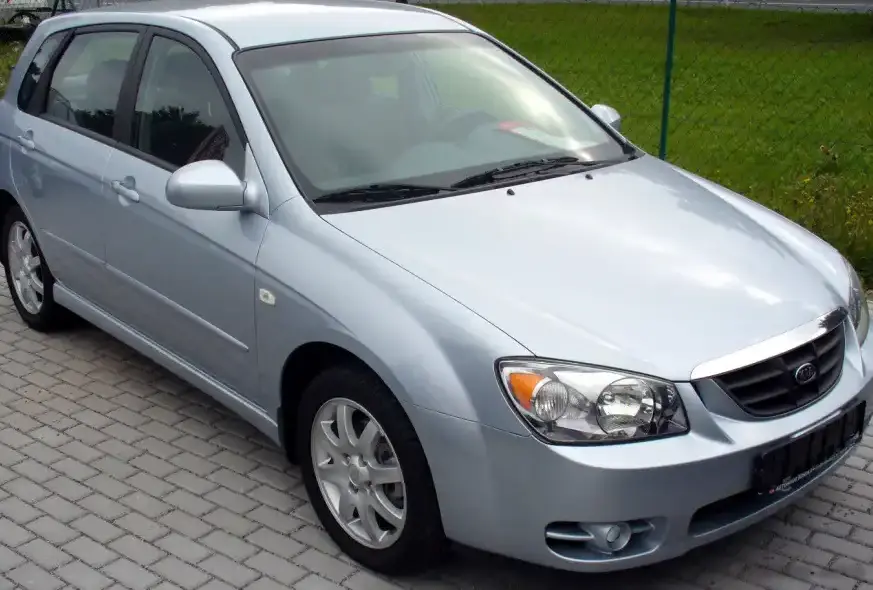
The Kia Cerato, known as the Spectra in some markets, represented Kia’s entry into the competitive compact car segment. The first generation Cerato hatchback, produced from 2004 to 2006, aimed to offer a value-oriented alternative to established European and Japanese rivals. The 1.6-liter (105 hp) variant, paired with a five-speed manual transmission, served as the entry point to the Cerato hatchback range, targeting budget-conscious buyers seeking a practical and economical vehicle. This model was primarily sold in Europe and other international markets, with Kia focusing on different models for the North American market during this period.
Technical Specifications
| Brand | Kia |
| Model | Cerato |
| Generation | Cerato I Hatchback |
| Type (Engine) | 1.6 (105 Hp) |
| Start of production | 2004 |
| End of production | 2006 |
| Powertrain Architecture | Internal Combustion engine |
| Body type | Hatchback |
| Seats | 5 |
| Doors | 5 |
| Fuel consumption (urban) | 9.2 l/100 km (25.6 US mpg) |
| Fuel consumption (extra urban) | 5.5 l/100 km (42.8 US mpg) |
| Fuel consumption (combined) | 6.9 l/100 km (34.1 US mpg) |
| CO2 emissions | 167 g/km |
| Fuel Type | Petrol (Gasoline) |
| Acceleration 0 – 100 km/h | 11 sec |
| Acceleration 0 – 62 mph | 11 sec |
| Acceleration 0 – 60 mph | 10.5 sec |
| Maximum speed | 186 km/h (115.58 mph) |
| Emission standard | Euro 4 |
| Weight-to-power ratio | 11.4 kg/Hp |
| Weight-to-torque ratio | 8.4 kg/Nm |
| Power | 105 Hp @ 5800 rpm |
| Torque | 143 Nm @ 4500 rpm (105.47 lb.-ft. @ 4500 rpm) |
| Engine layout | Front, Transverse |
| Engine Model/Code | Alpha II / G4ED |
| Engine displacement | 1599 cm3 (97.58 cu. in.) |
| Number of cylinders | 4 |
| Engine configuration | Inline |
| Cylinder Bore | 76.5 mm (3.01 in.) |
| Piston Stroke | 87 mm (3.43 in.) |
| Compression ratio | 10:1 |
| Number of valves per cylinder | 4 |
| Fuel injection system | Multi-port manifold injection |
| Engine aspiration | Naturally aspirated engine |
| Valvetrain | DOHC |
| Engine oil capacity | 3.3 l (3.49 US qt | 2.9 UK qt) |
| Coolant capacity | 8.1 l (8.56 US qt | 7.13 UK qt) |
| Kerb Weight | 1200 kg (2645.55 lbs.) |
| Max. weight | 1700 kg (3747.86 lbs.) |
| Max load | 500 kg (1102.31 lbs.) |
| Trunk (boot) space – minimum | 228 l (8.05 cu. ft.) |
| Trunk (boot) space – maximum | 1046 l (36.94 cu. ft.) |
| Fuel tank capacity | 55 l (14.53 US gal | 12.1 UK gal) |
| Length | 4340 mm (170.87 in.) |
| Width | 1735 mm (68.31 in.) |
| Height | 1470 mm (57.87 in.) |
| Wheelbase | 2610 mm (102.76 in.) |
| Front track | 1495 mm (58.86 in.) |
| Rear (Back) track | 1485 mm (58.46 in.) |
| Drag coefficient (Cd) | 0.33 |
| Minimum turning circle | 10.1 m (33.14 ft.) |
| Drivetrain Architecture | Front wheel drive |
| Number of gears | 5 |
| Gearbox type | Manual transmission |
| Front brakes | Ventilated discs |
| Rear brakes | Disc |
| Assisting systems | ABS (Anti-lock braking system) |
| Steering type | Steering rack and pinion |
| Tires size | 205/50 R16 |
| Wheel rims size | 16 |
Powertrain & Engine Architecture
The heart of this Cerato variant was the Kia Alpha II engine, specifically the G4ED code. This 1.6-liter inline-four engine featured a dual overhead camshaft (DOHC) valvetrain with four valves per cylinder. The engine utilized a multi-point fuel injection system, delivering fuel directly into the intake ports. The 10:1 compression ratio was typical for naturally aspirated engines of the era, balancing efficiency and performance. The engine’s design prioritized reliability and low-cost maintenance over outright power. The five-speed manual transmission was a standard offering, providing a relatively direct connection between the engine and the front wheels. Gear ratios were tuned for fuel economy and everyday drivability, rather than sporty acceleration.
Driving Characteristics
The 1.6-liter Cerato hatchback, with its 105 horsepower, offered modest performance. Acceleration from 0 to 60 mph took around 10.5 seconds, and top speed was approximately 115 mph. While not particularly quick, the engine provided adequate power for typical urban and highway driving. The manual transmission allowed drivers to maintain control over the engine’s RPMs, maximizing efficiency or extracting the most available power. Compared to potential higher-trim versions with larger engines (which weren’t widely available in the hatchback body style), this variant felt noticeably less responsive. The focus was on providing a comfortable and economical driving experience, rather than a thrilling one. The relatively light weight of the hatchback body style helped to mitigate the engine’s power deficit.
Equipment & Trim Levels
The 1.6-liter Cerato hatchback typically came with a basic level of equipment. Standard features generally included power steering, central locking, and an AM/FM radio. Air conditioning was often an optional extra. Interior upholstery was typically cloth, and the dashboard featured a functional, if somewhat basic, design. Higher trim levels, if available, might have added features like alloy wheels, upgraded audio systems, and power windows. However, the 1.6-liter model was positioned as the entry-level option, so luxury features were generally limited.
Chassis & Braking
The Cerato hatchback utilized a conventional front-wheel-drive chassis with MacPherson strut front suspension and a torsion beam rear suspension. Front brakes were ventilated discs, providing adequate stopping power, while rear brakes were solid discs. ABS (Anti-lock Braking System) was a standard safety feature. The suspension was tuned for comfort, prioritizing ride quality over sporty handling. Stabilizer bars were present, but relatively thin, contributing to a mild understeer bias in cornering. The overall chassis setup was designed to provide a safe and predictable driving experience.
Market Reception & Comparison
The 1.6-liter Cerato hatchback was generally well-received as a value-for-money option in its segment. Critics praised its practicality, fuel efficiency, and affordable price point. However, it was often criticized for its lack of refinement and relatively uninspiring performance. Compared to rivals like the Volkswagen Golf or Ford Focus, the Cerato lacked the same level of sophistication and driving dynamics. However, it often undercut those competitors in price. Fuel economy was a strong point, with combined fuel consumption figures around 34 mpg. Reliability was generally considered good, although not exceptional.
Legacy
The Kia Cerato I Hatchback 1.6 (105 Hp) has become a relatively affordable and readily available used car. The Alpha II engine is known for its durability, and with proper maintenance, can provide many years of reliable service. While not a collector’s item, these cars represent a significant step forward for Kia in terms of design and build quality. Common issues include wear and tear on suspension components and potential for oil leaks as the engine ages. However, parts availability is generally good, and repair costs are typically reasonable. Today, these Ceratos are often seen as practical and economical transportation for budget-conscious buyers.