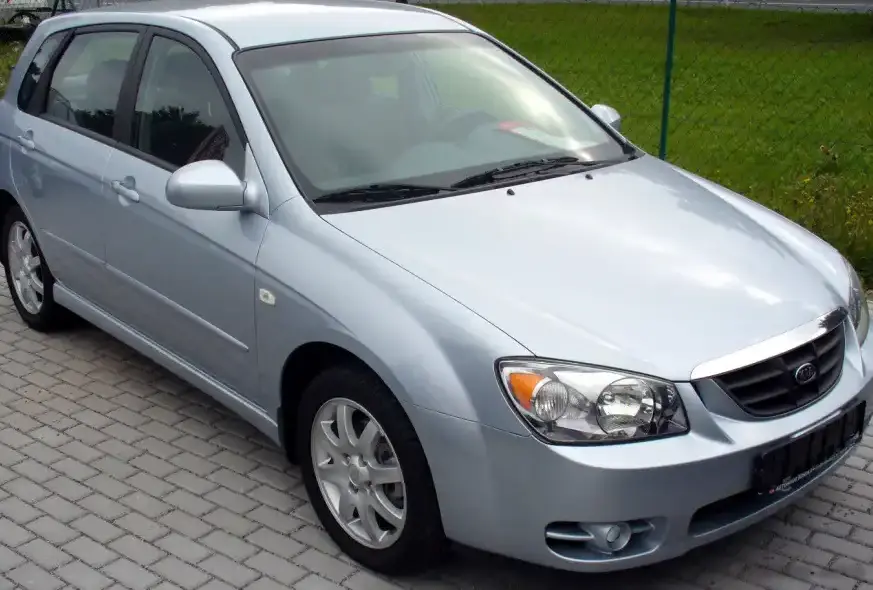
The Kia Cerato, known as the Spectra in some markets, represented Kia’s entry into the competitive compact car segment. The first generation Cerato hatchback, produced from 2004 to 2006, aimed to offer a blend of affordability, practicality, and a surprisingly generous feature set. The 2.0-liter (143 hp) automatic variant occupied a mid-range position within the Cerato hatchback lineup, offering a step up in performance from the base 1.6-liter engine while remaining more accessible than potential future performance trims. This model was primarily targeted towards buyers seeking a comfortable and reliable daily driver with the convenience of an automatic transmission.
Technical Specifications
| Brand | Kia |
| Model | Cerato |
| Generation | Cerato I Hatchback |
| Type (Engine) | 2.0 (143 Hp) Automatic |
| Start of production | 2004 |
| End of production | 2006 |
| Powertrain Architecture | Internal Combustion engine |
| Body type | Hatchback |
| Seats | 5 |
| Doors | 5 |
| Fuel consumption (urban) | 11.3 l/100 km (20.8 US mpg) |
| Fuel consumption (extra urban) | 6.6 l/100 km (35.6 US mpg) |
| Fuel consumption (combined) | 8.3 l/100 km (28.3 US mpg) |
| CO2 emissions | 198 g/km |
| Fuel Type | Petrol (Gasoline) |
| Acceleration 0 – 100 km/h | 10.4 sec |
| Acceleration 0 – 62 mph | 10.4 sec |
| Acceleration 0 – 60 mph | 9.9 sec |
| Maximum speed | 200 km/h (124.27 mph) |
| Emission standard | Euro 4 |
| Weight-to-power ratio | 8.9 kg/Hp |
| Weight-to-torque ratio | 6.9 kg/Nm |
| Power | 143 Hp @ 6000 rpm |
| Torque | 186 Nm @ 4500 rpm (137.19 lb.-ft. @ 4500 rpm) |
| Engine layout | Front, Transverse |
| Engine Model/Code | Beta II / G4GC |
| Engine displacement | 1975 cm3 (120.52 cu. in.) |
| Number of cylinders | 4 |
| Engine configuration | Inline |
| Cylinder Bore | 82 mm (3.23 in.) |
| Piston Stroke | 93.5 mm (3.68 in.) |
| Compression ratio | 10.1:1 |
| Number of valves per cylinder | 4 |
| Fuel injection system | Multi-port manifold injection |
| Engine aspiration | Naturally aspirated engine |
| Valvetrain | DOHC |
| Engine oil capacity | 4 l (4.23 US qt | 3.52 UK qt) |
| Coolant capacity | 8.14 l (8.6 US qt | 7.16 UK qt) |
| Kerb Weight | 1276 kg (2813.1 lbs.) |
| Max. weight | 1809 kg (3988.16 lbs.) |
| Max load | 533 kg (1175.06 lbs.) |
| Trunk (boot) space – minimum | 228 l (8.05 cu. ft.) |
| Trunk (boot) space – maximum | 1046 l (36.94 cu. ft.) |
| Fuel tank capacity | 55 l (14.53 US gal | 12.1 UK gal) |
| Length | 4340 mm (170.87 in.) |
| Width | 1735 mm (68.31 in.) |
| Height | 1470 mm (57.87 in.) |
| Wheelbase | 2610 mm (102.76 in.) |
| Front track | 1495 mm (58.86 in.) |
| Rear track | 1485 mm (58.46 in.) |
| Drag coefficient (Cd) | 0.33 |
| Minimum turning circle | 10.1 m (33.14 ft.) |
| Drivetrain | Front wheel drive |
| Number of gears | 4 |
| Gearbox type | Automatic transmission |
| Front brakes | Ventilated discs |
| Rear brakes | Disc |
| Assisting systems | ABS (Anti-lock braking system) |
| Steering type | Steering rack and pinion |
| Tires size | 205/50 R16 |
| Wheel rims size | 16 |
Powertrain & Engine Architecture
The heart of the Cerato 2.0 Automatic is the Beta II engine, specifically the G4GC code. This 1.975-liter inline-four engine utilizes a naturally aspirated configuration and a multi-port fuel injection system. The engine features a double overhead camshaft (DOHC) valvetrain with four valves per cylinder, contributing to its respectable power output for its displacement. The 10.1:1 compression ratio was a standard figure for engines of this era, balancing performance and fuel efficiency. The four-speed automatic transmission, while not as sophisticated as modern transmissions, provided smooth and convenient shifting for everyday driving. It was designed to prioritize comfort over outright performance, with gear ratios tuned for relaxed cruising and adequate acceleration.
Driving Characteristics
The 2.0-liter engine paired with the four-speed automatic delivered a comfortable, if not particularly sporty, driving experience. Acceleration from 0-60 mph took around 9.9 seconds, which was competitive for its class at the time. The automatic transmission’s shift points were calibrated for fuel economy and smooth operation, resulting in a noticeable difference in responsiveness compared to the available five-speed manual transmission. While the manual offered more direct control and quicker acceleration, the automatic appealed to drivers prioritizing ease of use. The relatively tall gear ratios in the automatic contributed to decent highway fuel economy, but could feel somewhat strained during aggressive acceleration or when climbing hills.
Equipment & Trim Levels
The 2.0-liter automatic Cerato hatchback typically came standard with features such as air conditioning, power windows and locks, and a basic audio system. Higher trim levels offered options like alloy wheels, a sunroof, upgraded upholstery, and a more advanced audio system with a CD player. Interior materials were generally durable and functional, reflecting the car’s value-oriented positioning. The hatchback body style provided a good level of practicality, with a versatile cargo area that could be expanded by folding down the rear seats. Safety features included ABS brakes, which were becoming increasingly common on vehicles in this segment.
Chassis & Braking
The Cerato hatchback utilized a conventional front-wheel-drive chassis with a MacPherson strut front suspension and a torsion beam rear suspension. The front brakes were ventilated discs, providing adequate stopping power, while the rear brakes were solid discs. The suspension tuning prioritized ride comfort over sharp handling, resulting in a relatively soft and forgiving ride quality. The steering was a rack-and-pinion system, offering reasonable precision and feedback. Tire size was typically 205/50 R16, providing a good balance of grip and ride comfort.
Market Reception & Comparison
The Kia Cerato 2.0 Automatic was generally well-received by critics as a practical and affordable compact car. It offered a good value proposition, providing a decent level of features and equipment for its price point. Compared to competitors like the Honda Civic, Toyota Corolla, and Mazda3, the Cerato often lagged slightly in terms of driving dynamics and refinement, but made up for it with its lower price and longer warranty. Fuel economy was average for its class, and reliability was generally considered to be good, although not exceptional. The automatic transmission was often praised for its smoothness, but criticized for its lack of responsiveness compared to manual transmissions.
Legacy
The first-generation Kia Cerato hatchback, particularly the 2.0-liter automatic variant, has proven to be a relatively durable and reliable vehicle. While not known for any groundbreaking innovations, it provided a solid and affordable transportation option for many buyers. Today, these cars can be found on the used car market at very affordable prices. The Beta II engine is generally considered to be a robust and long-lasting unit, although regular maintenance is essential to prevent issues. Common problems include oil leaks and sensor failures. Overall, the Cerato 2.0 Automatic remains a viable option for budget-conscious buyers seeking a practical and dependable compact car.