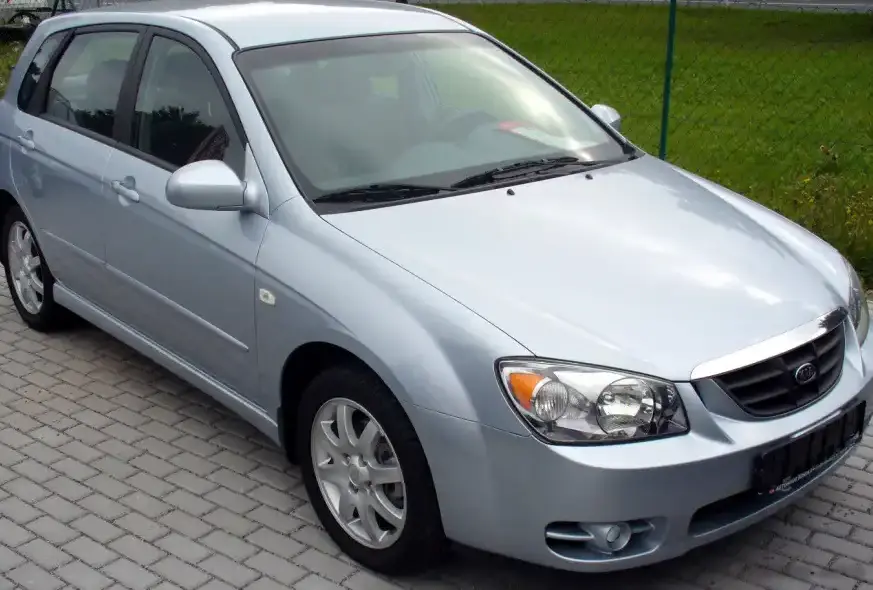
The Kia Cerato I Hatchback 2.0 CRDi, produced between 2004 and 2006, represented Kia’s entry into the competitive European and global compact hatchback segment. This variant, powered by the D4EA 2.0-liter common rail diesel engine producing 113 horsepower, was positioned as a fuel-efficient and practical option within the Cerato I range. It aimed to appeal to buyers seeking a versatile vehicle for daily commuting and family use. The Cerato I, built on the LD platform, was Kia’s first serious attempt at a globally competitive C-segment vehicle, and the 2.0 CRDi hatchback offered a diesel alternative to the gasoline-powered models.
Technical Specifications
| Brand | Kia |
| Model | Cerato |
| Generation | Cerato I Hatchback |
| Type (Engine) | 2.0 CRDi (113 Hp) |
| Start of production | 2004 |
| End of production | 2006 |
| Powertrain Architecture | Internal Combustion engine |
| Body type | Hatchback |
| Seats | 5 |
| Doors | 5 |
| Fuel consumption (urban) | 8.2 l/100 km (28.7 US mpg) |
| Fuel consumption (extra urban) | 4.6 l/100 km (51.1 US mpg) |
| Fuel consumption (combined) | 6 l/100 km (39.2 US mpg) |
| CO2 emissions | 157 g/km |
| Fuel Type | Diesel |
| Acceleration 0 – 100 km/h | 11.5 sec |
| Acceleration 0 – 62 mph | 11.5 sec |
| Acceleration 0 – 60 mph | 10.9 sec |
| Maximum speed | 190 km/h (118.06 mph) |
| Emission standard | Euro 3 |
| Weight-to-power ratio | 11.7 kg/Hp |
| Weight-to-torque ratio | 5.4 kg/Nm |
| Power | 113 Hp @ 4000 rpm |
| Torque | 245 Nm @ 1800 rpm (180.7 lb.-ft. @ 1800 rpm) |
| Engine layout | Front, Transverse |
| Engine Model/Code | D4EA |
| Engine displacement | 1991 cm3 (121.5 cu. in.) |
| Number of cylinders | 4 |
| Engine configuration | Inline |
| Cylinder Bore | 83 mm (3.27 in.) |
| Piston Stroke | 92 mm (3.62 in.) |
| Compression ratio | 17.7:1 |
| Number of valves per cylinder | 4 |
| Fuel injection system | Diesel Commonrail |
| Engine aspiration | Turbocharger, Intercooler |
| Valvetrain | SOHC |
| Engine oil capacity | 5.9 l (6.23 US qt | 5.19 UK qt) |
| Kerb Weight | 1324 kg (2918.92 lbs.) |
| Max. weight | 1856 kg (4091.78 lbs.) |
| Max load | 532 kg (1172.86 lbs.) |
| Trunk (boot) space – minimum | 228 l (8.05 cu. ft.) |
| Trunk (boot) space – maximum | 1046 l (36.94 cu. ft.) |
| Fuel tank capacity | 55 l (14.53 US gal | 12.1 UK gal) |
| Length | 4340 mm (170.87 in.) |
| Width | 1735 mm (68.31 in.) |
| Height | 1470 mm (57.87 in.) |
| Wheelbase | 2610 mm (102.76 in.) |
| Front track | 1495 mm (58.86 in.) |
| Rear (Back) track | 1485 mm (58.46 in.) |
| Drag coefficient (Cd) | 0.33 |
| Minimum turning circle | 10.1 m (33.14 ft.) |
| Drivetrain | Front wheel drive |
| Number of gears | 5 |
| Gearbox type | Manual transmission |
| Front brakes | Ventilated discs |
| Rear brakes | Disc |
| Assisting systems | ABS (Anti-lock braking system) |
| Steering type | Steering rack and pinion |
| Tires size | 205/50 R16 |
| Wheel rims size | 16 |
Powertrain & Engine Architecture
The heart of the Cerato 2.0 CRDi is the D4EA engine, a 1991cc inline-four cylinder diesel. This engine utilizes a second-generation common rail direct injection system, delivering fuel at extremely high pressures for improved combustion efficiency and reduced emissions. The D4EA features a single overhead camshaft (SOHC) valvetrain operating four valves per cylinder. A turbocharger with an intercooler is employed to boost power output and improve torque across the rev range. The engine’s 17.7:1 compression ratio is typical for a diesel engine, contributing to its thermal efficiency. The 5-speed manual transmission was the standard offering for this variant, providing a balance between fuel economy and drivability. The transmission’s gear ratios were tuned to maximize the engine’s torque output, offering reasonable acceleration and highway cruising ability.
Driving Characteristics
The 113 horsepower and 245 Nm (180.7 lb-ft) of torque provided by the 2.0 CRDi engine delivered adequate performance for everyday driving. Acceleration from 0-60 mph took around 10.9 seconds, and top speed was approximately 118 mph. While not a particularly sporty setup, the engine’s strong low-end torque made it well-suited for overtaking and navigating city traffic. Compared to the gasoline-powered Cerato variants, the 2.0 CRDi offered significantly better fuel economy. The manual transmission allowed for greater driver control, but the gear ratios were somewhat tall, prioritizing fuel efficiency over outright acceleration. The ride quality was generally comfortable, although the suspension could feel a bit firm over rough road surfaces.
Equipment & Trim Levels
The Cerato I Hatchback 2.0 CRDi typically came with a reasonable level of standard equipment. This included power steering, central locking, electric front windows, and an air conditioning system. Interior upholstery was typically cloth, with a functional and durable design. Optional extras included alloy wheels, a CD player with MP3 compatibility, and upgraded interior trim. The specific trim level could vary depending on the market, but the 2.0 CRDi generally occupied a mid-range position in the Cerato lineup, offering a good balance of features and affordability.
Chassis & Braking
The Cerato I Hatchback featured a MacPherson strut front suspension and a torsion beam rear suspension. This setup provided a good compromise between ride comfort and handling. The front brakes were ventilated discs, offering good stopping power, while the rear brakes were solid discs. Anti-lock Braking System (ABS) was standard, enhancing safety during emergency braking situations. The steering was a rack and pinion system, providing precise and responsive steering feel. The 205/50 R16 tires offered good grip in a variety of conditions.
Market Reception & Comparison
The Kia Cerato I Hatchback 2.0 CRDi was generally well-received by automotive critics as a practical and fuel-efficient option in the compact hatchback segment. It was praised for its spacious interior, comfortable ride, and strong diesel engine. However, some critics noted that the interior materials were not as refined as those found in some of its competitors. Compared to other diesel-powered hatchbacks in its class, the Cerato 2.0 CRDi offered a competitive level of performance and fuel economy. It was often seen as a more affordable alternative to established European brands.
Legacy
The D4EA engine, used in the Cerato 2.0 CRDi, proved to be a relatively reliable powertrain. With proper maintenance, these engines can accumulate high mileage without major issues. The Cerato I Hatchback 2.0 CRDi remains a relatively affordable used car option today, appealing to buyers seeking a practical and fuel-efficient vehicle. While not a collector’s item, it represents an important step in Kia’s evolution as a global automotive manufacturer. The Cerato I laid the foundation for Kia’s subsequent success in the European and global markets, demonstrating the brand’s ability to produce competitive and well-equipped vehicles.