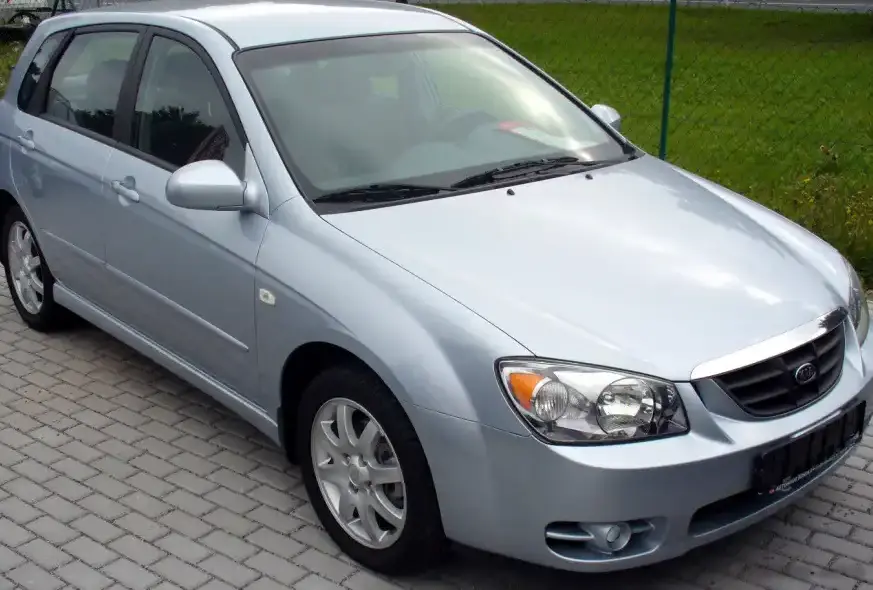
The Kia Cerato, known as the Spectra in some markets, represented Kia’s entry into the competitive compact sedan segment. Introduced for the 2004 model year as a replacement for the Kia Spectra, the first generation Cerato (designated LD) aimed to offer a more refined and modern alternative to established rivals. The 1.6-liter (105 hp) variant, produced from 2004 to 2006, served as the entry-level trim in many markets, particularly in regions where smaller displacement engines were favored due to taxation or fuel economy considerations. This model played a crucial role in establishing Kia’s reputation for value and reliability in the global automotive landscape.
Technical Specifications
| Brand | Kia |
| Model | Cerato |
| Generation | Cerato I Sedan |
| Type (Engine) | 1.6 (105 Hp) |
| Start of production | 2004 |
| End of production | 2006 |
| Powertrain Architecture | Internal Combustion engine |
| Body type | Sedan |
| Seats | 5 |
| Doors | 4 |
| Fuel consumption (urban) | 9.1 l/100 km (25.8 US mpg) |
| Fuel consumption (extra urban) | 5.5 l/100 km (42.8 US mpg) |
| Fuel consumption (combined) | 6.8 l/100 km (34.6 US mpg) |
| CO2 emissions | 165 g/km |
| Fuel Type | Petrol (Gasoline) |
| Acceleration 0 – 100 km/h | 11 sec |
| Acceleration 0 – 62 mph | 11 sec |
| Acceleration 0 – 60 mph | 10.5 sec |
| Maximum speed | 186 km/h (115.58 mph) |
| Emission standard | Euro 4 |
| Weight-to-power ratio | 11.2 kg/Hp |
| Weight-to-torque ratio | 8.2 kg/Nm |
| Power | 105 Hp @ 5800 rpm |
| Torque | 143 Nm @ 4500 rpm (105.47 lb.-ft. @ 4500 rpm) |
| Engine layout | Front, Transverse |
| Engine Model/Code | Alpha II / G4ED |
| Engine displacement | 1599 cm3 (97.58 cu. in.) |
| Number of cylinders | 4 |
| Engine configuration | Inline |
| Cylinder Bore | 76.5 mm (3.01 in.) |
| Piston Stroke | 87 mm (3.43 in.) |
| Compression ratio | 10:1 |
| Number of valves per cylinder | 4 |
| Fuel injection system | Multi-port manifold injection |
| Engine aspiration | Naturally aspirated engine |
| Valvetrain | DOHC |
| Engine oil capacity | 3.3 l (3.49 US qt | 2.9 UK qt) |
| Coolant capacity | 8.1 l (8.56 US qt | 7.13 UK qt) |
| Kerb Weight | 1178 kg (2597.05 lbs.) |
| Max. weight | 1720 kg (3791.95 lbs.) |
| Max load | 542 kg (1194.91 lbs.) |
| Trunk (boot) space – minimum | 381 l (13.45 cu. ft.) |
| Fuel tank capacity | 55 l (14.53 US gal | 12.1 UK gal) |
| Length | 4480 mm (176.38 in.) |
| Width | 1735 mm (68.31 in.) |
| Height | 1470 mm (57.87 in.) |
| Wheelbase | 2610 mm (102.76 in.) |
| Front track | 1495 mm (58.86 in.) |
| Rear (Back) track | 1485 mm (58.46 in.) |
| Drag coefficient (Cd) | 0.32 |
| Minimum turning circle | 10.1 m (33.14 ft.) |
| Drivetrain Architecture | Front wheel drive |
| Number of gears | 5 |
| Gearbox type | Manual transmission |
| Front brakes | Ventilated discs |
| Rear brakes | Disc |
| Assisting systems | ABS (Anti-lock braking system) |
| Steering type | Steering rack and pinion |
| Tires size | 195/60 R15 |
| Wheel rims size | 15 |
Powertrain & Engine Architecture
The heart of the Cerato 1.6 was the Kia Alpha II engine, specifically the G4ED code. This 1.6-liter inline-four engine featured a dual overhead camshaft (DOHC) valvetrain with four valves per cylinder, contributing to its relatively efficient operation. It utilized a multi-point fuel injection system, delivering fuel directly to the intake ports. The engine produced 105 horsepower at 5,800 rpm and 143 Nm (105.47 lb-ft) of torque at 4,500 rpm. The engine’s design prioritized fuel efficiency and smooth operation over outright performance. The engine was transversely mounted in the front of the vehicle, driving the front wheels. The standard transmission for this variant was a five-speed manual gearbox, although a four-speed automatic transmission was also available, albeit less common.
Driving Characteristics
The 1.6-liter Cerato with the five-speed manual transmission offered adequate, though not exhilarating, performance. Acceleration from 0 to 60 mph took approximately 10.5 seconds, and top speed was around 115.58 mph. The engine felt somewhat strained at higher speeds, particularly when fully loaded. The five-speed manual gearbox provided reasonable control, but the shift quality wasn’t particularly sporty. The automatic transmission, while offering convenience, further diminished acceleration and responsiveness. The suspension was tuned for comfort, resulting in a relatively soft ride, but also some body roll during cornering. Overall, the driving experience was geared towards practicality and ease of use rather than dynamic driving enjoyment.
Equipment & Trim Levels
The 1.6-liter Cerato typically represented the base trim level. Standard features generally included air conditioning, power steering, central locking, and an AM/FM radio. Interior upholstery was typically cloth, and the dashboard featured a simple, functional design. Optional extras, depending on the market, could include power windows, power mirrors, alloy wheels, and an upgraded audio system. Safety features were relatively basic, typically including dual front airbags and ABS brakes. The overall interior ambiance was functional and durable, prioritizing value over luxury.
Chassis & Braking
The Cerato I Sedan utilized a MacPherson strut front suspension and a torsion beam rear suspension. The front brakes were ventilated discs, providing adequate stopping power, while the rear brakes were solid discs. The suspension setup was tuned for comfort and ride quality, prioritizing a smooth ride over sporty handling. The steering was a rack-and-pinion system, offering reasonable precision. Tire size was typically 195/60 R15, mounted on 15-inch steel or alloy wheels. The chassis was designed to provide a balance between comfort, handling, and affordability.
Market Reception & Comparison
The 1.6-liter Cerato was generally well-received as an affordable and reliable compact sedan. Critics praised its value for money and spacious interior, but noted its lack of refinement and somewhat underwhelming performance. Compared to higher-trim Cerato models with larger engines (such as the 2.0-liter), the 1.6-liter variant offered significantly less power and acceleration. However, it also delivered better fuel economy. In terms of reliability, the 1.6-liter engine proved to be generally robust, with few major issues reported. It competed directly with other entry-level compact sedans such as the Honda Civic, Toyota Corolla, and Hyundai Elantra.
Legacy
The Kia Cerato 1.6 (105 hp) has proven to be a relatively durable and reliable vehicle in the used car market. The Alpha II engine, while not known for its performance, is generally considered to be long-lasting and relatively inexpensive to maintain. Parts availability is generally good, and repair costs are typically reasonable. While not a particularly sought-after model among enthusiasts, the Cerato 1.6 remains a practical and affordable option for those seeking a basic, reliable compact sedan. Its contribution lies in establishing Kia as a viable competitor in the global automotive market, offering a compelling value proposition to budget-conscious buyers.