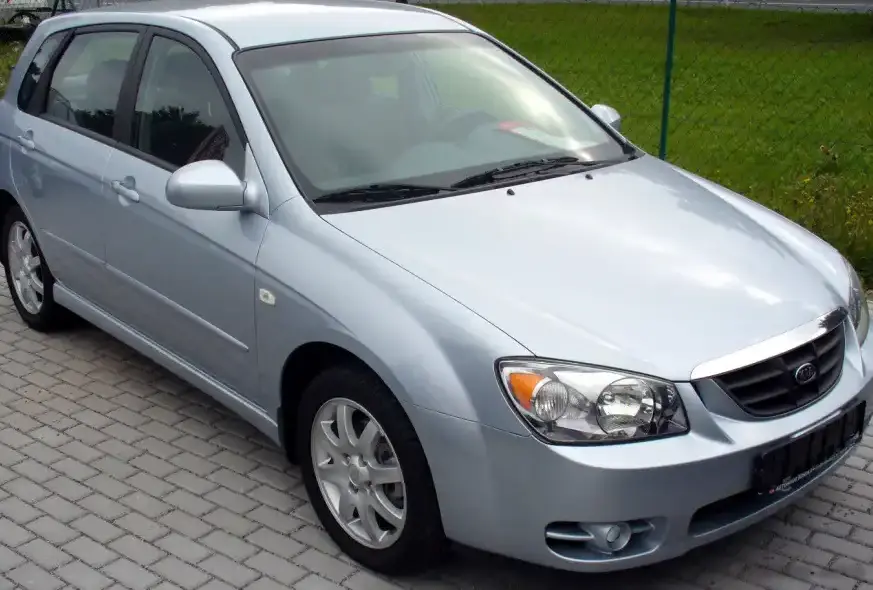
The Kia Cerato, known as the Spectra in some markets, represented Kia’s entry into the competitive compact sedan segment. Introduced for the 2004 model year as a replacement for the Kia Spectra, the first generation Cerato (designated LD) aimed to offer a more refined and modern alternative to established rivals. The 2.0 CRDi variant, producing 113 horsepower, was a key offering, particularly in European and Asian markets where diesel engines held significant popularity. Production of this specific configuration ran from 2004 to 2006. This model sat as a mid-range offering, bridging the gap between the base gasoline engines and potentially higher-trim levels with more features.
Technical Specifications
| Brand | Kia |
| Model | Cerato |
| Generation | Cerato I Sedan |
| Type (Engine) | 2.0 CRDi (113 Hp) |
| Start of production | 2004 |
| End of production | 2006 |
| Powertrain Architecture | Internal Combustion engine |
| Body type | Sedan |
| Seats | 5 |
| Doors | 4 |
| Fuel consumption (urban) | 8.2 l/100 km (28.7 US mpg) |
| Fuel consumption (extra urban) | 4.6 l/100 km (51.1 US mpg) |
| Fuel consumption (combined) | 6 l/100 km (39.2 US mpg) |
| CO2 emissions | 157 g/km |
| Fuel Type | Diesel |
| Acceleration 0 – 100 km/h | 11.5 sec |
| Acceleration 0 – 62 mph | 11.5 sec |
| Acceleration 0 – 60 mph | 10.9 sec |
| Maximum speed | 190 km/h (118.06 mph) |
| Emission standard | Euro 3 |
| Weight-to-power ratio | 11.5 kg/Hp |
| Weight-to-torque ratio | 5.3 kg/Nm |
| Power | 113 Hp @ 4000 rpm |
| Torque | 245 Nm @ 1800 rpm (180.7 lb.-ft. @ 1800 rpm) |
| Engine layout | Front, Transverse |
| Engine Model/Code | D4EA |
| Engine displacement | 1991 cm3 (121.5 cu. in.) |
| Number of cylinders | 4 |
| Engine configuration | Inline |
| Cylinder Bore | 83 mm (3.27 in.) |
| Piston Stroke | 92 mm (3.62 in.) |
| Compression ratio | 17.7:1 |
| Number of valves per cylinder | 4 |
| Fuel injection system | Diesel Commonrail |
| Engine aspiration | Turbocharger, Intercooler |
| Valvetrain | SOHC |
| Engine oil capacity | 5.9 l (6.23 US qt | 5.19 UK qt) |
| Kerb Weight | 1299 kg (2863.8 lbs.) |
| Max. weight | 1840 kg (4056.51 lbs.) |
| Max load | 541 kg (1192.7 lbs.) |
| Trunk (boot) space – minimum | 381 l (13.45 cu. ft.) |
| Fuel tank capacity | 55 l (14.53 US gal | 12.1 UK gal) |
| Length | 4480 mm (176.38 in.) |
| Width | 1735 mm (68.31 in.) |
| Height | 1470 mm (57.87 in.) |
| Wheelbase | 2610 mm (102.76 in.) |
| Front track | 1495 mm (58.86 in.) |
| Rear (Back) track | 1485 mm (58.46 in.) |
| Drag coefficient (Cd) | 0.32 |
| Minimum turning circle | 10.1 m (33.14 ft.) |
| Drivetrain Architecture | Front wheel drive |
| Number of gears | 5 |
| Gearbox type | Manual transmission |
| Front brakes | Ventilated discs |
| Rear brakes | Disc |
| Assisting systems | ABS (Anti-lock braking system) |
| Steering type | Steering rack and pinion |
| Tires size | 205/50 R16 |
| Wheel rims size | 16 |
Powertrain & Engine Architecture
The heart of the Cerato 2.0 CRDi was the Kia D4EA engine, a 1.991-liter inline-four cylinder diesel. This engine utilized a second-generation common-rail direct injection system, delivering fuel at extremely high pressure for improved combustion efficiency and reduced emissions. The D4EA featured a single overhead camshaft (SOHC) valvetrain operating four valves per cylinder. A turbocharger with an intercooler was employed to boost power output and enhance torque across a wider RPM range. The 113 horsepower peak was achieved at 4,000 rpm, while the substantial 245 Nm (180.7 lb-ft) of torque was readily available from just 1800 rpm. This configuration was paired with a five-speed manual transmission, providing a balance between fuel economy and drivability. The engine was transversely mounted in the front of the vehicle, driving the front wheels.
Driving Characteristics
The 2.0 CRDi engine in the Cerato offered a distinctly different driving experience compared to the gasoline-powered variants. The high torque output at low engine speeds provided strong acceleration from a standstill and effortless cruising. While not a particularly sporty engine, it was well-suited for everyday driving and long-distance journeys. The five-speed manual transmission allowed for precise control, but the gear ratios were geared more towards fuel efficiency than outright performance. Compared to a hypothetical higher-output gasoline engine, the CRDi variant prioritized fuel economy and low-end grunt over peak horsepower. The manual transmission also offered a more engaging driving experience than an automatic, which wasn’t offered with this engine.
Equipment & Trim Levels
The 2.0 CRDi trim level typically included features such as air conditioning, power windows, power door locks, and a basic audio system. Depending on the market and optional packages, additional features could include alloy wheels, a sunroof, and upgraded interior trim. Interior upholstery was generally cloth, with a focus on durability rather than luxury. The dashboard layout was functional and straightforward, prioritizing ease of use. Safety features included dual front airbags and ABS (Anti-lock Braking System) as standard equipment.
Chassis & Braking
The Cerato I Sedan utilized a conventional front-wheel-drive chassis with MacPherson strut front suspension and a multi-link rear suspension. The suspension setup was tuned for comfort and ride quality, rather than sporty handling. The front brakes were ventilated discs, providing adequate stopping power, while the rear brakes were solid discs. The steering system was a rack-and-pinion setup, offering reasonable precision and feedback. The 2.0 CRDi variant, being heavier than the base gasoline models, often featured slightly stiffer suspension components to compensate for the added weight.
Market Reception & Comparison
The Kia Cerato 2.0 CRDi was generally well-received in markets where diesel engines were popular. Critics praised its fuel efficiency, strong torque output, and comfortable ride. However, some reviewers noted that the engine was somewhat noisy compared to gasoline engines and that the interior lacked the refinement of some competitors. Compared to the gasoline-powered Cerato variants, the CRDi offered significantly better fuel economy but slightly less overall performance. It also tended to be priced slightly higher due to the more complex diesel engine technology. Against rivals like the Ford Focus, Volkswagen Golf, and Opel/Vauxhall Astra, the Cerato offered a competitive package with a strong value proposition.
Legacy
The Kia Cerato 2.0 CRDi, while not a groundbreaking vehicle, played a significant role in establishing Kia as a credible player in the compact sedan segment. The D4EA engine proved to be relatively reliable, although like all diesel engines, it required regular maintenance and careful fuel selection. Today, well-maintained examples of the Cerato 2.0 CRDi can still be found on the used car market, offering a fuel-efficient and practical transportation option. The engine’s durability and readily available parts contribute to its continued viability. However, potential buyers should be aware of the age-related issues common to older diesel engines, such as turbocharger wear and potential issues with the fuel injection system.