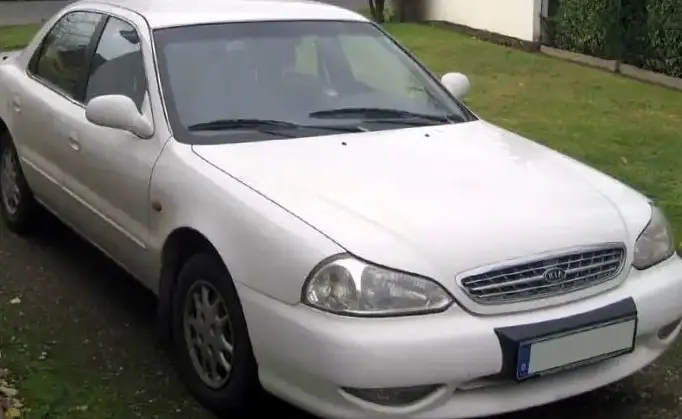
The Kia Clarus Combi (GC) 1.8 i 16V, produced between 1998 and 2001, was a station wagon variant of Kia’s Clarus model, designed primarily for the European market. Positioned as a practical and affordable family vehicle, the Combi offered increased cargo space compared to the sedan version. This particular 1.8-liter, 116 horsepower configuration represented a mid-range offering within the Clarus lineup, slotting between the base 1.6-liter engine and the more powerful 2.0-liter options. It aimed to balance fuel efficiency with adequate performance for everyday driving needs.
Technical Specifications
| Brand | Kia |
| Model | Clarus |
| Generation | Clarus Combi (GC) |
| Type (Engine) | 1.8 i 16V (116 Hp) |
| Start of production | 1998 |
| End of production | 2001 |
| Powertrain Architecture | Internal Combustion engine |
| Body type | Station wagon (estate) |
| Seats | 5 |
| Doors | 5 |
| Fuel consumption (urban) | 12.1 l/100 km (19.4 US mpg) |
| Fuel consumption (extra urban) | 7.8 l/100 km (30.2 US mpg) |
| Fuel Type | Petrol (Gasoline) |
| Acceleration 0 – 100 km/h | 10.7 sec |
| Acceleration 0 – 62 mph | 10.7 sec |
| Acceleration 0 – 60 mph | 10.2 sec |
| Maximum speed | 185 km/h (114.95 mph) |
| Weight-to-power ratio | 11 kg/Hp |
| Weight-to-torque ratio | 8.4 kg/Nm |
| Power | 116 Hp @ 5750 rpm |
| Torque | 152 Nm @ 4500 rpm (112.11 lb.-ft. @ 4500 rpm) |
| Engine layout | Front, Transverse |
| Engine Model/Code | T8 |
| Engine displacement | 1793 cm3 (109.42 cu. in.) |
| Number of cylinders | 4 |
| Engine configuration | Inline |
| Cylinder Bore | 81 mm (3.19 in.) |
| Piston Stroke | 87 mm (3.43 in.) |
| Compression ratio | 9.5:1 |
| Number of valves per cylinder | 4 |
| Fuel injection system | Multi-port manifold injection |
| Engine aspiration | Naturally aspirated engine |
| Valvetrain | DOHC |
| Engine oil capacity | 4 l (4.23 US qt | 3.52 UK qt) |
| Kerb Weight | 1275 kg (2810.89 lbs.) |
| Max. weight | 1840 kg (4056.51 lbs.) |
| Max load | 565 kg (1245.61 lbs.) |
| Trunk (boot) space – minimum | 304 l (10.74 cu. ft.) |
| Trunk (boot) space – maximum | 1580 l (55.8 cu. ft.) |
| Fuel tank capacity | 60 l (15.85 US gal | 13.2 UK gal) |
| Length | 4750 mm (187.01 in.) |
| Width | 1785 mm (70.28 in.) |
| Height | 1495 mm (58.86 in.) |
| Wheelbase | 2659 mm (104.69 in.) |
| Front track | 1500 mm (59.06 in.) |
| Rear (Back) track | 1500 mm (59.06 in.) |
| Drivetrain Architecture | The Internal combustion engine (ICE) drives the front wheels of the vehicle. |
| Drive wheel | Front wheel drive |
| Number of gears and type of gearbox | 5 gears, manual transmission |
| Front suspension | Wishbone |
| Rear suspension | Coil spring |
| Front brakes | Ventilated discs |
| Rear brakes | Drum |
| Assisting systems | ABS (Anti-lock braking system) |
| Steering type | Steering rack and pinion |
| Power steering | Hydraulic Steering |
| Tires size | 195/70 R14 |
Powertrain & Engine Architecture
The heart of the Clarus Combi 1.8 i 16V was the Kia T8 engine, a 1.8-liter inline-four cylinder gasoline engine. This engine featured a double overhead camshaft (DOHC) valvetrain operating 16 valves (four per cylinder), contributing to improved breathing and higher-end power delivery. Fuel delivery was managed by a multi-port fuel injection system, providing precise fuel metering for optimal combustion. The engine produced 116 horsepower at 5750 rpm and 152 Nm (112 lb-ft) of torque at 4500 rpm. The engine’s design prioritized reliability and ease of maintenance over outright performance. The five-speed manual transmission was the standard offering, providing a balance between fuel economy and driver control. While an automatic transmission was available in some markets, it wasn’t as commonly paired with this engine.
Driving Characteristics
The 1.8-liter engine, coupled with the five-speed manual transmission, provided adequate, though not exhilarating, performance. Acceleration from 0 to 60 mph took approximately 10.2 seconds, and the car had a top speed of around 115 mph. The engine felt relatively responsive in the mid-range, making it suitable for everyday driving and highway cruising. Compared to the higher-output 2.0-liter versions, the 1.8 felt less powerful, particularly when fully loaded with passengers and cargo. However, the 1.8 offered better fuel economy and a more relaxed driving experience. The manual transmission allowed for greater driver engagement and control, while the gear ratios were well-suited for both city and highway driving.
Equipment & Trim Levels
The Clarus Combi 1.8 i 16V typically came with a reasonable level of standard equipment. This included power steering, central locking, electric front windows, and an AM/FM radio. Higher trim levels offered features such as air conditioning, alloy wheels, a sunroof, and upgraded interior upholstery. Interior materials were generally durable and practical, reflecting the car’s focus on affordability and functionality. The dashboard layout was straightforward and easy to use, with clearly labeled controls. Safety features included ABS (Anti-lock Braking System) as standard equipment, a notable inclusion for a vehicle in this class during the late 1990s.
Chassis & Braking
The Clarus Combi featured a front-wheel-drive layout with independent wishbone suspension at the front and a coil spring rear suspension. This suspension setup provided a comfortable ride quality, absorbing bumps and imperfections in the road surface effectively. The front brakes were ventilated discs, offering good stopping power, while the rear brakes were drums. The steering was rack and pinion, providing precise and responsive handling. The car’s weight distribution was relatively balanced, contributing to stable handling characteristics. Tire size was typically 195/70 R14, providing a good compromise between ride comfort and grip.
Market Reception & Comparison
The Kia Clarus Combi 1.8 i 16V was generally well-received as a practical and affordable family vehicle. Critics praised its spacious interior, comfortable ride, and reasonable fuel economy. However, some reviewers noted that the engine lacked the power of its larger counterparts. Compared to competitors such as the Ford Focus Estate and the Vauxhall/Opel Astra Estate, the Clarus Combi offered a competitive price point and a generous level of standard equipment. Fuel economy was comparable to other vehicles in its class, averaging around 30 mpg on the highway. Reliability was generally good, although some owners reported minor issues with electrical components.
Legacy
The Kia Clarus Combi 1.8 i 16V, while not a particularly groundbreaking vehicle, played an important role in establishing Kia as a credible player in the European market. The T8 engine proved to be a reliable and durable unit, and many examples are still on the road today. In the used car market, the Clarus Combi 1.8 i 16V represents an affordable and practical option for those seeking a spacious and reliable station wagon. Maintenance costs are relatively low, and parts availability is generally good. While it may not offer the performance or refinement of more modern vehicles, the Clarus Combi remains a testament to Kia’s commitment to building value-for-money cars.