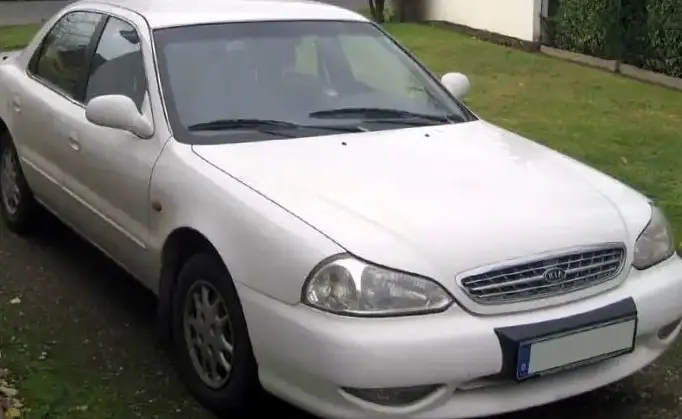
The Kia Clarus (GC), produced between 1998 and 2001, represented Kia’s attempt to establish a foothold in the mid-size sedan segment. Positioned as a more affordable and spacious alternative to established Japanese and American competitors, the Clarus aimed to offer value and practicality. The 1.8i 16V Automatic variant, powered by the T8 engine, served as a mainstream offering within the Clarus lineup, targeting buyers prioritizing comfort and ease of use over outright performance. It was a key model for Kia as they expanded their presence in export markets, particularly in Europe and Australia, though sales in the US were limited.
Technical Specifications
| Brand | Kia |
| Model | Clarus |
| Generation | Clarus (GC) |
| Type (Engine) | 1.8i 16V (116 Hp) Automatic |
| Start of production | 1998 |
| End of production | 2001 |
| Powertrain Architecture | Internal Combustion engine |
| Body type | Sedan |
| Seats | 5 |
| Doors | 4 |
| Fuel consumption (urban) | 15 l/100 km (15.7 US mpg, 18.8 UK mpg, 6.7 km/l) |
| Fuel consumption (extra urban) | 8.7 l/100 km (27 US mpg, 32.5 UK mpg, 11.5 km/l) |
| Fuel consumption (combined) | 11 l/100 km (21.4 US mpg, 25.7 UK mpg, 9.1 km/l) |
| CO2 emissions | 253 g/km |
| Fuel Type | Petrol (Gasoline) |
| Acceleration 0 – 100 km/h | 13.9 sec |
| Acceleration 0 – 62 mph | 13.9 sec |
| Acceleration 0 – 60 mph | 13.2 sec |
| Maximum speed | 178 km/h (110.6 mph) |
| Emission standard | Euro 2 |
| Weight-to-power ratio | 10.8 kg/Hp, 92.8 Hp/tonne |
| Weight-to-torque ratio | 8.2 kg/Nm, 121.6 Nm/tonne |
| Power | 116 Hp @ 5750 rpm |
| Power per litre | 64.7 Hp/l |
| Torque | 152 Nm @ 4500 rpm (112.11 lb.-ft. @ 4500 rpm) |
| Engine layout | Front, Transverse |
| Engine Model/Code | T8 |
| Engine displacement | 1793 cm3 (109.42 cu. in.) |
| Number of cylinders | 4 |
| Engine configuration | Inline |
| Cylinder Bore | 81 mm (3.19 in.) |
| Piston Stroke | 87 mm (3.43 in.) |
| Compression ratio | 9.5:1 |
| Number of valves per cylinder | 4 |
| Fuel injection system | Multi-port manifold injection |
| Engine aspiration | Naturally aspirated engine |
| Valvetrain | DOHC |
| Engine oil capacity | 4 l (4.23 US qt | 3.52 UK qt) |
| Kerb Weight | 1250 kg (2755.78 lbs.) |
| Trunk (boot) space – minimum | 444 l (15.68 cu. ft.) |
| Trunk (boot) space – maximum | 784 l (27.69 cu. ft.) |
| Fuel tank capacity | 60 l (15.85 US gal | 13.2 UK gal) |
| Length | 4731 mm (186.26 in.) |
| Width | 1770 mm (69.69 in.) |
| Height | 1420 mm (55.91 in.) |
| Wheelbase | 2659 mm (104.69 in.) |
| Front track | 1500 mm (59.06 in.) |
| Rear (Back) track | 1500 mm (59.06 in.) |
| Minimum turning circle | 10.6 m (34.78 ft.) |
| Drivetrain Architecture | The Internal combustion engine (ICE) drives the front wheels of the vehicle. |
| Drive wheel | Front wheel drive |
| Number of gears and type of gearbox | 4 gears, automatic transmission |
| Front suspension | Coil spring |
| Rear suspension | Coil spring |
| Front brakes | Ventilated discs |
| Rear brakes | Disc |
| Assisting systems | ABS (Anti-lock braking system) |
| Steering type | Steering rack and pinion |
| Power steering | Hydraulic Steering |
| Tires size | 195/65 R14 |
| Wheel rims size | 14 |
Powertrain & Engine Architecture
The heart of the Clarus 1.8i Automatic is the Kia T8 engine, a 1.8-liter inline-four cylinder gasoline engine. This engine utilizes a multi-port fuel injection system, delivering fuel directly into the intake ports just before the intake valves. The engine features a double overhead camshaft (DOHC) valvetrain, operating 16 valves (four per cylinder) to optimize airflow and improve volumetric efficiency. The T8 engine, while not particularly powerful, was known for its relative simplicity and durability. It was a derivative of Mitsubishi’s 4G63 engine, reflecting Kia’s technical partnership with Mitsubishi at the time. The four-speed automatic transmission, while providing smooth shifts, was a relatively conventional design. It lacked the sophistication of more modern automatic transmissions with multiple gears and electronic control. The transmission’s gear ratios were tuned for comfortable cruising rather than spirited acceleration.
Driving Characteristics
The 116 horsepower and 152 Nm (112 lb-ft) of torque produced by the 1.8L engine and automatic transmission combination resulted in a driving experience focused on comfort and ease of use. Acceleration was modest, taking approximately 13.9 seconds to reach 62 mph (100 km/h). The automatic transmission, while smooth, contributed to a noticeable loss of power compared to the available five-speed manual transmission. The gear ratios were spaced to prioritize fuel economy and relaxed highway cruising. In real-world driving, the Clarus 1.8i Automatic felt adequate for everyday commuting and family transportation, but lacked the punch needed for quick overtaking maneuvers or spirited driving. Compared to higher-trim Clarus models equipped with the 2.0-liter engine, the 1.8L felt noticeably underpowered.
Equipment & Trim Levels
The 1.8i Automatic trim typically included features such as power windows, power door locks, air conditioning, and a basic audio system. Interior upholstery was generally cloth, with options for upgraded materials available. Dashboard configuration was straightforward and functional, prioritizing usability over aesthetic flair. Optional extras included a sunroof, alloy wheels, and an upgraded audio system with a cassette player. The Clarus aimed to provide a good level of standard equipment for its price point, making it an attractive option for budget-conscious buyers.
Chassis & Braking
The Clarus 1.8i Automatic utilized a conventional suspension setup with coil springs and a stabilizer bar at both the front and rear. The front brakes were ventilated discs, providing adequate stopping power, while the rear brakes were solid discs. The suspension was tuned for comfort, resulting in a relatively soft ride quality. The steering was hydraulic power-assisted, offering light and easy steering feel. The chassis was designed to provide a balance between ride comfort and handling stability, but it wasn’t particularly sporty or engaging to drive.
Market Reception & Comparison
The Kia Clarus 1.8i Automatic received mixed reviews from automotive critics. While praised for its spacious interior, comfortable ride, and competitive price, it was often criticized for its lack of performance and somewhat bland styling. Compared to other trims in the Clarus lineup, the 1.8L Automatic offered the best fuel economy but the slowest acceleration. Its reliability was generally considered average, with some reports of minor electrical issues. Fuel economy figures of around 21.4 US mpg combined were typical for the class at the time, but not exceptional.
Legacy
The Kia Clarus, while not a groundbreaking vehicle, played an important role in establishing Kia as a viable competitor in the global automotive market. The 1.8i Automatic variant, with its focus on affordability and practicality, proved to be a popular choice among buyers seeking a comfortable and reliable family sedan. Today, the Clarus 1.8i Automatic is a relatively rare sight on the roads, but well-maintained examples are sought after by enthusiasts and collectors. The T8 engine, while not known for its high performance, is generally considered to be durable and relatively easy to maintain, making it a reasonably reliable choice in the used car market. Parts availability can be a challenge, however, as the Clarus is now an older vehicle.